Editorial: S. Korea finally takes first step toward AI data center
이 글자크기로 변경됩니다.
(예시) 가장 빠른 뉴스가 있고 다양한 정보, 쌍방향 소통이 숨쉬는 다음뉴스를 만나보세요. 다음뉴스는 국내외 주요이슈와 실시간 속보, 문화생활 및 다양한 분야의 뉴스를 입체적으로 전달하고 있습니다.
President Lee Jae-myung has appointed Ha Jung-woo, former head of Naver Cloud’s AI Innovation Center, as senior secretary for artificial intelligence (AI) future planning. He will lead the national goal to become one of the world’s top three AI powers and manage 100 trillion won in AI investment. The selection of a private-sector expert in his forties to design this cutting-edge strategic industry offers new hope. Ha has long championed the development of a Korean-style sovereign AI model. Unlike AI platforms from U.S. tech giants aimed at global dominance, sovereign AI is developed and used at the national level. Having such a model enables domestic firms to create diverse AI services independently and build an ecosystem free from foreign control.
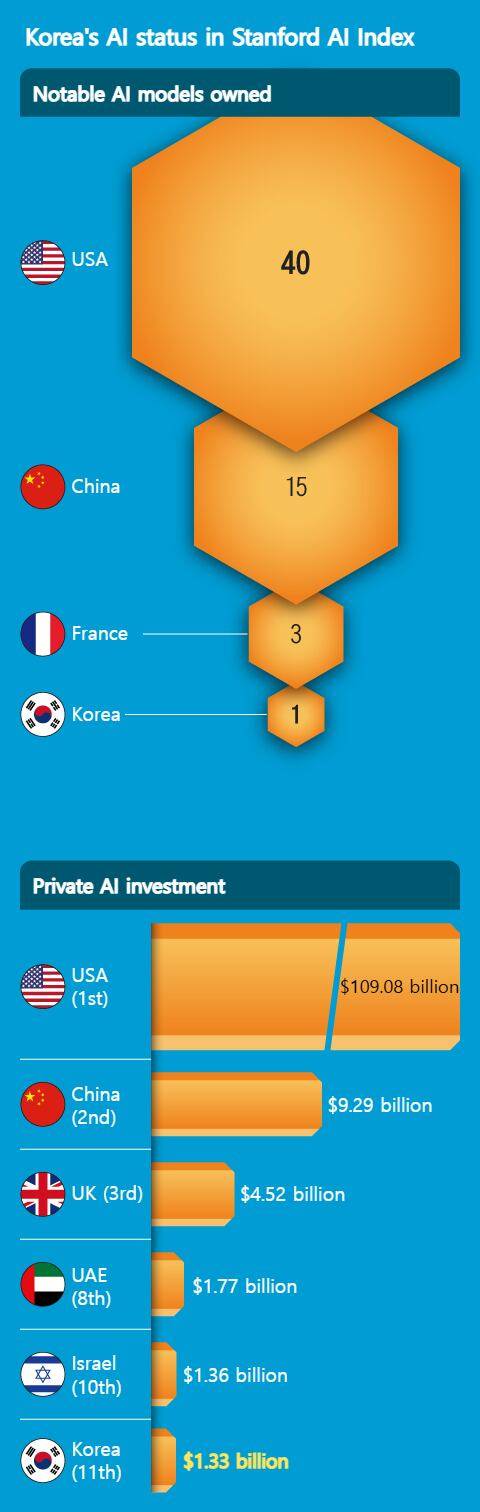
Despite being a global IT leader, South Korea has lagged behind its competitors in building an AI ecosystem. Since ChatGPT’s launch in 2022, countries rushed to gain advantage in AI, but Korea wasted over four years due to political deadlock in the National Assembly, delaying the AI Framework Act. Though the law finally passed late last year, the government’s bid to select an operator for the national AI data center has failed twice. The main hurdle was the project’s setup, where the government holds a 51% stake and decision-making power, while private companies bear full responsibility for operations and profits.
In the meantime, U.S. tech giants have invested hundreds of trillions of won to build AI data centers and release proprietary AI models. China is rapidly closing the gap with low-cost, highly efficient models like DeepSeek. Taiwan, a leader in AI semiconductors, has partnered with Nvidia to become a hub of the AI ecosystem. Except for producing high-bandwidth memory (HBM) chips used in AI semiconductors, South Korea’s presence in the global AI industry remains minimal.
Given this late start, Korea must now move quickly to catch up. The national AI data center should be established immediately to provide companies, universities, and research institutes with infrastructure to develop Korean AI models and services. Using the center to create a Korean-style AI model and releasing it as open source will boost ecosystem growth. Chipmakers must enhance design and manufacturing capabilities, while universities must build systems to train AI talent. Though a massive project, it is achievable with the president leading the way.
Copyright © 조선일보. 무단전재 및 재배포 금지.
- 요리에 식용 불가 ‘개미 토핑’… 미쉐린 2스타 식당 대표 기소
- 정유미 검사장 “박상용 징계사유에 검사들 멘붕”
- [아무튼, 주말]#이세돌알파고대국10년#2026년판부조금
- [산업X파일] ‘침대 없는 침대 광고’로 침대 1위... 왜 이게 통할까
- 1kg 1만4900원 제주 흑돼지로 연매출 110억원, 홍콩 진출에 10억원 벤처투자까지
- 출시 1년 안 돼 1만5000대 팔려, 3만5000원 아이리버 무선 이어폰 뭐가 다르길래
- 60대 보험료 17만4000원 → 4만2000원 확 내려가, 5세대 실손 뭐가 달라졌나 총정리
- ‘첨가물 제로’ 블루베리 40개를 통째로 한 포에, 한 달 먹고 생긴 변화
- 스무 살 때부터 할머니 역할… ‘대한민국 공채 배우 1호’ 박주아
- [단독] 대검의 22쪽 박상용 징계 청구서… ‘술’은 한 글자도 없었다