Lee stresses national safety in emergency meeting after Israeli strike on Iran
전체 맥락을 이해하기 위해서는 본문 보기를 권장합니다.
"Our economy, which had entered a phase of increasing stability, now seems to be falling into a considerably unstable condition," Lee said. "I ask for thorough management and supervision of our economy to ensure it does not suffer greater damage due to external shocks."
"To the people, I would like to say this: The government will take all necessary measures, so please carry on with your daily lives without worrying too much," Lee said. "We will make every effort to handle the situation as swiftly as possible."
이 글자크기로 변경됩니다.
(예시) 가장 빠른 뉴스가 있고 다양한 정보, 쌍방향 소통이 숨쉬는 다음뉴스를 만나보세요. 다음뉴스는 국내외 주요이슈와 실시간 속보, 문화생활 및 다양한 분야의 뉴스를 입체적으로 전달하고 있습니다.
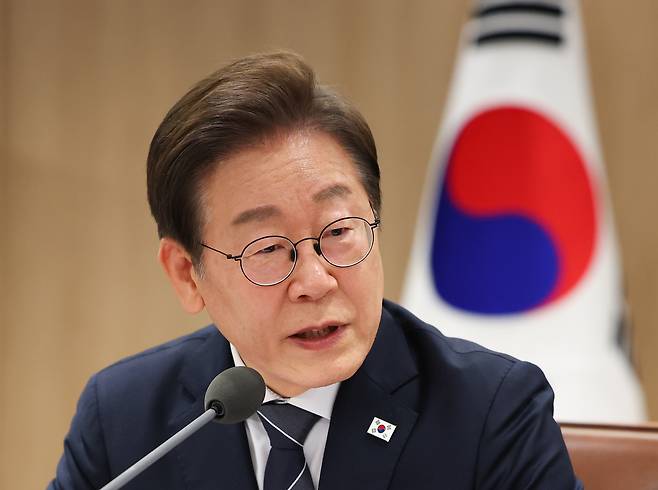
President Lee Jae-myung ordered that the safety of the Korean people be put first and called for measures to prevent any harm during an emergency meeting on Israel’s attack on Iran, according to the presidential office in Seoul.
Lee convened an emergency security and economic meeting on the wide scale airstrikes against Iran, just hours after they occurred, at around 12:30 p.m. at the presidential office in Yongsan, Seoul.
“For now, the most important thing is the lives and safety of our people. I call for a thorough assessment of the situation of our nationals living there, to determine whether there has been any damage, and carefully check what measures are needed to prevent any harm,” Lee said during the meeting.
Lee also instructed his key aides to prevent economic fallout and maintain stability at a time when oil prices, exchange rates and stock prices are fluctuating significantly in the aftermath of Israel’s airstrike on Iran.
“Our economy, which had entered a phase of increasing stability, now seems to be falling into a considerably unstable condition,” Lee said. “I ask for thorough management and supervision of our economy to ensure it does not suffer greater damage due to external shocks.”
The meeting was attended by key aides, including chief of staff Kang Hoon-sik, national security adviser Wi Sung-lac and policy chief Kim Yong-beom.
“To the people, I would like to say this: The government will take all necessary measures, so please carry on with your daily lives without worrying too much,” Lee said. “We will make every effort to handle the situation as swiftly as possible.”
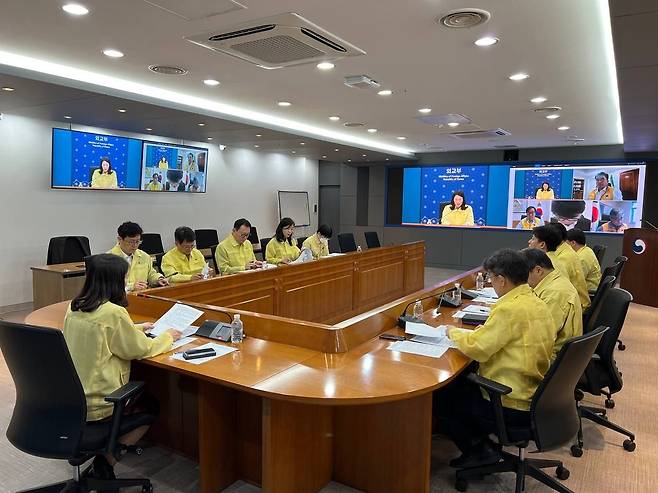
Newly appointed Second Vice Foreign Minister Kim Jina also convened a joint meeting between headquarters and diplomatic missions on Friday, following the Israeli strike against Iran.
The meeting aimed to analyze the situation in the Middle East following Israel’s attack on Iran and to review measures to protect Korean nationals in Iran.
“Vice Minister Kim called for doing everything possible to ensure the safety of Korean nationals residing there, while closely monitoring the possibility of sudden changes in the situation in the Middle East, and maintaining constant communication between headquarters and overseas missions,” the Foreign Ministry in Seoul said in a press statement following the meeting.
“The Foreign Ministry will continue to closely monitor the situation in the Middle East and take all necessary measures to ensure the safety of Korean nationals," the statement added.
According to the Foreign Ministry in Seoul, no damage or harm to Korean nationals had been reported as of Friday noon. Around 100 South Koreans reside in Iran as of Thursday.
“Our diplomatic mission is issuing safety notices to Korean nationals residing in the area and is continuously checking on their safety through emergency contact networks,” the Foreign Ministry said in a separate statement.
Later in the day, the Foreign Ministry issued a special "red" travel advisory for certain areas in Iran and Israel, effective Saturday, in response to escalating tensions in the Middle East.
The advisory is equivalent to a level 3 alert within the four-stage travel alert system, which advises nationals to leave the designated area unless it is an emergency and to postpone or cancel planned trips to the region. Level 1 is the lowest alert, advising travelers to exercise caution.
While previously issued level 3 or 4 alerts for specific regions of Iran and Israel remain unchanged, all other remaining regions that were previously under a level 2, or yellow, alert have now been upgraded to a special travel advisory, according to the Foreign Ministry in Seoul.
“We urge our nationals to cancel or postpone travel to Israel and Iran, and for those already staying in these two countries, to move to safer regions unless they have urgent business," the ministry said.
The Foreign Ministry also called for a reduction of tensions in the Middle East in a separate statement issued under spokesperson Lee Jae-woong.
"Our government expresses serious concern over the rapidly escalating tensions in the Middle East, including Israel’s attack on Iran on Friday, and condemns all actions that aggravate the situation," the spokesperson's statement read.
"Our government urges all parties to exercise maximum restraint in order to alleviate tensions in the region," the statement added.
Israel launched a wave of strikes across Iran, targeting the main uranium enrichment facility in Natanz and military sites, including those related to the ballistic missile program, killing at least two top military officers.
After the strike, Israeli Prime Minister Benjamin Netanyahu announced that Israel had struck the Natanz enrichment site, Iran's ballistic missile program, and leading nuclear scientists and officials. Netanyahu also alleged that Iran was devising new plans to destroy Israel.
Copyright © 코리아헤럴드. 무단전재 및 재배포 금지.