Petition to expel Lee Jun-seok from Assembly surpasses 500,000
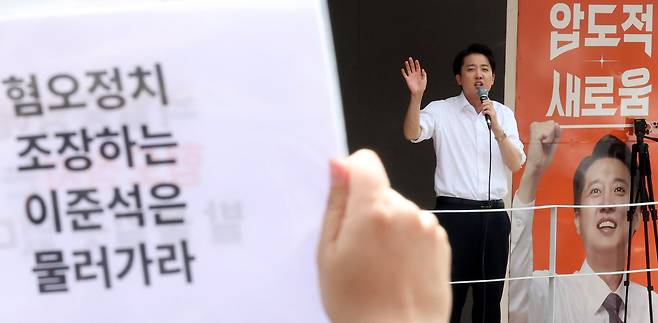
Rep. Lee Jun-seok, presidential candidate for the minor conservative New Reform Party in the June 3 election, is facing mounting public backlash for alleged misogyny in a remark he made in a televised debate, with more than 500,000 people signing a petition calling for his expulsion from the National Assembly.
The petition quickly gained traction, surpassing 510,000 signatures as of 5 p.m. Tuesday — just six days after it was posted on the National Assembly’s official website on June 4. By law, petitions that receive over 50,000 signatures in 30 days are forwarded to a National Assembly committee for review.
“Rep. Lee Jun-seok has long promoted discriminatory and divisive rhetoric, particularly targeting women and minorities,” the petition reads.
Lee made the controversial remark during the final televised presidential debate on May 27, when he cited a vulgar expression involving chopsticks and a part of the female body while questioning Social Democratic Party candidate Kwon Young-guk.
According to the 40-year-old lawmaker, the reference was meant as an attack on Democratic Party of Korea candidate Lee Jae-myung, alleging it had been used in an online post by Lee’s son.
The petition's signature count has far exceeded the petition filed last December calling for the impeachment of then-President Yoon Suk Yeol over his Dec. 3 martial law declaration. That petition drew around 400,000 signatures.
The backlash over Lee’s remark also aligns with broader criticism of his political trajectory.
Since the mid-2010s, gender issues have become prominent in South Korean politics. And Lee shaped his political identity by resonating with young men who felt sidelined by this trend, particularly under the liberal Moon Jae-in administration’s gender policies.
He has frequently amplified issues gaining traction in male-dominated online communities — such as opposition to gender quotas, protests at women’s universities and criticism of disability rights activism — reinforcing his image as a voice for the disaffected.
During the 2022 presidential race, while serving as the People Power Party's chief and leading the campaign for then-candidate Yoon Suk Yeol, Lee pledged to abolish the Ministry of Gender Equality and Family. He framed it as a symbol of preferential treatment toward women, but the stance drew widespread criticism as socially divisive.
Lee revived the pledge in 2025 under his own platform as the presidential candidate of the New Reform Party.
According to exit polls conducted by South Korea’s three major broadcasters, Lee won 37.2 percent of the vote among men in their 20s in the June 3 presidential election — well above Democratic Party candidate Lee Jae-myung’s 24 percent in the same group.
In contrast, his support among female voters was markedly lower. Aside from women in their 20s, where he secured 10.3 percent, his approval among older age groups fell to single digits: 3 percent among those in their 40s, 3.3 percent in their 50s, 1.9 percent in their 60s, and just 1 percent among those in their 70s.
Despite the public outcry, Lee has stopped short of a full apology, though he acknowledged the level of offense it caused.
“If I could go back, I wouldn’t bring it up. … I’ll be more careful with my expressions going forward,” Lee said in a recent press briefing, explaining that the reference was intended as scrutiny of a rival candidate.
However, political commentator Choi In-han said the backlash reflects more than a single misstep.
“Lee Jun-seok’s rise has been driven by a politics of division, drawing lines across gender, generation and even disability,” Choi told The Korea Herald. “This controversy is not just about how the public responds to his single remark, but about how they evaluate his entire political approach.”
“Running for president in one’s 40s is itself a testament to political skill,” Choi added. “But without a sincere apology — not just softened language — his future prospects could be severely damaged.”
In 2011, former lawmaker Kang Yong-seok also faced backlash after being accused of making sexually inappropriate comments about female broadcasters.
Kang was expelled from his party and suspended from Assembly activities for one month. He later ran as an independent in the 2012 general election but failed to retain his seat.
Copyright © 코리아헤럴드. 무단전재 및 재배포 금지.