Spine Robot Wars: Curexo Rises as Global Giants Fall
전체 맥락을 이해하기 위해서는 본문 보기를 권장합니다.
"We recently secured regulatory approvals and subsequent sales in Malaysia and Pakistan," Lee explained. "Approval is also pending in Indonesia."
He added, "We expect to sell around 5 to 7 units this year, with further approvals in the Middle East and Southeast Asia underway."
이 글자크기로 변경됩니다.
(예시) 가장 빠른 뉴스가 있고 다양한 정보, 쌍방향 소통이 숨쉬는 다음뉴스를 만나보세요. 다음뉴스는 국내외 주요이슈와 실시간 속보, 문화생활 및 다양한 분야의 뉴스를 입체적으로 전달하고 있습니다.
[Kim Jiwan, Edaily Reporter] Curexo , which had struggled in the spine surgery robot market, is making a comeback. As global giants pull out from the field one after another, Curexo is expanding its presence in the vacuum they left behind.
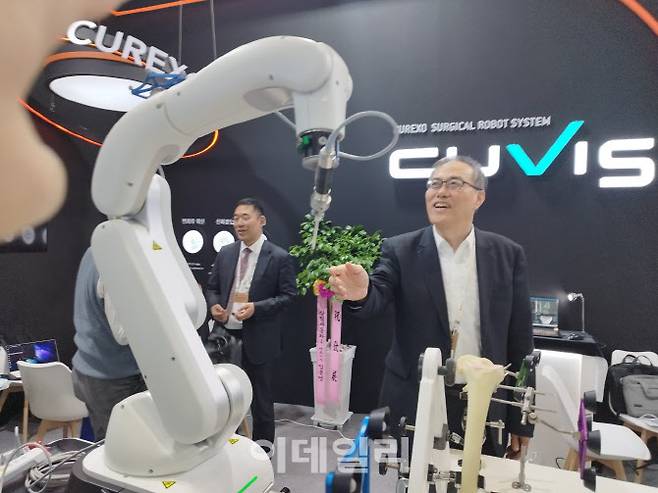
According to Curexo on June 8, the company sold two units of its spine surgery robot “CUVIS-Spine” so far this year. The robot had no sales in 2023, but demand is picking up across Asia in 2024. The previous annual sales record was three units in 2023. The average price per unit is estimated at 500 to 600 million KRW (approx. $370,000~$440,000).
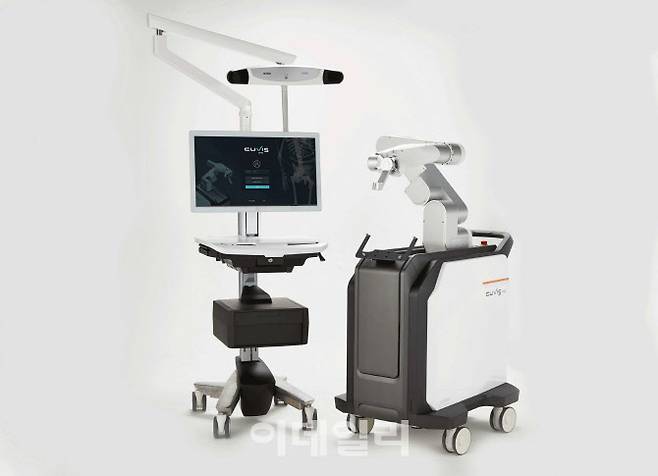
The CUVIS-Spine allows surgeons to pre-plan exactly where and at what angle to insert pedicle screws, and then helps guide the procedure with robotic precision. Thanks to its robotic arm and real-time sensors that track patient movement, even minute angles can be adjusted accurately during surgery. The device received U.S. FDA approval in 2021.
On May 28, Edaily conducted a phone interview with CEO Lee Jae-jun to discuss the current status, competitive landscape, and future outlook of CUVIS-Spine.
“Targeting 5 to 7 Units This Year”
CUVIS-Spine appears to be regaining momentum.
“We recently secured regulatory approvals and subsequent sales in Malaysia and Pakistan,” Lee explained. “Approval is also pending in Indonesia.”
He added, “We expect to sell around 5 to 7 units this year, with further approvals in the Middle East and Southeast Asia underway.”
Two successful spine surgeries using the CUVIS-Spine were recently performed at KPJ Ipoh Specialist Hospital in Malaysia.
“Southeast Asia has large hospital groups, and many of them are actively adopting surgical robots,” Lee said, reflecting on the shifting market sentiment.
Momentum is building domestically as well.
“Severance Hospital and Pusan National University Yangsan Hospital are undergoing IRB processes to adopt our CUVIS-Spine system,” he said. “We’re seeing a change in perception more surgeons are open to using robotic systems for spinal surgeries.”
Breaking the Mold with Modular Systems
CEO Lee expressed confidence in the rebound of the CUVIS-Spine business.
“We‘re considering selling the navigation module separately to lower the entry barrier for hospitals,” he said. “Even with just the navigation system, surgical accuracy improves significantly, and we expect strong market interest.”
The company plans to decouple the navigation system from the robot body. The navigation module, which uses 3D imaging and X-rays to map surgical areas precisely, was previously bundled with the full robot system. By selling it independently, hospitals can adopt robotic systems gradually.
Lee added, “Hospitals that adopt the navigation module will later be able to connect and use the robotic arm directly.” He noted that the modular version has already received approval from Korea’s Ministry of Food and Drug Safety (MFDS), with international regulatory work underway.
Curexo also plans to diversify its product lineup by segmenting its robotic platforms.
“We’ll offer high-end, mid-range, and low-end versions of the CUVIS-Spine to meet various market needs,” Lee explained.
Global Giants Exit, Curexo Steps In
The withdrawal of major players has opened a rare opportunity for smaller, tech-driven firms like Curexo.
Stryker, Zimmer Biomet, and Johnson & Johnson (J&J) three major players in the orthopedic device market have all scaled back or spun off their spine implant divisions over the past few years.
In April 2024, Stryker sold its U.S. spine implant business to New York-based investment firm Viscogliosi Brothers, which launched a new company, VB Spine.
Zimmer Biomet announced at the end of 2023 that it would divest its spine unit to Highridge Medical, a subsidiary of private equity firm H.I.G. Capital, in a deal worth approximately $375 million. The company plans to refocus on dental and broader orthopedic markets.
J&J, too, announced a strategic retreat from lower-margin orthopedic sectors at the end of 2023, stating it would phase out its spine and other skeletal product lines by the end of 2025. By November 2024, its MedTech division confirmed the closure of DePuy Synthes’ spine portfolio.
With all three giants retreating, a substantial void has emerged in the spine surgery robot market.
Lee said, “Big players are pulling out because the spine segment is less profitable than spine surgery. But for a tech-oriented SME like us, it’s an opening.”
He added, “Spine robots are still in their infancy globally. With our modular navigation strategy and international partnerships, we can carve out a strong position. We’ll actively collaborate with implant manufacturers worldwide and aim to set a new standard in robotic spine surgery.”
김지완 (2pac@edaily.co.kr)
Copyright © 이데일리. 무단전재 및 재배포 금지.
- K뮤지컬의 쾌거…'어쩌면 해피엔딩' 美토니상서 6관왕 달성(종합)
- "당장 연봉부터 깎일텐데..." 주4.5일제 물어보니
- 이경규 측 "약물 복용 운전? 공황장애약 때문…경찰 확인 중"[공식]
- 의회서 ‘알몸 사진’ 공개한 女의원 “역겹다, 그럼에도…”
- 李대통령 파기환송 재판 중지…법원 "헌법 84조 따른 조치"
- 삼성전자, 두 달만에 6만전자 탈환…엔비디아·신정부 훈풍(종합)
- "온수 안 나와"...윤석열 정부 측이 밝힌 관저 내 '의문의 수조'
- '전쟁터' 같은 LA…한인들 "표적될까 두렵다" 초긴장
- 대통령실, 경호처 최고위 간부급 전원 대기발령…“직무대행 체제”(상보)
- [단독]李정부 첫 노동 입법은 ‘고용보험 확대’