Korean scientists develop shape-shifting e-ink
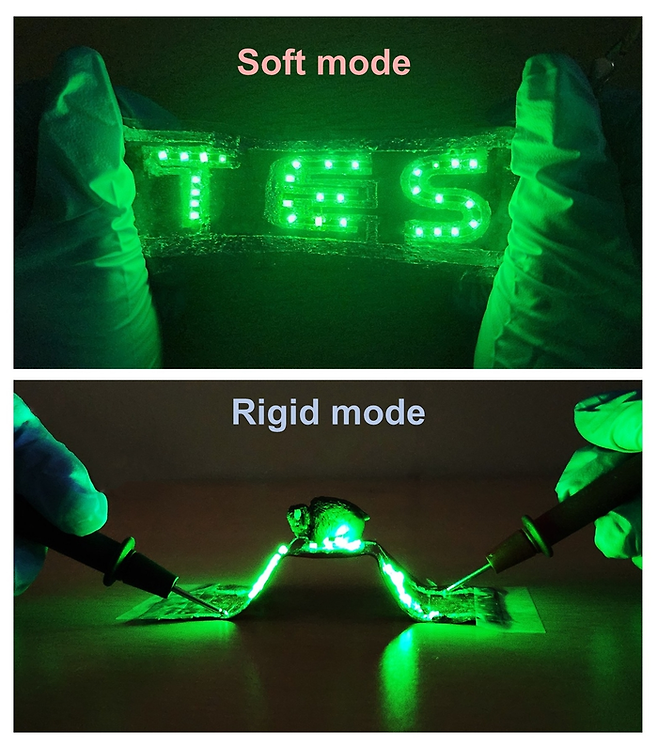
The research team, led by Jeong Jae-woong of KAIST School of Electrical Engineering and Steve Park of the Department of Materials Science and Engineering alongside Park Sung-joon from Seoul National University, announced their breakthrough on Wednesday.
The team focused on gallium, a metal that is solid at room temperature but melts into a soft liquid at around 29.8°C (85.6°F), to overcome the limitations of traditional rigid electronics.
While gallium’s unique phase change makes it ideal for creating flexible circuits, its tendency to form droplets and instability in liquid form previously made it difficult to use in precise circuit manufacturing.
The team developed a method to control gallium’s acidity (pH) to freely adjust its stiffness. By mixing micrometer-scale gallium particles with a neutral solvent and polymers, they created a stable e-ink that evenly disperses the particles.
When the printed circuit is heated, the neutral solvent generates acidic compounds that dissolve the oxide layer on the gallium, allowing the circuit to conduct electricity. This technology allows for high-resolution printing at room temperature, enabling the production of electronic devices that can switch between rigid and soft states like plastic and rubber respectively.
The team demonstrated a wearable healthcare device that remains rigid until worn, then softens to conform to the body. They also developed a brain probe that remains rigid during insertion but softens inside the brain, minimizing tissue inflammation.
“This research solves longstanding issues in liquid metal printing and enables high-resolution circuit fabrication at room temperature,” Jeong said, adding, “It has potential applications in multifunctional electronics, medical technology, and robotics.”
The study was published in the May 30th, 2025, issue of Science Advances.
Copyright © 매일경제 & mk.co.kr. 무단 전재, 재배포 및 AI학습 이용 금지
- 출구조사 나오자 “아이고”...얼어붙은 국힘, 말 없이 허공만 응시 [현장] - 매일경제
- ‘대선 보이콧’ 외치던 전한길…무릎 꿇고 오열한 이유는? - 매일경제
- 오늘의 운세 2025년 6월 4일 水(음력 5월 9일) - 매일경제
- “호남서 이름 석자 지운다” 비난…‘김문수 지지’ 이낙연의 운명은 - 매일경제
- 흙수저 소년공→변호사→시장→도지사 강한 돌파력으로 대통령까지 거머쥐어 [이재명 시대] -
- 기호 8번 ‘전과 17범’ 송진호…득표율 0.1% [방송3사 출구조사] - 매일경제
- 군통수권 이양받은 이재명 대통령…美 “한미동맹 철통같다” - 매일경제
- “게걸스럽게 먹더니 조용히 사라졌다”…대낮 편의점 급습한 도둑의 정체 - 매일경제
- [속보] 이재명 대통령 “계엄때 군장병 부당한 명령에 소극대응…잘한 일” - 매일경제
- 구체적 이적료 나왔다... ‘최소 627억’ 이강인, 이탈리아 챔피언으로 향하나···“이강인 측과