Chinese capital expands grip on S. Korea’s travel market with low-price strategy
이 글자크기로 변경됩니다.
(예시) 가장 빠른 뉴스가 있고 다양한 정보, 쌍방향 소통이 숨쉬는 다음뉴스를 만나보세요. 다음뉴스는 국내외 주요이슈와 실시간 속보, 문화생활 및 다양한 분야의 뉴스를 입체적으로 전달하고 있습니다.
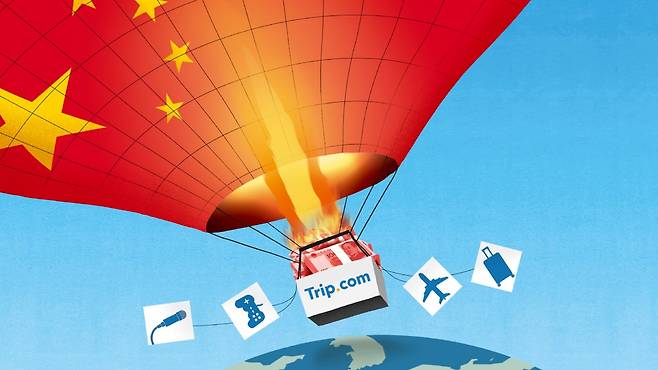
Chinese capital is rapidly expanding its influence in South Korea’s leisure and entertainment sectors, moving beyond gaming and media into travel. Lodging and airfare have become new targets, where Chinese firms use substantial financial backing to capture shares in Korea’s relatively small market.
Online travel agency Trip.com is leading this push with aggressive discounting. Supported by Trip.com Group, China’s largest travel company, it attracts Korean consumers by offering hotel and flight deals that undercut domestic competitors.
A 40-year-old office worker named Lee recently booked a one-night stay at a five-star hotel in central Seoul through Trip.com for 390,000 won. The same room was priced above 450,000 won on other platforms. After applying Trip.com’s discount coupons, Lee saved nearly 60,000 won, a notable gap given that most booking sites vary by only 10,000 to 20,000 won.
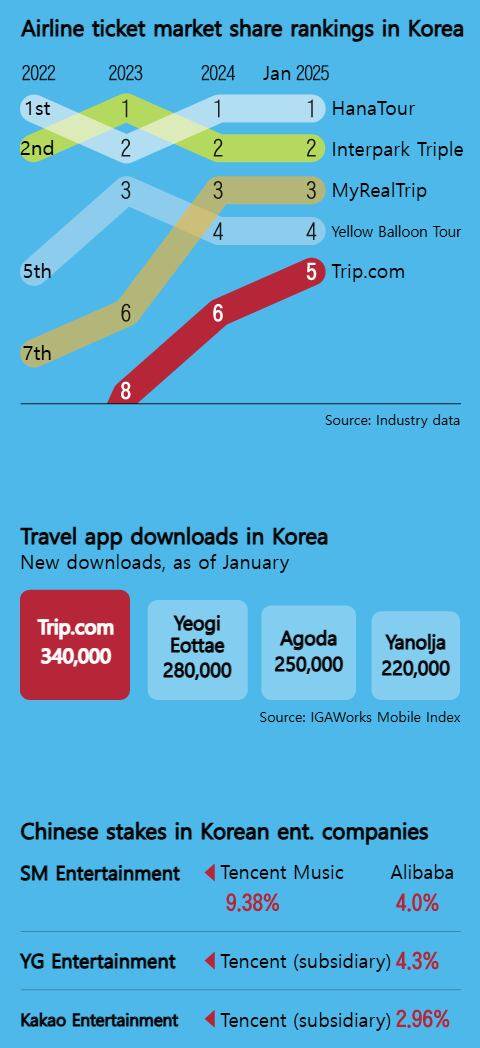
According to mobile index data from analytics firm IGAWorks, Trip.com topped travel app downloads in South Korea this January with 340,000 new installs. Domestic rivals Yeogi Eottae and Yanolja followed with 280,000 and 220,000 downloads, respectively.
Trip.com Group, headquartered in Shanghai, rebranded from its original name, Ctrip, to Trip.com in 2019 to reduce its Chinese image and appeal to global users. Like Chinese e-commerce giants Temu and AliExpress, which have gained ground in South Korea through low prices, Trip.com is pushing a lowest-price strategy to dominate the South Korean travel market.
A domestic travel industry insider said, “The lodging and airfare markets are highly price-sensitive because price comparison sites are widely used. Even a small price difference leads consumers to choose cheaper options. Trip.com targets Korean consumers by investing heavily to offer industry-lowest prices.”
Trip.com is rapidly growing in South Korea’s airline ticket market. According to January data from the BSP (Billing and Settlement Plan) system, it ranked fifth with a market share just above 5%. The platform steadily advanced from 13th in 2022 to eighth in 2023, and sixth last year, finally breaking into the top five. In ticket sales, Trip.com recorded 44.9 billion won in January, closely trailing fourth-ranked Yellow Balloon Tour with 47 billion won.
Since acquiring flight comparison site Skyscanner in 2016, Trip.com has boosted sales by prioritizing low-fare tickets sold directly on its platform. For example, round-trip flights from Incheon to Osaka in mid-June cost about 20,000 won less on Trip.com than on other booking sites.
Chinese capital has deeply penetrated South Korea’s entertainment and gaming industries. According to the Financial Supervisory Service’s electronic disclosure system, Tencent Music recently acquired Hybe’s entire 9.38% stake in SM Entertainment, becoming the third-largest shareholder after Kakao and Kakao Entertainment. Alibaba, China’s largest e-commerce company, bought a 4% stake in SM back in 2016. Together, Chinese investors now hold nearly 15% of the company.
Tencent’s reach in Korean entertainment is wider. In 2016, through its subsidiary Tencent Mobility, it acquired a 4.3% stake in YG Entertainment, which it still holds. Another Tencent subsidiary, SkyBlue Creative Investment, owns 2.96% of Kakao Entertainment.
Copyright © 조선일보. 무단전재 및 재배포 금지.
- 반도체 훈풍에도 소매판매 5분기 만에↓ 고용률도 하락 조짐
- 국회예산정책처 “2029년부터 추가세수 발생 않아”...미래대응기금 지속가능성 우려
- 금융권 연쇄 해킹에 당국 긴급 대응… AI 보안관제 강화 추진
- 코스피, 지난달 하락률 역대 일곱번째
- 수출 10월까지 첫 9000억달러 돌파… “11월 중 1조 달러 달성 확실시”
- 독극물 주사 두 차례 맞고도 생존한 美 여성 사형수…내놓은 첫 입장은
- “보우소나루가 이긴다” 몰빵한 브라질 펀드들…룰라 승리에 하루 32% 손실
- 조현 외교장관, 영·EU·독·폴·인도·멕시코와 연쇄 회담… 한반도·각지 정세 논의
- 운전자는 기름값에 우는데, ‘석유공룡’은 웃었다…한 분기 75조원 벌어
- 중국 견제 위해 뭉치는 美와 동맹국들… 한국은 서해 문제에도 침묵