President Lee hopes extra budget can jumpstart dead economy, but long-term road map needed
전체 맥락을 이해하기 위해서는 본문 보기를 권장합니다.
"This is a brutal reality," the manager said. "Our clients are under intense financial strain, struggling to meet payroll, settle fees with e-commerce platforms and pay us amid plummeting sales. On our end, we are trying to offset the drop in delivery volume by raising rates."
"In this critical juncture, we are facing a complex crisis across all areas from livelihoods to the economy, diplomacy, national security and democracy — all tangled like a knotted thread," said Lee in his inauguration speech on Wednesday. "We will begin with restoring livelihoods and reviving the economy."
이 글자크기로 변경됩니다.
(예시) 가장 빠른 뉴스가 있고 다양한 정보, 쌍방향 소통이 숨쉬는 다음뉴스를 만나보세요. 다음뉴스는 국내외 주요이슈와 실시간 속보, 문화생활 및 다양한 분야의 뉴스를 입체적으로 전달하고 있습니다.
![Pictured is President-elect Lee Jae-myung on April 27, after being nominated as the party’s presidential candidate. [YONHAP]](https://img3.daumcdn.net/thumb/R658x0.q70/?fname=https://t1.daumcdn.net/news/202506/04/koreajoongangdaily/20250604191700208hysn.jpg)
Hit by weak domestic demand and the subsequent fall in sales, an inventory manager at a major local logistics firm saw his assigned inventory plunge by one-third over the past four months compared to a year ago.
While clients — mainly consumer goods companies — are insisting on reduced delivery costs, the company is pressuring him to raise rates, as both sides struggle to navigate a faltering economy.
“This is a brutal reality,” the manager said. “Our clients are under intense financial strain, struggling to meet payroll, settle fees with e-commerce platforms and pay us amid plummeting sales. On our end, we are trying to offset the drop in delivery volume by raising rates.”
The manager's anecdote resonates across the country, encapsulating a multitude of economic challenges facing newly elected President Lee Jae-myung.
"In this critical juncture, we are facing a complex crisis across all areas from livelihoods to the economy, diplomacy, national security and democracy — all tangled like a knotted thread," said Lee in his inauguration speech on Wednesday. "We will begin with restoring livelihoods and reviving the economy."
Lee’s victory comes at a tumultuous moment when the country faces political division, intensified by the former president’s declaration of martial law, and economic challenges that include near-zero percent growth, record-breaking national debt and a currency rally that is battering an export-driven economy.
![Small business owners have been hit hard by weak domestic demand as Korea faces weak annual growth estimated at 0.8 percent this year, according to the Bank of Korea. The wave of business closures have spread across beauty industry. [YONHAP]](https://img3.daumcdn.net/thumb/R658x0.q70/?fname=https://t1.daumcdn.net/news/202506/04/koreajoongangdaily/20250604191702322nmjo.jpg)
Lee is set to become the first president to take office amid near-zero economic growth since the Kim Dae-jung administration that kicked off in 1998 in the wake of the Asian financial crisis that started a year prior.
The Bank of Korea (BOK) projects the country to grow by just 0.8 percent this year after its GDP contracted 0.2 percent in the January-March period from the three months earlier, the first contraction since the fourth quarter of 2020.
The last times the growth rate fell below 1 percent were during the global financial crisis in 2008 at 0.8 percent and the Covid-19 pandemic in 2020, which recorded negative 0.7 percent. Will a supplementary budget do the trick?
To tackle sluggish growth, Lee has proposed an ambitious supplementary budget of at least 30 trillion won ($23 billion) to boost consumer spending and support small businesses in various forms, like the issuance of regional gift certificates.
“A supplementary budget is just a quick fix to put out fires,” said Won Jai-hwan, a finance professor at Sogang University. “But we very much need it to circulate liquidity to spur domestic demand and strengthen corporate activities.”
“The new government needs to adopt an expansionary fiscal approach to stimulate domestic demand,” said Jang Bo-sung, a research fellow at the Korea Capital Market Institute, a local think tank. “If it places too much emphasis on fiscal soundness at this point, it may fail to respond timely to economic risks.”
Still, the steep budget could further strain the government's fiscal status.
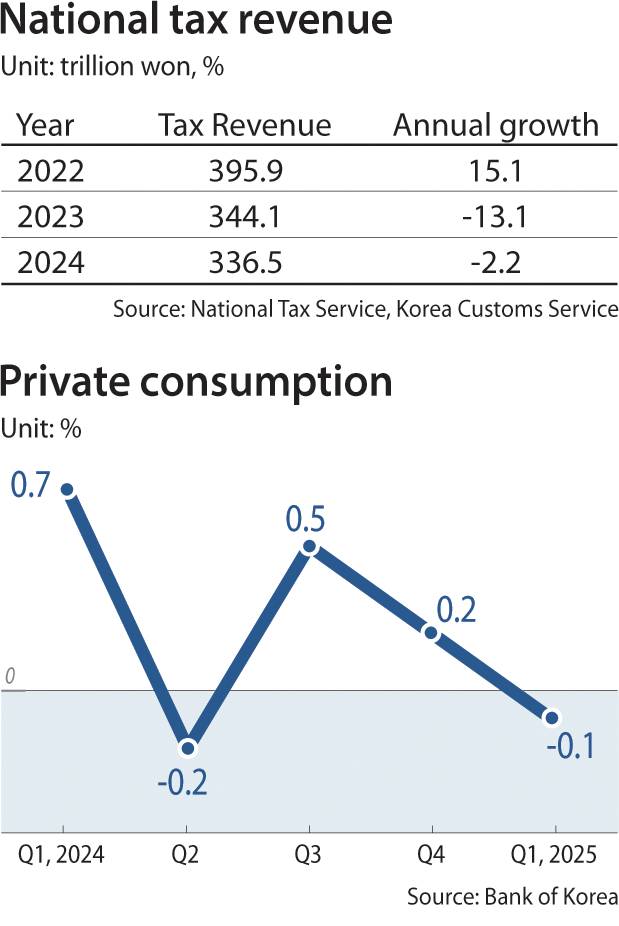
The supplementary budget proposal comes despite an ongoing tax revenue shortfall that is expected to persist through 2025, which would mark the third consecutive year of deficit.
A household’s consumption expenditure, adjusted for inflation, slid 0.7 percent to 2.95 million won on year in the first quarter, according to data from Statistics Korea in May.
Stimulating the economy
The new government will have to develop high-value-added industries like AI and apply it at work sites to improve the weak economy by improving labor productivity, according to Yoo Byung-joon, a professor at Seoul National University Business School.
“For instance, the manufacturing sector is facing a labor shortage as younger generations tend to avoid blue-collar jobs. AI could help fill the gap, enabling companies to maintain production levels without hiring new workers."
Yoo also emphasized the need to create high-quality jobs for the youth as companies cut recruitment amid a slowing economy.
The number of young Koreans facing long-term unemployment increased in 2024, breaking a four-year streak of steady improvement, according to an April report by the Korea Enterprises Federation.
The report found that last year, 69,000 people aged 15 to 29 remained jobless for more than four months — the threshold used by the BOK to define long-term unemployment.
The self-employed have also been pushed to the brink. The average sales of small business owners decelerated 0.72 percent in the first quarter from a year earlier, according to a May report by Korea Credit Data.
The drop reflects weakening retail sales, which fell 0.2 percent in the first four months of this year from a year earlier, marking the third consecutive year of decline, according to Statistics Korea data earlier this month.
"Former president Yoon Suk Yeol's economic policies in the past three years, marked by tax cuts and reduced supplementary budgets, have shown little indication of stimulating the economy," said Prof. Won of Sogang University.
"To overcome the weakened economy, the new government should raise the country's potential growth rate by internally investing in high-value-added industries like AI and externally improving ties with major overseas markets such as Russia, where post-war reconstruction is expected to drive substantial demand in the construction sector," he added.
BY JIN MIN-JI [jin.minji@joongang.co.kr]
Copyright © 코리아중앙데일리. 무단전재 및 재배포 금지.
- Actor Lee Je-hoon forgets work-life balance to pursue love of cinema
- LIVE: Lee Jae-myung Day 1: New president makes first cabinet appointments
- Lee Jae-myung to be Korea's next president — as it happened
- Teenager fined 5 million won for making deepfake porn with image of classmate
- Who is Lee Jae-myung, Korea's next president?
- Lee Jae-myung elected Korea’s president
- Yoo Ah-in shines in 'Hi-Five' despite off-screen controversies
- Exclusive: Samsung's $37B U.S. chip project to total 7M square feet by 2028
- Victory or foul? Jeong Hyun-gyu's win on 'The Devil's Plan' season two sparks viewer backlash
- Unity through solidarity: Lee Jae-myung sets tone for presidency