From left to right to left again: S. Korea’s political pendulum swings again
Since South Korea’s democratization in 1987, power has swung back and forth between conservative and progressive forces with a certain rhythm — roughly every decade. These shifts have often been triggered by public discontent over corruption, economic crises, and leadership scandals. In more recent years, however, that rhythm has noticeably accelerated, signaling an era of increasingly unpredictable and chaotic politics.
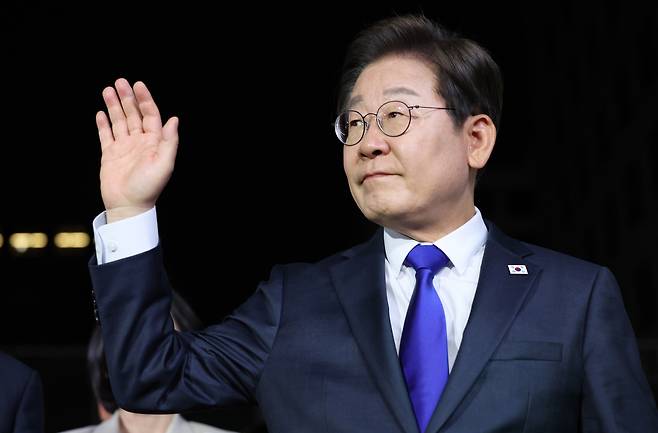
With conservative President Yoon Suk Yeol removed from office in April, an early presidential election was held on Tuesday just three years after the last one. (South Korea has a single-term, five-year presidency.) Now that progressive politician Lee Jae-myung has won the election, the country has shifted once again, bringing a liberal administration back to power and reinforcing a pattern of rapid political turnover.
From a steady cycle to whiplash
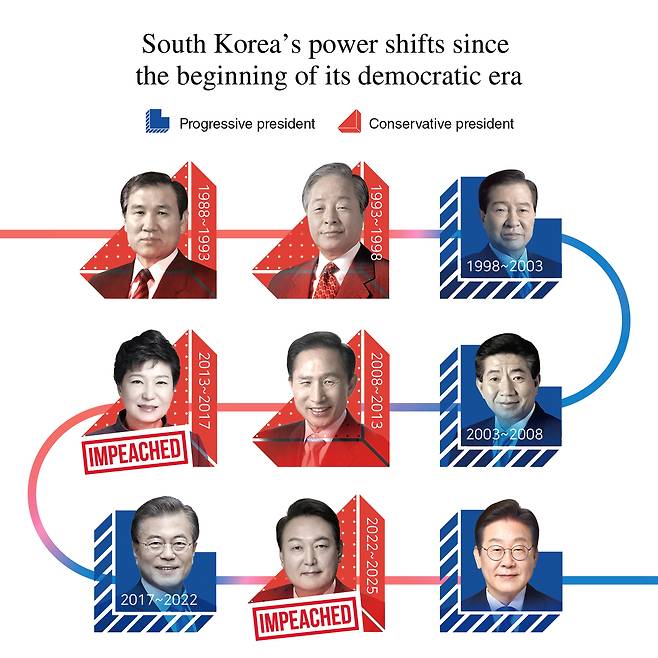
South Korea’s political pendulum began with a period of conservative party dominance. Roh Tae-woo won the presidential election in 1987 — the first direct vote held after decades of military rule. He was succeeded by another conservative leader, Kim Young-sam, in 1993.
Progressives first rose to power in 1998, with Kim Dae-jung, a longtime opposition figure and human rights advocate, taking over the top post to steer the country from the depths of the Asian financial crisis. His successor, Roh Moo-hyun, who took office in 2003, further advanced the liberal agenda. In 2004, the second year of his administration, Roh survived a parliamentary impeachment attempt. It was the first time that the country saw this mechanism mobilized against a sitting president.
In 2007, voter fatigue with liberal leadership — compounded by concerns over economic stagnation and a lack of progress in relations with North Korea — brought the conservatives back. The business-friendly President Lee Myung-bak took the reins in 2008. Five years later, Park Geun-hye, the daughter of former strongman Park Chung-hee, became the country’s first female president and continued the period of conservative rule.
Her presidency, however, came to an abrupt end in 2017 after a massive influence-peddling scandal ignited nationwide candlelight protests. Park Geun-hye was impeached and removed from office with roughly a year left in her term — the first time a sitting leader was formally ousted. This marked the start of a disruption in the 10-year cycle of power shifts.
With Park Geun-hye’s fall, the liberals surged. Moon Jae-in, former chief of staff to President Roh Moo-hyun and the runner-up in the vote that elected Park, won the election that followed.
After five years of Moon's liberal administration, the pendulum swung back once again. In 2022, Yoon Suk Yeol, a former prosecutor with no prior political experience, narrowly won the presidency on a conservative platform.
Yoon's presidency lasted only three years. In April 2025, Yoon was removed from office by the Constitutional Court over his short-lived martial law declaration in December 2024. He became the second president in South Korea’s history to be impeached.
With Lee Jae-myung having won Tuesday’s early presidential election, the pendulum has once again swung to the left. Now, the question is how long the liberal bloc can hold on to power in South Korea’s increasingly turbulent political landscape -- one marked by mounting domestic challenges and growing pressures on the global stage.
This is an updated version of a previously published article. -- Ed.
Copyright © 코리아헤럴드. 무단전재 및 재배포 금지.