New leader to take office immediately
As soon as the election results are confirmed by the National Election Commission, expected between 7 a.m. and 9 a.m. Wednesday, the winner is expected to assume office immediately.
Exit polls Tuesday evening indicated Democratic Party of Korea candidate Lee Jae-myung held a decisive lead — by a margin of from at least by 7.5 percentage points to as much as 12.4 points — over his main rival Kim Moon-soo of the People Power Party.
The winner will take over from acting President Lee Ju-ho, who has led the country in a caretaker capacity.
The early election to fill the vacancy in the nation’s top office became necessary after former President Yoon Suk Yeol was impeached in December and the Constitutional Court upheld his removal in April.
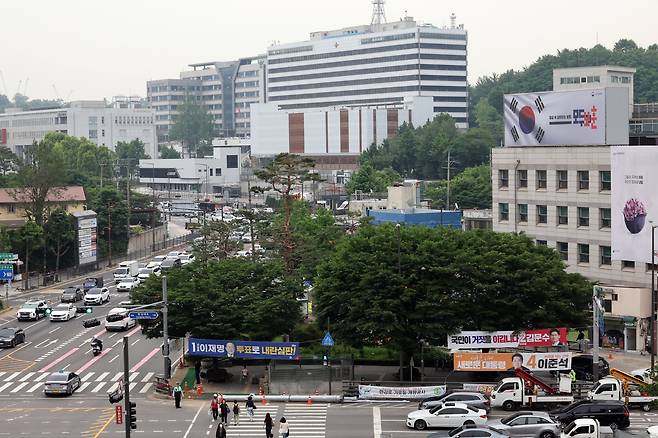
As such, the new leader will start his five-year term with a Cabinet appointed by the ousted predecessor and in the Yongsan office in central Seoul, the much-disputed site of relocation chosen by Yoon.
The Public Officials Election Act states that the winner of a presidential early election shall commence his or her term immediately after the win is confirmed, which would be during the general assembly of the National Election Commission on Wednesday morning. In normal circumstances, a state-funded transition team assists the president-elect in affairs related to the new administration, such as forming a Cabinet, preparing policies and other matters related to the takeover.
In the case of the 2017 presidential election on May 9, 2017 — the first-ever presidential early election after the direct election system was implemented in 1987 — Moon Jae-in's win was confirmed at around 8:09 a.m. on May 10. His inauguration took place at noon that day, although it was only a formality, given his term had already started the moment the NEC confirmed his win.
The political turmoil following Yoon's martial law imposition in December not only led to his own early departure from office, it set off a series of resignations at the ministerial level, including two key positions of the Cabinet: the prime minister and the finance minister, who are next in line in the order of presidential succession.
The third in line, Education Minister Lee thus assumed the role of acting president, prime minister and finance minister to lead the administrative branch until the new president takes office.
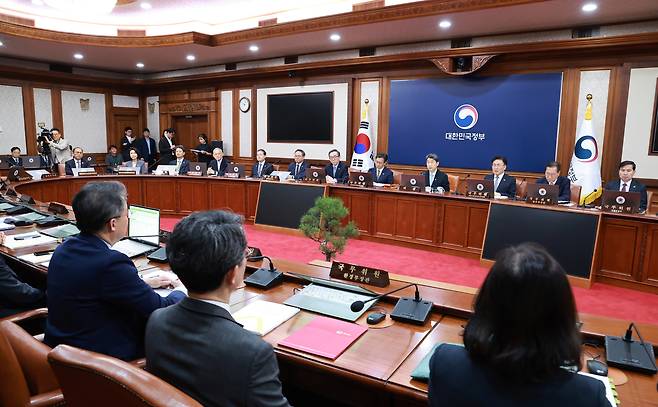
Of a total 21 Cabinet seats, only 14 are now occupied. Vacant seats include core roles such as the interior minister and the defense minister. The next president will have to run the government with a short-staffed Cabinet.
Precedents set by the Moon administration suggest it will take a considerable period of time for the new president to fully replace the ministers to form the inaugural Cabinet. It took 76 days for Moon to hold his first Cabinet meeting in which all the members were his own appointments.
The appointment of a prime minister requires the approval of more than half of the National Assembly members in attendance at a session. This would not likely present a problem for the Democratic Party, which already has over half of the 300 seats in the parliament. The People Power Party, however, holds well below a majority in the parliament.
Should Lee be elected, his administration would lead to the relocation of the presidential office from the current spot in Yongsan-gu, Seoul. Lee has said Yongsan is just a provisional office, although the time constraint of the snap election would mean he would have to begin his term there.
Lee said he would first relocate to the former presidential office of Cheong Wa Dae before ultimately pushing for a move to the administrative town of Sejong, some 120 kilometers south of Seoul. Kim said he would maintain the current presidential office in Yongsan if elected.
Copyright © 코리아헤럴드. 무단전재 및 재배포 금지.