Daunting economic tasks lie ahead for new president
The newly elected Korean president will take office amid mounting internal pressures and global headwinds, setting the stage for an aggressive fiscal and industrial policy pivot.
The new government inherits a fragile economy with deteriorating fundamentals. Recent data show declines in output, consumption and investment — underscoring a downturn worsened by global shocks and the political turbulence that stemmed from former President Yoon Suk Yeol’s short-lived martial law decree.
Candidate Lee Jae-myung of the liberal Democratic Party of Korea was projected to win the election, according to Tuesday's exit polls. With Korea’s economy at a crossroads, his campaign focused on a two-pronged strategy of countering US-led trade measures while accelerating the nation’s tech ambitions. If Lee wins, execution will be key as his administration works to turn campaign pledges into a tangible economic rebound.
Mission to reignite domestic demand
Asia’s fourth-largest economy is forecast to grow less than 1 percent this year, dragged down by weak private consumption, heavy household debt and a sluggish construction sector.
If elected, Lee Jae-myung has pledged a second extra budget worth 35 trillion won ($25.4 billion), with a focus on quickly funding programs targeting small businesses, construction and welfare.
A supplementary budget of 30 trillion won could lift GDP growth by 0.4 to 0.5 percentage point, according to Hyundai Research Institute estimates, potentially pushing full-year growth into the low one percent range, up from the Bank of Korea’s 0.8 percent forecast.
The administration’s fiscal stimulus plan centers on near-term impact. Lee's flagship initiative of distributing shopping coupons for small retailers will aim at spurring consumption and revitalizing local economies.
Infrastructure and urban renewal projects are also slated for early-stage investment to generate employment and economic momentum.
The Bank of Korea moved swiftly last week, cutting its key rate by 25 basis points to 2.5 percent, in a bid to support demand. Further easing is likely, said Kim Jin-wook, economist at Citigroup.
“We expect the Bank of Korea to pursue a rate-cutting cycle, with 25-basis point cuts in August 2025, November 2025 and February 2026, targeting a 1.75 percent terminal rate,” Kim said.
He warned that the drag from US trade restrictions will be among the steepest for Korea, with cumulative negative effects on GDP growth through 2026 projected to be more severe than for most major economies.
Tariff battle and tech leadership
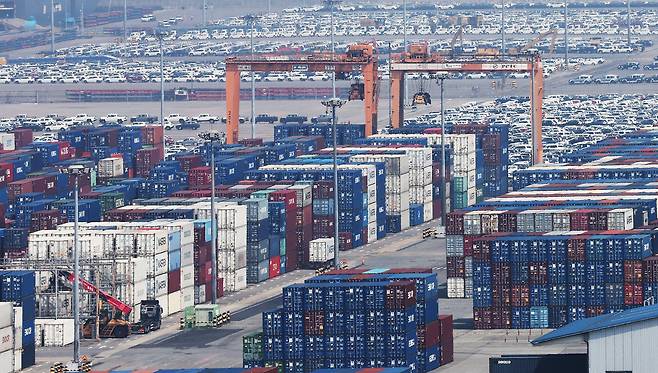
Korea’s industrial sector faces its own set of urgent challenges with the escalation of US-led tariffs, initially targeting autos, steel and aluminum having already begun to hit exports hard.
In May, shipments to the US shrank sharply, with auto exports plunging 32 percent on-year, and steel and auto parts also experiencing double-digit declines. The risk of future US measures raising tariffs to 50 percent remains a concern, especially for the steel industry, which accounts for about 13 percent of Korean exports.
Negotiations with the US, which began in April, are focused on creating a “July Package” that could lift tariffs before the current suspension expires on July 8, potentially saving key industries from further damage.
On negotiations with the US, Lee maintains that Korea's national interest is his priority, and that he “will not rush” into any early settlement.
"We need to make it clear that Korea and the US are not simply trading partners, but allies who share security and strategy," he said at a candidate debate.
Beyond trade issues, Lee must bolster Korea's strategic industries, such as semiconductors and artificial intelligence.
Semiconductors, long a backbone of Korea’s export-driven economy, have seen a global market share decline over the past five years, according to the Korea Institute for International Economic Policy, despite various government support measures, including tax credits for R&D.
Lee has said he will push to swiftly pass the Special Semiconductor Act pending at the National Assembly and introduce other tax benefits, such as production tax credits, and support research and incentives to encourage the reshoring of chipmakers.
The special chips law includes provisions mandating government support for infrastructure areas as electricity, water supply and roads.
With related industries calling for direct subsidies to match those offered by the US, Japan and China, eyes are on whether the new president will come up with similar measures.
Artificial intelligence is another area the new administration should swiftly address. Stressing the public’s role in creating large-scale investments, Lee has pledged state support to develop a “Korean-style ChatGPT” to be provided for free to the public.
He also proposed a 100 trillion won ($71.9 billion) fund through a public-private partnership to build national AI data clusters, with the goal of making the country one of the world’s top three nations in AI.
“Regulatory reform must go beyond rhetoric. The new president should maintain the existing system, which evaluates regulations that are in place, not just imposing new ones,” said Yang Jun-seok, an economics professor at Catholic University of Korea.
Removing unnecessary regulations will be part of the foundation for nurturing Korea's next-generation industries in emerging sectors such as AI, robotics and biotechnology, according to Kim Tae-il, a public administration professor at Korea University.
"With global competitors accelerating support for these strategic technologies, Korea cannot afford to fall behind."
Copyright © 코리아헤럴드. 무단전재 및 재배포 금지.