D-day showdown: Lee aims to seal ‘solid win’ as Kim hopes for reversal
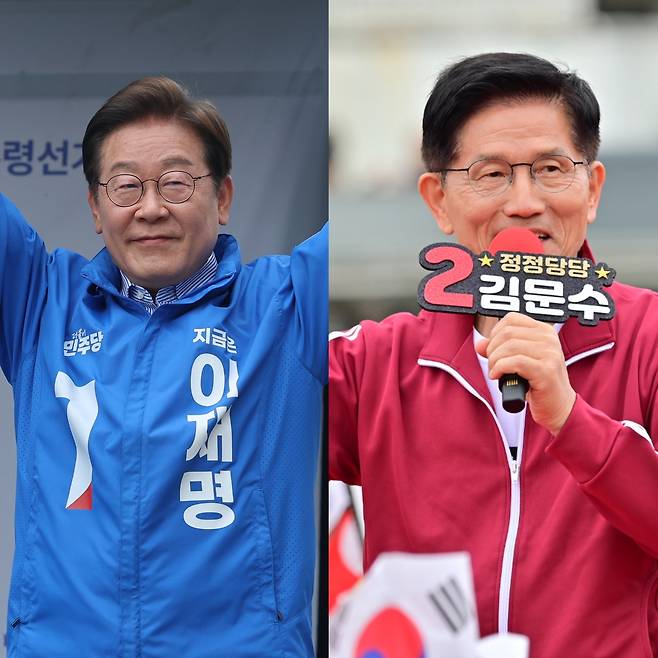
On the last day of campaigning for the presidential election, Democratic Party front-runner Lee Jae-myung made a final push to lock in a "solid win," while People Power Party candidate Kim Moon-soo made a last-minute blitz in hopes of a dramatic reversal.
The contrasting finales chosen by Lee and Kim demonstrated the deep divide in their campaign strategies and the essence of their political narratives.
Lee’s decision to close out his campaign on Monday evening with a rally in Yeouido Park— a stone's throw from the National Assembly, where he blocked former President Yoon Suk Yeol’s Dec. 3 martial law declaration and joined rallies with the public to impeach Yoon — underscored both the symbolism and central message of his candidacy.
Lee has touted his win would serve as a direct judgment on Yoon’s martial law attempt and the People Power Party, to which Yoon belonged until May.
“The significance of this election fundamentally lies in judging and suppressing insurrection, which is why the campaign chose Yeouido as the (final) gathering place to reflect that symbolism,” Rep. Kim Min-seok, standing co-chair of the Democratic Party’s election countermeasures committee, said Monday during his radio interview with local state-run broadcaster KBS.
Kim, however, struck a cautious note about the possibility of Lee scoring a landslide victory — a sentiment echoed not only by him but also widely within the Democratic Party.
“It’s not as if the number of People Power Party supporters in South Korea has disappeared, so expecting an overwhelming margin of victory might be too high an expectation,” Kim said. “Still, I hope we can achieve a solid win.”
Yoon Yeo-joon, who leads the Democratic Party’s election campaign committee, underscored that “we should do our utmost with humility until the very end,” calling for the party not to let its guard down during Monday’s meeting of the election campaign committee.
Lee’s final campaign day also traced a symbolic path through his political roots. Lee began in Seoul’s Gangbuk-gu district and made stops in the cities of Hanam, Seongnam, and Gwangmyeong in Gyeonggi Province — a nod to both his two terms as mayor in Seongnam and his tenure as governor of Gyeonggi Province.
Lee held a press conference at Seongnam Jumin Church — the place where he first resolved to enter politics while seeking refuge in the church’s prayer room in 2004, after being charged as a civic activist for protesting the failed passage of a municipal hospital bill.
“Our country has been shaken to its core by insurrection. The economy has plunged,” Lee said during the news conference. “But I will not give up. Together with you, the great people, we can and will overcome this.”
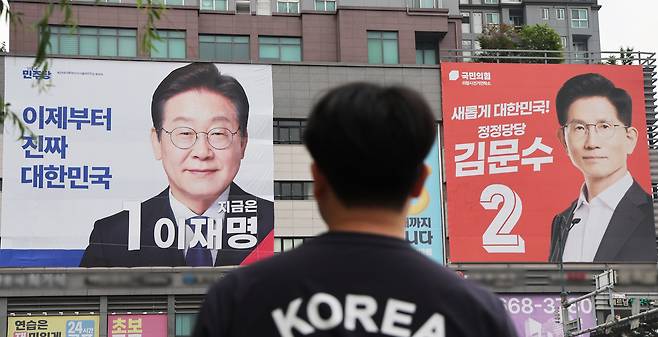
In contrast, Kim’s final day on the campaign trail was spent crossing the country, culminating with a rally at Seoul City Hall Plaza in central Seoul after traveling from Jeju Island in the far south through the party’s traditional conservative strongholds of Busan, Daegu and Daejeon.
The cross-country push reflects Kim’s strategy to reach as many voters as possible in the final hours, compensating for his late entry into the race compared to Lee, which was a result of the party’s internal strife over candidacy nomination.
In his stump speech in Busan, Kim apologized for failing to merge his candidacy with that of the minor conservative New Reform Party’s candidate Lee Jun-seok and for Yoon’s martial law declaration.
“If you vote for Lee Jun-seok, you will only be helping Lee Jae-myung,” Kim said. “However, we will continue efforts to unify until the very end without giving up hope.”
The People Power Party has publicly touted that the election race has entered the “golden cross” phase — the point at which Kim’s support can potentially surpass that of front-runner Lee.
“While we cannot quantify the overall state of the race, we believe we have entered the golden cross zone, as the momentum of (Kim’s) chase after (Lee) continues,” said Rep. Shin Dong-uk, chief spokesperson for the People Power Party’s election campaign headquarters during Monday's press briefing.
Shin also underscored higher participation from conservative bastions in the June 3 vote, explaining that “the golden cross zone means victory or defeat will be determined by how many of our supporters show up at the polls until the very end."
Pertaining to the lower voting rates in the party’s traditional strongholds during the May 29–30 early voting, Shin explained, “Concerns over poor management of early voting seem to have kept many of our supporters from turning out.”
“But if our supporters turn out in large numbers at the polls tomorrow, we believe a turnaround is possible,” Shin added.
In the Honam region — comprising South and North Jeolla Provinces and Gwangju, and considered a Democratic Party stronghold — early voting exceeded 50 percent in all areas, well above the national average.
In contrast, turnout rates in the Yeongnam region, the People Power Party’s base, were below the national average, with Daegu recording the lowest turnout at 25.63 percent, while turnout in Ulsan, Busan, and South and North Gyeongsang provinces hovered between 30 and 32 percent.
Copyright © 코리아헤럴드. 무단전재 및 재배포 금지.