‘Near repeat’ of Daegu disaster averted in Seoul subway fire
이 글자크기로 변경됩니다.
(예시) 가장 빠른 뉴스가 있고 다양한 정보, 쌍방향 소통이 숨쉬는 다음뉴스를 만나보세요. 다음뉴스는 국내외 주요이슈와 실시간 속보, 문화생활 및 다양한 분야의 뉴스를 입체적으로 전달하고 있습니다.
When flames broke out inside a subway car in Seoul during the morning hour on May 31, it could have become one of South Korea’s deadliest transit disasters. But the fire — deliberately set by a passenger — was quickly extinguished. There were no fatalities. Twenty-three people were treated for smoke inhalation, but all survived.
It was, as safety experts later noted, a close call — a “near repeat” of the 2003 Daegu subway arson attack that killed 192 people and prompted sweeping safety reforms. This time, they say, the outcome was different thanks to better materials, stricter protocols, and a more informed public — all shaped by lessons learned from that tragedy.
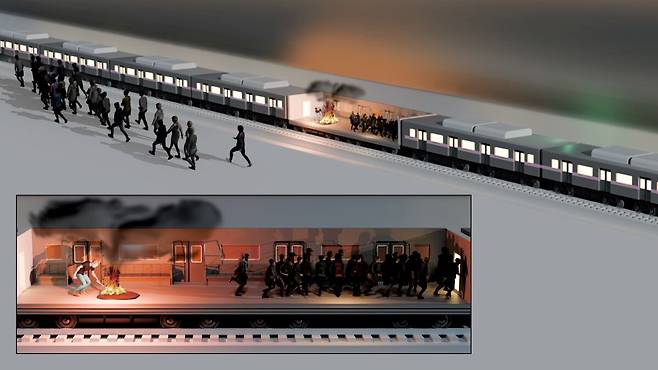
In the 22 years since the Daegu disaster, the South Korean government and local municipalities have invested more than 340 billion won (about $250 million) to improve subway safety. Trains were retrofitted with nonflammable and fire-retardant materials — changes that likely saved lives last week.
The fire began when a man in his 60s poured gasoline on the floor of the fourth subway car on Seoul Metro Line 5 and set it alight, causing flames to flash through the train and smoke to quickly fill the car, according to passengers. But the blaze failed to spread. The seats were made of polycarbonate — the same material used in motorcycle helmets and hard-shell luggage — while the floors were coated in synthetic rubber, which does not ignite easily.
In contrast, the 2003 Daegu subway cars were highly flammable, lined with polyurethane foam and vinyl-coated floors that ignited quickly and produced thick, toxic smoke. Most of the 192 victims died of asphyxiation. The conductor fled without alerting headquarters, and most passengers did not know how to evacuate.
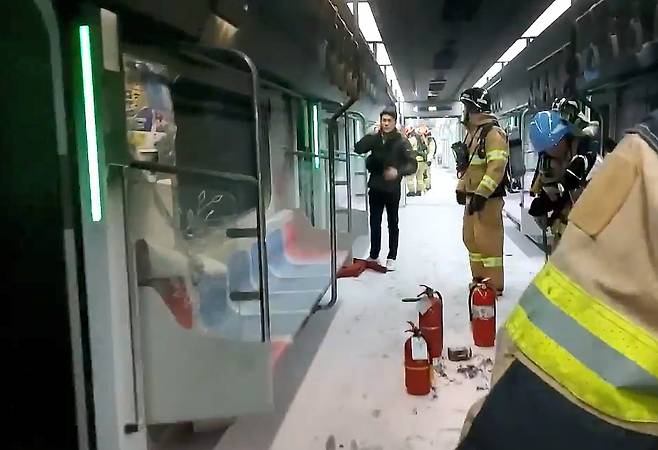
This time, the response followed a different script — one that had been rehearsed for years.
As soon as the fire broke out, passengers used the emergency intercom to alert the conductor. Security cameras inside the train confirmed the situation, and the conductor, following Seoul Metro protocol, notified the control center and issued a broadcast instructing passengers to move to a different car. He then rushed toward the burning carriage and, along with several passengers, used fire extinguishers to put out the flames.
The control center immediately stopped incoming trains, allowing passengers to evacuate safely through the tunnel. A Seoul Metro official said the conductor had completed a fire simulation drill just a month earlier, on April 29 — an eerily similar scenario to the real emergency.
Seoul Metro conducts these drills every three to four months. According to investigators, the conductor told officials after the incident: “I was terrified I might suffocate, but once I confirmed the fire with my own eyes, I grabbed an extinguisher and ran.”
Lee Chang-woo, a professor at Korea Soongsil Cyber University’s Department of Fire and Disaster Prevention, said that during the Daegu fire, “The only instruction was to follow control center orders if there was a fire. There was no detailed manual, so everyone panicked in the chaos.”
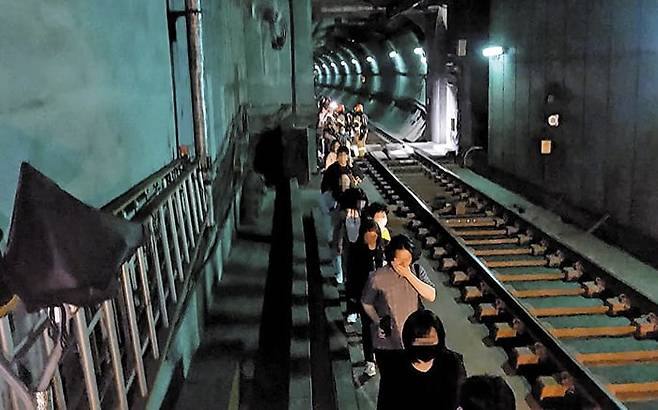
Passengers played a key role as well. After noticing the fire, many used the emergency phones in the train cars to report the incident. Others pulled the red-painted emergency door release levers under the seats to open the doors and evacuate. According to Seoul Metro, more than 60 percent of the 64 doors on the train were manually opened by passengers.
Some carried elderly passengers on their backs to safety. Others remained behind to help extinguish the fire despite the smoke. A fire official later remarked, “By the time our crews arrived, there were no flames left to put out — the passengers and conductor had already handled it.”
The contrast with Daegu is stark. In 2003, although fire extinguishers and manual door levers were present, few passengers knew how — or had time — to use them. Most victims were found piled near unopened train doors.
Emergency communication systems have also improved. After Daegu, Seoul Metro installed a system that transmits emergency intercom messages to both the conductor and control center at the same time. That upgrade helped ensure a swift response on May 31.
Still, safety experts caution against complacency. While the May 31 incident showed the system worked as designed, they warn that opening train doors and entering tunnels without proper instruction can be dangerous.
The 2003 Daegu subway fire occurred on February 18, when a man set fire to a train stopped at Jungangno Station. The flames quickly engulfed another train that had just entered the station. The tragedy led to the creation of the Framework Act on the Management of Disasters and Safety and the establishment of the National Emergency Management Agency.
Copyright © 조선일보. 무단전재 및 재배포 금지.