Novelist Kwon Yeo-sun, cellist Yang Sung-won, Lee Tae Seok Foundation receive Musan Cultural Awards
전체 맥락을 이해하기 위해서는 본문 보기를 권장합니다.
"But I believe literature has the power to bridge that gap, even if only slightly. I hope my novels can expand the boundaries of what pain can touch. Sadly, I cannot write at the moment, and that breaks my heart. I want to return to writing as soon as possible."
"I have come to believe that the greatest form of social critique is love," said Goo, who was formerly a documentary producer at KBS. "When we think about how to change society for the better, it's not just about laws and systems — it's about people. The most powerful message we can send is a message of compassion."
이 글자크기로 변경됩니다.
(예시) 가장 빠른 뉴스가 있고 다양한 정보, 쌍방향 소통이 숨쉬는 다음뉴스를 만나보세요. 다음뉴스는 국내외 주요이슈와 실시간 속보, 문화생활 및 다양한 분야의 뉴스를 입체적으로 전달하고 있습니다.
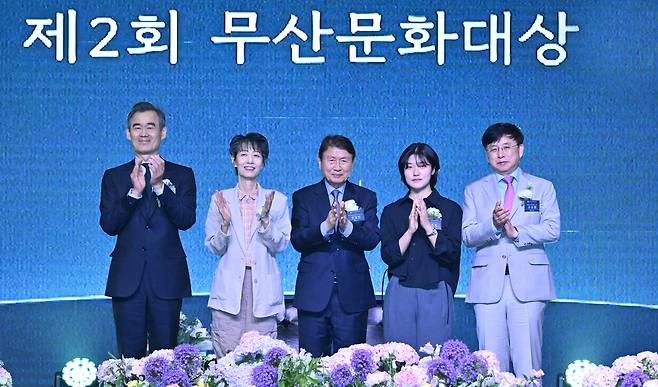
The Manhae Musan Foundation held its second Musan Cultural Awards ceremony Friday at the Grand Hyatt Seoul in Yongsan, central Seoul, presenting prizes to three winners: writer Kwon Yeo-sun, cellist Yang Sung-won and the Lee Tae Seok Foundation.
The Musan Cultural Awards were established to honor the life and legacy of the late poet and Buddhist monk Cho Oh-hyun, known by his pen name Musan. Each prize carries a cash prize of 100 million won ($72,500).
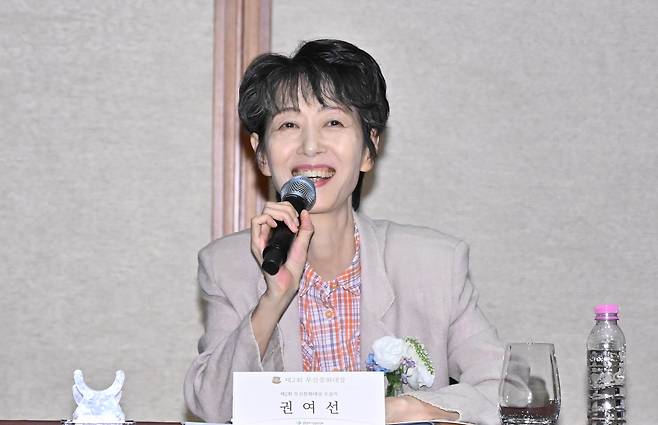
In the literature category, novelist Kwon was recognized for what the committee described as her "sensitive perception and unique rhythm that cut through social issues and illuminate the unspoken contours of life," as well as for her ability to confront pain with compassion.
Speaking to reporters ahead of the ceremony, Kwon shared that she was recently rushed to an emergency room, went into shock and had to undergo surgery.
"I still go to the hospital daily for follow-up treatment. Pain and sorrow have always been eternal themes in literature. But when I’m overwhelmed by my own suffering, I realize that my ability to empathize with others may not even amount to a fistful," said Kwon.
"But I believe literature has the power to bridge that gap, even if only slightly. I hope my novels can expand the boundaries of what pain can touch. Sadly, I cannot write at the moment, and that breaks my heart. I want to return to writing as soon as possible."
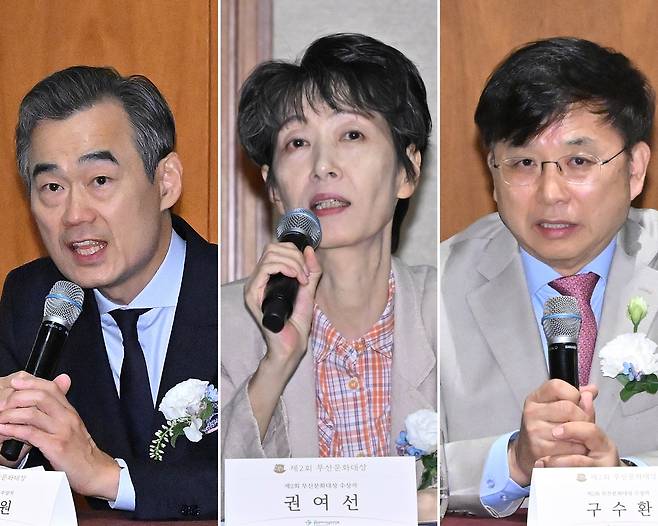
In the arts category, the foundation recognized cellist Yang for his contributions to cultural exchange and artistic inspiration through music.
“The values that Musan emphasized — respect for humanity, introspection expressed through silence and a return to traditional values — deeply resonate with the direction that arts should take," said Yang.
“Arts open hearts, connect emotions, and help us understand one another,” he added.
The Lee Tae Seok Foundation, represented by Chair Goo Soo-hwan, received the award for its ongoing humanitarian efforts. Established in 2012, the nonprofit carries on the legacy of the late Catholic priest from which it takes its name, who devoted his life to medical and educational service in South Sudan. The foundation provides medical supplies and essentials to communities in need, including leprosy villages in Tonj, South Sudan and war-torn regions such as Ukraine.
“I have come to believe that the greatest form of social critique is love,” said Goo, who was formerly a documentary producer at KBS. “When we think about how to change society for the better, it’s not just about laws and systems — it’s about people. The most powerful message we can send is a message of compassion.”
The life and legacy of Lee were previously captured in the acclaimed 2010 documentary "Don't Cry for Me Sudan." A follow-up film, "Resurrection" (2020), screened at the Vatican last year.
Goo added, “Later this year, we hope to release the third film of the trilogy, offering guidance on the direction our society should take.”
Copyright © 코리아헤럴드. 무단전재 및 재배포 금지.