Chinese inverter security risks expose overreliance in Korea’s solar supply chain
![A massive solar panel complex in South Jeolla [JOONGANG ILBO]](https://img1.daumcdn.net/thumb/R658x0.q70/?fname=https://t1.daumcdn.net/news/202505/30/koreajoongangdaily/20250530181426054xbrk.jpg)
The discovery of unidentified devices in Chinese-made solar inverters in the United States has fueled tighter scrutiny in Korea — where most solar power components are imported from China — due to its heavy reliance on renewable energy tech import from its neighbor to the west.
Though the Korean government has not yet initiated a full-scale investigation, industry watchers caution that the threat is not limited to foreign markets, underscoring the urgent need for Korea to implement decisive and preemptive measures to secure its energy infrastructure.
What concerns Korea most is the potential for a security breach to expose sensitive information about the national power grid and electricity supply status — or worse, enable deliberate manipulation of inverters to trigger blackouts or large-scale grid disruptions.
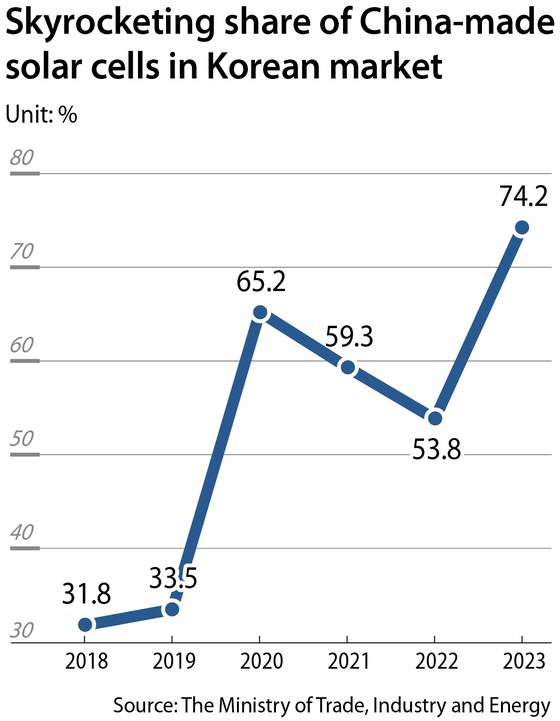
Currently, around 95 percent of inverters, the key in solar panels behind the U.S. case, distributed in Korea are either manufactured in China or produced through original equipment manufacturing arrangements with Chinese factories and sold under domestic brand names. Beyond inverters, China maintains a dominant presence in Korea’s solar supply chain, particularly in the production of solar cells and modules.
“Korea may not be immune to such risks; While large firms typically conduct rigorous inspections when importing Chinese-made inverters, and may reject entire shipments if irregularities are found, smaller firms often lack the resources or technical capacity for such thorough vetting,” a source in one of the major solar firms in Korea.
“And if the Chinese suppliers were to deliberately falsify documentation or conceal malicious components, even large companies could find it virtually impossible to detect the threat in advance.”
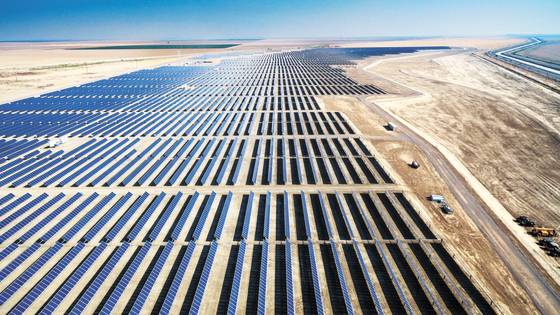
Solar inverters, commonly regarded as the “brains” of solar power systems, play a critical role by converting the direct current (DC) electricity generated by solar panels into alternating current (AC) electricity suitable for residential, commercial, and grid applications. Inverters include remote access capabilities to enable updates and maintenance, and they are also used in a range of appliances, including wind turbines, batteries, heat pumps and vehicle chargers.
The U.S. Energy Department has discovered unexplained communication components inside China-made inverters that were not listed in product documents that may “allow firewalls to be circumvented remotely, with potentially catastrophic consequences," according to a Reuters report citing two unnamed sources from the Energy Department.
“Inverters are fundamentally software-driven devices, equipped with automatic update features that, in principle, should always notify the user of any changes. However, these functions could be exploited through covert communication modules, allowing malicious actors to remotely access systems via the network," said cybersecurity professor Lim Jong-in at Korea University, who served as the special cyber secretary under the former Yoon Suk Yeol administration.
"In worst-case scenarios, such infiltration could trigger operational shutdowns or even widespread blackouts," Lim said. “Given the ubiquity of Chinese components across the global supply chain, Korea’s industrial infrastructure is far from safe from these risks.”
The Ministry of Trade, Industry and Energy also held a meeting on May 21 with major domestic solar firms, including Hanwha Qcells, Hyundai Energy Solutions and Hyosung Heavy Industries, to review the current status of solar inverter deployment in the country and possible expected threats.
“The next steps will be determined following consultations with multiple inverter experts and industry specialists,” an official from the Industry Ministry told the Korea JoongAng Daily, adding that it currently has "no plans to conduct a comprehensive investigation into all inverters" distributed domestically.
BY SARAH CHEA [chea.sarah@joongang.co.kr]
Copyright © 코리아중앙데일리. 무단전재 및 재배포 금지.
- Navy aircraft crashes in Pohang, killing all four crew members
- Bullet found in luggage of American dad departing Korea after child's K-pop audition
- aespa’s Karina faces backlash over election-season Instagram post
- Korea assessing China-made solar inverters after U.S. probe over undefined devices
- HYBE China opens in Beijing as K-pop powerhouse aims to boost presence in local scene
- UAU's members say performing in Dreamcatcher 'made us what we are today'
- This new $650 Dyson hairstyler cut 4 minutes from my morning routine. Here’s how
- Korea's presidential candidates want constitutional reform. Experts say they don't go far enough.
- Lee Jun-seok apologizes for asking if sticking chopsticks in women is misogyny: 'I was quoting'
- Behind Korea’s high senior employment rate: A need for more meaningful work