S. Korea, China, Japan buy 94% of global EV battery minerals
이 글자크기로 변경됩니다.
(예시) 가장 빠른 뉴스가 있고 다양한 정보, 쌍방향 소통이 숨쉬는 다음뉴스를 만나보세요. 다음뉴스는 국내외 주요이슈와 실시간 속보, 문화생활 및 다양한 분야의 뉴스를 입체적으로 전달하고 있습니다.
Asian battery manufacturers from South Korea, China, and Japan maintain a strong hold on the global battery mineral market despite a temporary slowdown in electric vehicle demand.
In the first quarter of this year, companies from these three countries accounted for 94% of global purchases of critical battery minerals. While China holds a significant advantage in securing overseas minerals with government support, South Korea remains over 90% dependent on China for critical materials such as precursors and graphite.
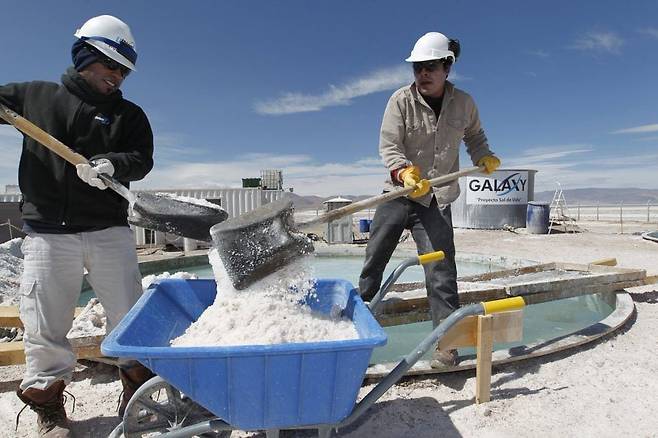
According to recent data from EV supply chain research firm Adamas Intelligence, $3.01 billion (about 4.12 trillion won) worth of battery metals were used in newly sold electric vehicle battery packs worldwide in the first quarter.
Battery manufacturers headquartered in South Korea, China, and Japan accounted for about 94% of this raw material spending. China led with $1.635 billion, or 54.31%, followed by South Korea with $918 million (30.50%) and Japan with $277 million (9.20%). The top four companies including China’s CATL and BYD, South Korea’s LG Energy Solution and Japan’s Panasonic made up two-thirds of total purchases.
In the battery market, South Korean and Japanese firms specialize in NCM (nickel, cobalt, manganese) batteries, while Chinese companies dominate lithium iron phosphate (LFP) batteries. However, China has nearly monopolized the LFP market and is quickly catching up to South Korean and Japanese firms in NCM battery technology.
The gap is even wider in securing raw materials. A July 2024 survey by the Korea Chamber of Commerce and Industry showed that among the three countries, China holds stakes in 407 mines producing lithium, nickel and cobalt, the three key minerals that make up half the cost of cathode materials. Japan has stakes in 31 mines and South Korea in 15. China’s state-owned enterprises have aggressively secured major mining assets overseas, especially in Africa, while Japan relies on partnerships between private trading companies and state-backed firms to obtain mineral resources.
Copyright © 조선일보. 무단전재 및 재배포 금지.
- 선관위 특검, 입찰비리 업체 탈세 정황 포착…국세청 조사 요청
- “신종 사마귀인 줄 알았는데”… AI로 조작한 가짜 곤충이었다
- “소득 4만달러 시대라며, 왜?”…‘내 살림’ 팍팍한 이유 있었다
- 노동부, 연내 ‘동일가치노동 동일임금’ 로드맵 발표
- 제15회 대구국제로봇산업전, 21~24일 엑스코에서 열려
- 프리즘에 반한 소녀, 반세기 동안 빛을 그리다
- CXMT, 3분기 매출 최대 24조원 전망…성장세는 둔화
- 나체로 주택가 배회… 40대 男, 테이저건 맞고 체포
- ‘날 해고하다니’… 업체 사장 모녀 협박하고 집 찾아간 50대 실형
- “이사장 책임지라” 했는데 회장이 사퇴… ‘응급실 뺑뺑이 방지법’에 의료계 내홍