'Hanok Avengers' on future of Korean architecture
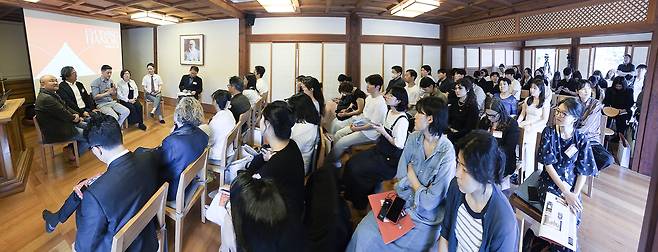
The Korea Herald’s "Architecture Talk: Evolving Hanok" brought together a group of so-called “Hanok Avengers” on Wednesday at the Eundeok Cultural Center — a beautifully restored, century-old building in central Seoul that exemplifies the elegance of traditional Korean architecture.
Building on a six-part series titled "Evolving Hanok" published in May by The Korea Herald, the third edition of the annual "Architecture Talk" was jointly hosted with the state-run Architecture & Urban Research Institute.
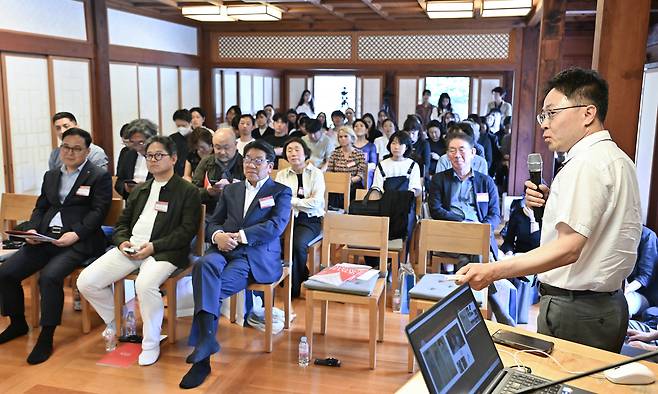
Dubbed the “Hanok Avengers” by Shin Chi-hoo, manager and research fellow at the National Hanok Center, the speakers shared insights and experiences that reflected the current state -- and evolving identity -- of hanok in contemporary Korea.
In addition to Shin, the event featured leading figures in the field: Hwang Doo-jin, director of Doojin Hwang Architects; Jeon Bong-hee, an architecture professor at Seoul National University; Cho Jung-goo of guga Urban Architecture; Kim Yong-mi, architect and CEO of GS Architects & Associates; and Daniel Tandler, co-founder of Urbandetail Architecture.
“The National Hanok Center had set the goal of achieving a hanok renaissance by 2022, but we failed. We will achieve that goal by 2032,” Shin said, emphasizing that many hanok neighborhoods have vanished under a development-first mindset.
Still, the fact that such a goal could even be articulated marks a significant cultural shift. Over the past decade, the notion of a hanok renaissance has gained momentum, fueled by devoted architects, policy support and growing interest from younger generations.
Kim, the panelist with the longest experience working with hanok, recalled once thinking her passion for traditional Korean architecture was just a personal preference -- one decidedly outside the mainstream. That changed when she came across architect Hwang Doo-jin’s 2006 book, "Hanok Has Returned." “I was shocked,” she said, adding that the book transformed her view, helping her realize that her passion was part of a larger, emerging movement.
Kim also reflected on a small but meaningful gathering she had a decade ago with fellow architects Hwang Doo-jin and Cho Jung-goo -- all passionate about hanok. Since then, the small group of architects who are engaged seriously in hanok design has remained largely the same, Kim noted, except for one notable addition: Tandler. At the time, Tandler was just beginning to explore hanok. Today, he is recognized for his dedication to the form and his growing contributions to its evolution.
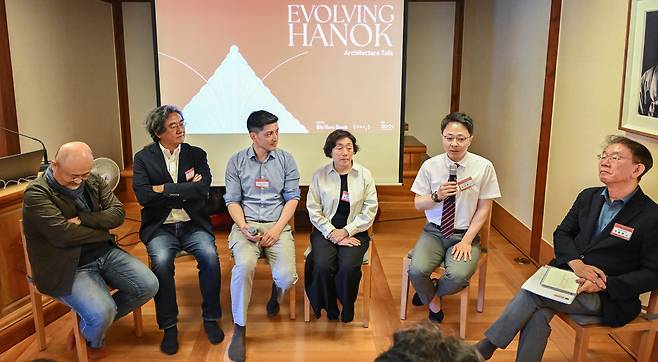
"We need to worry less about making mistakes. As people do experiments with hanok, there will inevitably be some strange outcomes. And that’s okay -- people can simply see them and move on," Tandler said.
"Because building hanok is far from the futuristic images of sci-fi movies, there once was a time that I thought I wasn't taking part in building the future. I now believe we need to create new architectural spaces that align with the concepts and philosophies of our time -- spaces that even Millennials and Generation Z can appreciate," Cho said.
The discussion also touched on key elements that define hanok and offered valuable insights for those still grappling with what the term truly means. Among those reflecting on hanok's evolving identity was Dagmar Schmidt Tartagli, the ambassador of Switzerland to Korea, who shared with the roughly 90 participants the embassy’s experience of introducing the “Swiss Hanok.”
“The Swiss Hanok” came about through an open architecture competition.
“At first, people told us, ‘This is not a hanok,’ because it wasn’t built in the traditional way or linked to heritage hanok construction,” she explained. “Yet the more I listened to this architectural debate on what hanok can become, the more I understood. People began referring to the embassy as the ‘Swiss Hanok.’ When you incorporate these elements — the madang, the light, the spatial flow -- there’s also a kind of globalization aspect," Tartagli said.
From the international community in Seoul, Michela Linda Magri, director of the Italian Cultural Institute of Seoul, and Marie Antonia von Schonburg, President & CEO of the Korean-German Chamber of Commerce and Industry, were among those attending the event.
Choi Jin-young, president of Herald Media Group, spoke about how his mood shifted upon entering the hanok. “After going through all sorts of big and small meetings, by around lunchtime I often find myself completely drained. The workload is quite intense, and today was one of those days. But the moment I stepped into this place, all that fatigue just melted away. I felt an incredible sense of calm — as if I had arrived at a sanctuary for the soul,” he said.
Choi Jong-bok, chairman of Zyx Technology, which was one of the sponsors of the event, expressed his confidence and aspiration to become a global leader in CAD solutions for architecture, especially for hanok.
Copyright © 코리아헤럴드. 무단전재 및 재배포 금지.