Leading architects challenge hanok orthodoxy
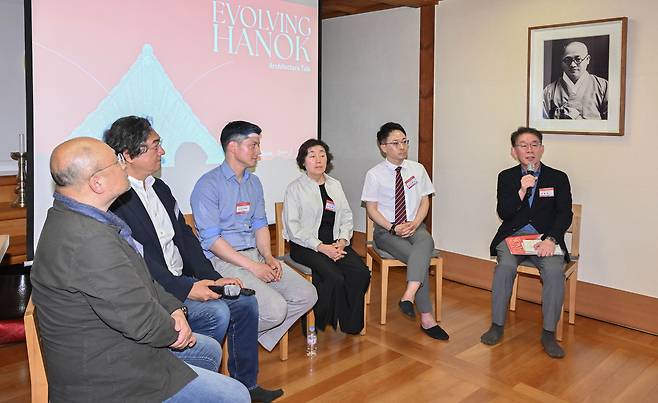
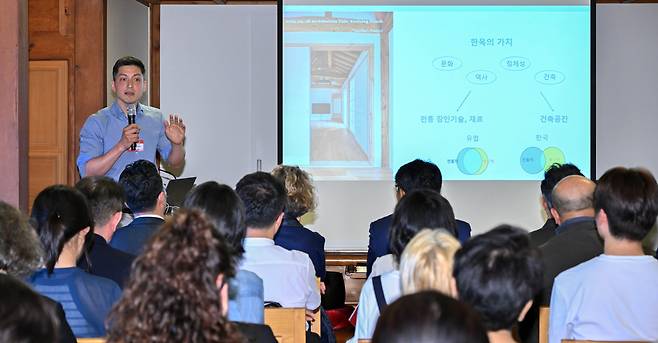
"Let's face it, hanok may never become fully mainstream. But it remains an essential part of our architectural culture," said Daniel Tandler, co-founder of Urbandetail Architecture, whose contemporary interpretations of Korea's traditional housing have earned international recognition.
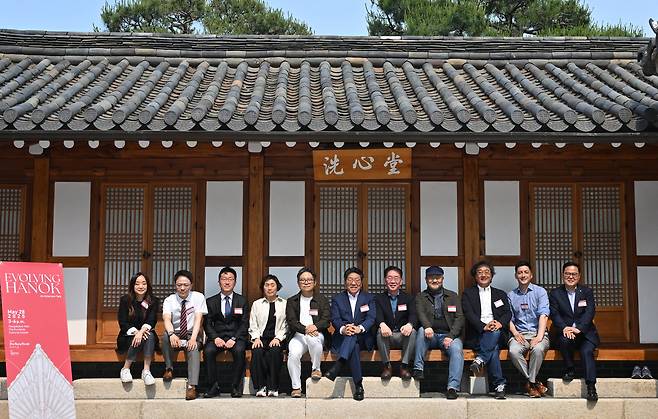
The Eundeok Cultural Center in central Seoul was packed Wednesday, with attendees spilling onto the floor of the century-old hanok building. They had come to hear six leading voices debate the future of hanok -- Korea's traditional wooden houses with their signature tiled roofs and central courtyards -- at "Architecture Talk: Evolving Hanok" jointly organized by The Korea Herald and Architecture & Urban Research Institute.
A clear consensus emerged around the limitations of current approaches to hanok preservation and development. The discussion revealed broad agreement among experts that rigid definitions of hanok could prove detrimental to innovation.
"Why must hanok have fixed definitions?" questioned Shin Chi-hoo, manager of the National Hanok Center. "No one defines apartments or single-family houses when selling them. Instead of seeking what makes hanok special, we should focus on how people actually live -- the relationships between spaces, what kind of life happens inside these places."
Cho Jung-goo, architect of guga Urban Architecture, emphasized this point through his concept of "architectural reincarnation," describing how traditional Korean spatial arrangements persist across different materials and construction methods.
"In Jeju, I observed traditional thatched houses alongside modern slab houses sharing nearly identical floor plans," he explained. "Traditional materials evolved into contemporary concrete construction. Hanok shouldn't remain static but continue evolving and being reborn."
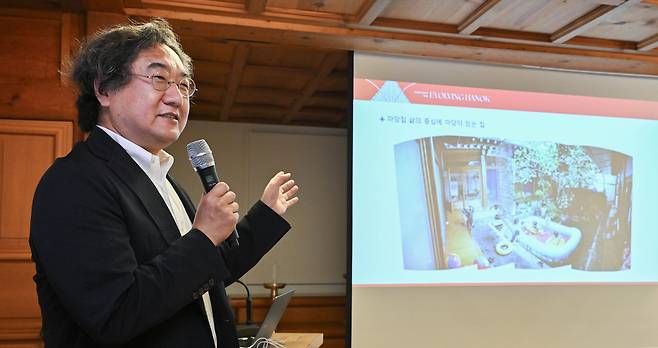
This flexibility extends to construction methods that allow for technological adaptation. In presentations preceding the panel discussion, each architect showcased projects that demonstrate contemporary adaptations of hanok's traditional elements: Tandler's steel reinforcement systems for structural integrity, Kim Yong-mi's hybrid wood-concrete construction methods, Hwang Doo-jin's integration of glass skylights within traditional wooden floor systems, and Cho's reinterpretation of traditional courtyard spatial arrangements for modern contexts.
The current institutional framework reinforces creative limitations by enforcing technical requirements that projects must meet to qualify for subsidies, experts say. Seoul's hanok support initiative, for instance, requires "wooden architectural structures built on the basis of traditional Korean-style frameworks consisting of columns and purlins," language that panelists argued perpetuates orthodox standards and restricts experimental approaches.
The panelists echoed broader frustration with widespread traditionalist expectations that hanok should preserve historical elements without any contemporary modification, an idea Tandler characterized as "Joseon-era (1392-1910) style obsession."
"Some techniques are indeed worth preserving, but regarding the late Joseon-era formalities -- the hanok we live in today are far removed from those historical models anyway," he said.
Despite agreement on the need for flexibility, the discussion exposed nuanced disagreements about hanok's role in urban landscapes. This tension centered on whether hanok should adapt to densely populated urban conditions or maintain certain characteristics that may limit widespread adoption.
Understanding this debate requires a look at Seoul's unique housing landscape. The city houses approximately 10 million people in 605 square kilometers, with apartment complexes comprising over 60 percent of housing stock. These complexes, typically 15-25 stories high, house multiple families on small footprints while providing amenities and security that individual houses cannot practically match.
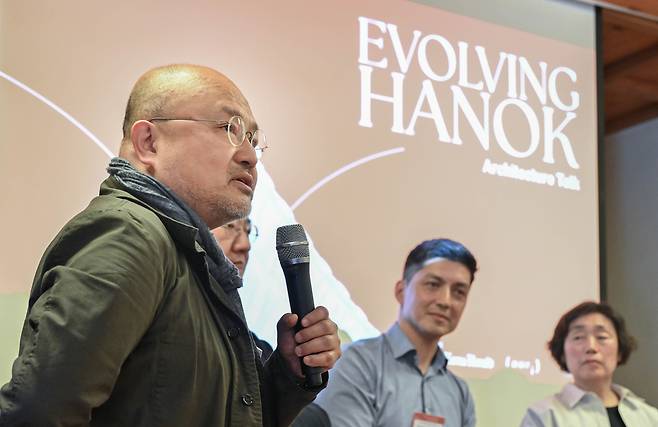
Hwang and Kim advocated for multistory hanok that could establish a more common presence in urban settings. "Multistory development -- turning hanok into multiple floors -- is key," Hwang said. "Even two stories significantly raise density. If traditional neighborhoods had multifloor hanok, they wouldn't have been completely razed for redevelopment."
"Korea historically had different priorities -- less focus on wealth accumulation through property, which allowed for these unique single-story buildings," he added. "That worked well in the past, but it can't handle today's urban pressures. That's why hanok get torn down voluntarily, without any war or colonization forcing it."
Kim went further in her presentation, envisioning "hanok cities" with five-story hanok buildings serving as police stations and fire departments. "Why not dream of hanok cities?" she asked. "This can be a healing project for Korea's damaged landscape."
Tandler and Cho offered opposing perspectives, arguing that hanok's value lies precisely in qualities that resist urban adaptation. Tandler questioned the premise of mass adoption: "Korea's small hanok percentage won't create density problems. Hanok probably won't become mainstream anyway, so these talks about density aren't really necessary."
His position reflects broader skepticism about compromising hanok characteristics for practical considerations: "If we focus too much on efficiency, why build hanok at all? It's like comparing handmade leather shoes with factory-made ones -- even with the same leather, they're completely different."
Cho cautioned against equating higher density with progress, arguing that apartment complexes reduce community spaces while displacing long-time residents.
"When they build apartment complexes, the number of households actually decreases, and they drive out many people. It's strange to call that increased density," he said.
He drew parallels to historic preservation: "No one thinks we should increase density at Gyeongbokgung Palace just because Geunjeongjeon Hall is only two stories. Why should we treat hanok neighborhoods differently?"
This perspective treats hanok as inherently limited in scale, valuable for its difference from mainstream housing rather than its potential to replace it. Tandler suggested this limitation enhances rather than diminishes hanok's significance: "Let hanok be hanok, and let our contemporary architecture incorporate and reinterpret hanok essence."
The discussion concluded with reflections on Korea's evolving stature on the global stage and its implications for cultural identity. Several panelists noted how Korea's rapid rise in cultural influence -- from technology to entertainment -- creates new opportunities for architectural expression.
Kim, who studied in Paris, reflected on changing perceptions: "Back in the days, people in Paris only knew Korea through images of tear gas and demonstrations. These days, everyone gathers around Korean students to see the latest smartphones and digital devices. Korea's status has risen that dramatically."
She expressed cautious optimism about future developments: "I don't expect many more hanok to be built, but what I do see is a much deeper exploration of what Korean-style architecture really means."
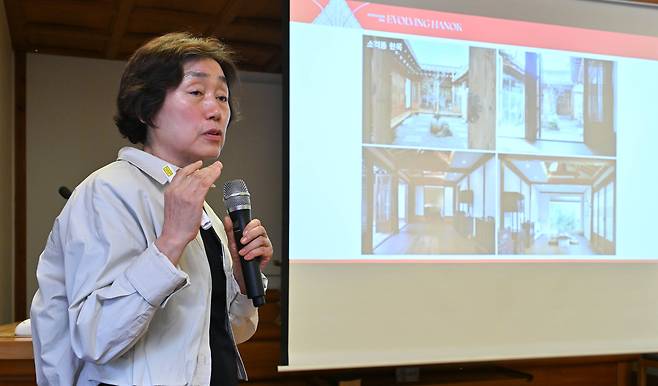
Cho articulated his vision for Korean architecture's future. "We have a creative calling -- something that hasn't emerged yet but needs to. Where will the biggest seeds for this come from? I am confident hanok will provide them."
"Take Japan -- Japan established this foundation centuries ago, then developed it through various schools over 150 years. Now, Japanese architects naturally produce work that feels Japanese."
For Korea, he suggested, "the future depends on us creating something similar -- but we're the ones who have to build it."
Copyright © 코리아헤럴드. 무단전재 및 재배포 금지.