BOK slashes growth forecast by half to 0.8%
전체 맥락을 이해하기 위해서는 본문 보기를 권장합니다.
"At that time, Korea's potential growth rate was around 3 percent. Now, it has fallen to 2 percent. A 0.8 percent growth is certainly painful, but it's not a crisis on the scale of 2008."
"Over the past two years, construction investment has been the biggest drag on growth," said Rhee. "The sector had overheated during the real estate boom and is now undergoing a sharp correction, which we expect to stabilize within this year."
이 글자크기로 변경됩니다.
(예시) 가장 빠른 뉴스가 있고 다양한 정보, 쌍방향 소통이 숨쉬는 다음뉴스를 만나보세요. 다음뉴스는 국내외 주요이슈와 실시간 속보, 문화생활 및 다양한 분야의 뉴스를 입체적으로 전달하고 있습니다.
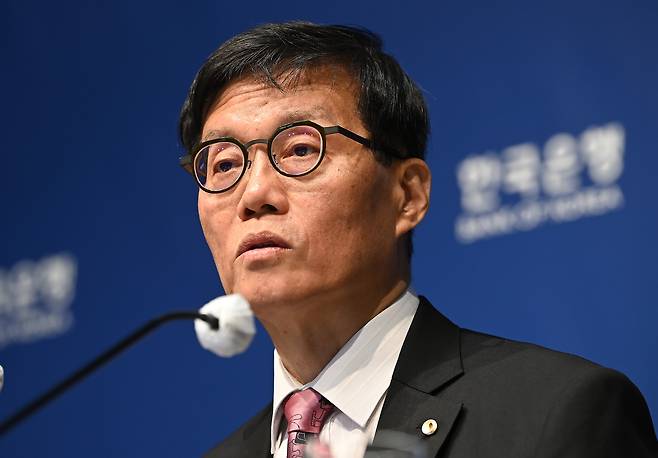
The Bank of Korea nearly halved its economic growth projection for this year to 0.8 percent on Thursday, reflecting deepening challenges both at home and abroad. In a bid to support the struggling economy, the central bank also delivered a quarter-point base rate cut.
The revised estimate for gross domestic product growth, a key measure of economic performance, is down 0.7 percentage point from the BOK’s previous forecast of 1.5 percent made in February. The downgrade factors in the 0.2 percent economic contraction in the first quarter and heightened trade risks, including US tariff actions.
If realized, the figure would match the 0.8 percent growth in 2009 seen during the global financial crisis. Since then, Korea has maintained growth of over 2 percent throughout the years, excluding the pandemic-triggered contraction in 2020.
“The economy is facing challenges, but it’s difficult to compare the current situation to that of 2008,” BOK Gov. Rhee Chang-yong said at a press conference following a Monetary Policy Board meeting.
“At that time, Korea's potential growth rate was around 3 percent. Now, it has fallen to 2 percent. A 0.8 percent growth is certainly painful, but it’s not a crisis on the scale of 2008.”
The BOK’s revised projection aligns with recent adjustments from other institutions. The Korea Development Institute, for instance, also halved its growth projection from 1.6 percent to 0.8 percent. Global investment banks have offered a similar outlook of under 1 percent.
Despite the downgrade for 2025, the BOK trimmed next year’s growth forecast by just 0.2 percentage point to 1.6 percent, suggesting a swift recovery.
“Over the past two years, construction investment has been the biggest drag on growth,” said Rhee. “The sector had overheated during the real estate boom and is now undergoing a sharp correction, which we expect to stabilize within this year.”
To stimulate economic activity, the central bank lowered the base rate by 0.25 percentage point to 2.5 percent. This marks the fourth rate cut since the BOK began monetary easing in October 2024.
All six voting members of the Monetary Policy Board supported the rate cut, excluding Rhee, whose vote is not disclosed. Four of the six members were open to further easing within the next three months, while the remaining two expressed opposition.
With the latest decision, the interest rate gap between South Korea and the US has widened to 2 percentage points. However, the recent appreciation of the Korean won has helped mitigate currency concerns for the BOK.
After slumping past the 1,480 mark per dollar in early April, the local won appreciated to nearly 1,360 per dollar this month. The value of the Korean won per dollar was quoted at 1,375.9 when daytime trading closed Thursday, after hitting 1,385 won when the BOK delivered the rate decision earlier in the day.
“The won’s earlier depreciation was excessive compared to the underlying fundamentals of the Korean economy," Rhee commented. "Its current appreciation is a normalization process."
Backed by the rate cut and the US federal trade court ruling against several tariff actions of the Donald Trump administration, South Korea’s benchmark Kospi soared to a year high, closing daytime trading at 2,720.64, up 50.49 points, or 1.89 percent, from the day prior.
Copyright © 코리아헤럴드. 무단전재 및 재배포 금지.