Millions flock to vote early; record-high turnout expected
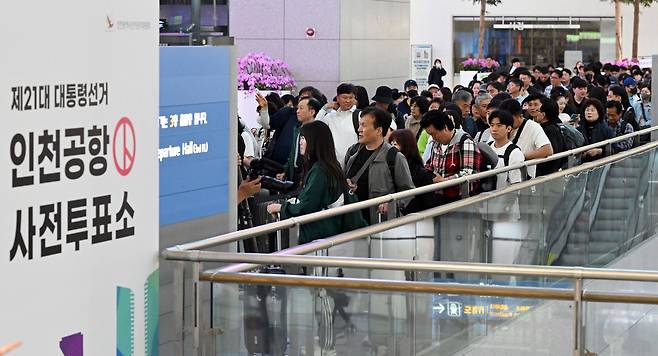
Two days of early voting for South Korea's next president kicked off, as millions of people — along with the presidential candidates themselves — cast their votes Thursday, with advance voting turnout numbers projected to be higher than in any previous election.
According to the National Election Commission, voter turnout on the first day of voting came to 19.68 percent Thursday, with 3,568 polling stations having opened nationwide at 6 a.m. and closed at 6 p.m. Thursday. It was the highest first-day figure out of all elections since South Korea's introduction of early voting for presidential elections in 2014.
This means about 8.69 million people out of 44.4 million eligible voters nationwide chose to go to a polling station on the first day of early voting, instead of Election Day on Tuesday next week.
By region, the southwestern region of the North and South Jeolla provinces and Gwangju — the main liberal stronghold — showed the highest turnout.
Early voting turnout for the last presidential election in 2022 amounted to 36.9 percent, up by more than 10 percentage points from the 2017 election.
Politicians, including presidential candidates, took part in early voting Thursday and encouraged others to cast their votes as well.
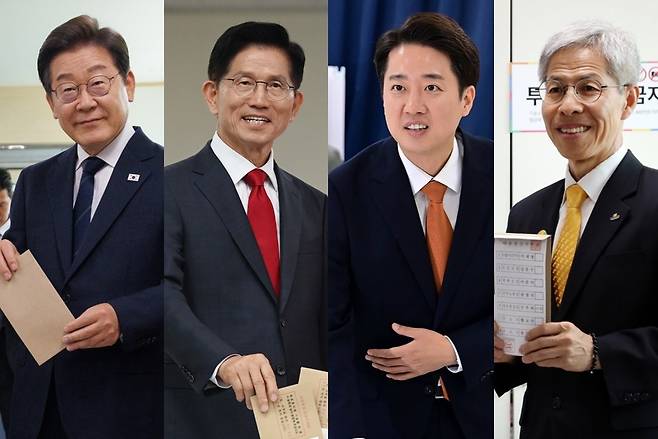
The Democratic Party of Korea's Rep. Lee Jae-myung, the clear front-runner in the race, cast his vote Thursday in the Sinchon-dong neighborhood of Seodaemun-gu, western Seoul. Lee voted alongside voters in their early 20s, according to the main liberal party. Lee's wife Kim Hye-kyung did not accompany him, as she voted separately in Busan.
Lee, 60, who has polled far ahead of the five other candidates, expressed the hope that the June election could make South Korea "return to the era of the young generation," while emphasizing people's participation in voting could help "overcome the crisis due to an insurrection," as he met with reporters after voting.
Kim Moon-soo, presidential candidate of the major conservative People Power Party, went to the polling station with his daughter in Gyeyang-gu, Incheon — the constituency of his main rival, Rep. Lee Jae-myung. After voting, Kim, 73, expressed confidence in a come-from-behind victory, despite significantly lagging Lee in polls throughout the campaigning period.
Rep. Lee Jun-seok of the minor conservative New Reform Party visited his home turf of the Dongtan neighborhood, a residential area in Hwaseong, Gyeonggi Province. He represents the Hwaseong-B constituency, which he won in a surprise upset that defied the polls in the 2024 general election. Lee, 40, said he envisioned a "generational transition" in South Korean politics.
Kwon Young-gook, 61, the candidate of the progressive Democratic Labor Party, voted in Yeosu, South Jeolla Province. There he raised concerns about the climate crisis and called for a broad shift to low-carbon production. Yeosu is home to an industrial complex dedicated to petrochemicals and steel.
Alongside the top four presidential candidates, acting President and Education Minister Lee Ju-ho also went to a polling station in Jongno-gu, Seoul, Thursday morning.
Lee has served as the acting president since May 2. Those ahead of Lee in the line of presidential succession, former Prime Minister Han Duck-soo and former Finance Minister Choi Sang-mok, resigned amid the ongoing political crisis after former President Yoon Suk Yeol was formally ousted in April for his brief imposition of martial law in December.
Also joining the wave of early in-person voting were former Presidents Moon Jae-in and Park Geun-hye.
Casting his vote with his wife in Yangsan, South Gyeongsang Province, Moon told reporters that people "should remember why the early election came into being," adding they must hold his successor Yoon accountable for "failure in handling state affairs and his acts of insurrection." Moon was the liberal leader of the country from 2017 to 2022
Park, who was also impeached and removed in 2017 due to a broad corruption scandal, cast her vote in Daegu near her residence. Park urged more people to vote as she met with reporters, downplaying concerns of election rigging in early voting. However, she declined to comment on the conservative candidates' failure to unite ahead of the election.
Voting in the June 3 election kicked off with overseas voting earlier in May, as election authorities' preliminary data showed that eligible turnout approached 80 percent, with 205,268 people having already voted overseas.
For the 2022 election, total voter turnout amounted to 77.1 percent.
Copyright © 코리아헤럴드. 무단전재 및 재배포 금지.