BOK cuts base rate by 25 basis points to 2.50%
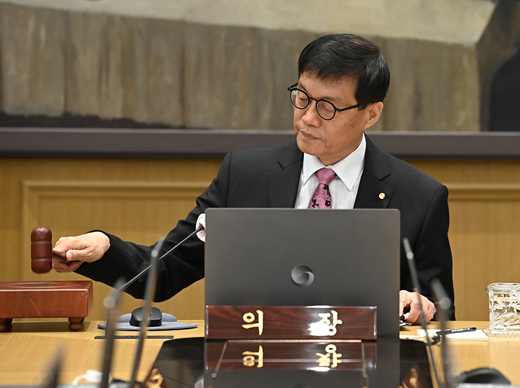
The Bank of Korea (BOK) reduced the base rate from 2.75 percent to 2.50 percent per annum during a Monetary Policy Board meeting on Thursday, its fourth rate cut in the seven months since October 2024.
The rate cut is viewed as a response to the weakening domestic economy, with private consumption and construction investment already dragging down the country’s real gross domestic product (GDP) growth in the first quarter of 2025.
Amid growing export uncertainties stemming from U.S. tariff measures, experts noted that the central bank judged that lowering interest rates could help revive domestic consumption and investment.
However, some experts warned that without sufficient fiscal policy measures, such as a supplementary budget, continued rate cuts alone could have a negligible impact on economic stimulus and fuel a surge in housing prices and household debt instead.
The interest rate gap with the United States (4.25 to 4.50 percent), which has widened to 2.00 percentage points, also raises concerns about currency depreciation and capital outflows.
The BOK first shifted toward a monetary easing in October 2024 with a 0.25 percentage point cut and unexpectedly followed with another cut the following month - the first back-to-back cuts since the 2008 global financial crisis.
After a pause in January 2025, the bank resumed easing in February with another 0.25 percentage point cut but held rates steady in April amid heightened volatility in the won/dollar exchange rate despite the weak fourth quarter growth (0.1 percent) and tariff-related risks.
However, with the shocking 0.2 percent contraction in the first quarter 2025 GDP now confirmed, experts agree that there is no room for further hesitation on rate cuts.
Cho Young-moo, a research fellow at LG Economic Research Institute, noted before the Monetary Policy Board meeting that “economic indicators are worse than expected, leading multiple institutions to revise down their growth forecasts for Korea in 2025. In this environment, the BOK has little choice but to cut rates.”
The Hyundai Research Institute slashed its 2025 growth forecast by a full percentage point from 1.7 percent to 0.7 percent earlier in May 2025. The Korea Development Institute (KDI), a state-run research institute, also halved its outlook from 1.6 percent to 0.8 percent. The average forecast by eight major global investment banks for Korea’s 2025 growth was just 0.8 percent as of late April.
The BOK also revised its own growth projection down from 1.5 percent to 0.8 percent - a 0.7 percentage point drop in just three months. With the won/dollar exchange rate recently stabilizing in the 1,300s, experts also noted that one of the key hurdles to rate cuts has also diminished.
The exchange rate surged to a post-financial-crisis high of 1,487.6 won during the second week of April 2025 following the U.S.’ retaliatory tariff announcement but fell to 1,360.4 won on Monday as the dollar weakened amid U.S. policy uncertainty and fiscal deficit concerns.
However, continuous rate cuts could fuel speculation in housing markets and reignite household debt concerns.
“After land transaction restrictions were lifted and expectations of a real estate rebounding under a new administration, housing prices and household debt could become unstable again even if some stabilization occurs in the second half of the year,” Nomura Securities Co. economist Park Jung-woo warned.
Household loans at Korea’s five major banks (KB Kookmin, Shinhan, Hana, Woori, and NH Nonghyup) totaled 746.49 trillion won ($539.93 billion) as of May 22nd, 2025, up 3.41 trillion from the end of April. This is a faster pace of growth than the 4.53 trillion won increase seen the previous month.
Park also pointed to the growing rate differential with the United States as a concern. Given that the won is not a key reserve currency like the dollar, a significantly lower interest rate could prompt foreign capital to exit in search of higher yields, weakening the won, he noted.
Critics also argue that monetary policy alone has limits in reviving the economy.
“The rate cut will not be entirely ineffective, but its impact will be limited,” Cho of LG Economic Research Institute said. “Lending conditions and attitudes among financial institutions are still tight, so a lower rate may not even lead to more borrowing by households or businesses.”
“The focus of economic response has already shifted from monetary easing to fiscal policy, such as supplementary budgets, since earlier in 2025,” he added.
Nevertheless, both market participants and experts expect the BOK to prioritize escaping from sub-1 percent growth and deliver one or two more rate cuts in the second half of 2025 despite the risks and limitations.
Copyright © 매일경제 & mk.co.kr. 무단 전재, 재배포 및 AI학습 이용 금지
- “문수 오늘 잘한다”…논란 일으킨 KBS 댓글, 정체 알고보니 - 매일경제
- 오늘의 운세 2025년 5월 29일 木(음력 5월 3일) - 매일경제
- “정말 부럽다, 이런 부부”…국민연금 통장에 다달이 543만원씩 꽂힌다 - 매일경제
- “형편 어려운 학생들에게 써주길”…현금다발 들고 와 기부한 어르신 - 매일경제
- 이재명, 4100만원 투자한 주식 계좌 공개 “확실히 밀어드리겠다” - 매일경제
- ‘대선 닷새 앞두고’ 한은, 기준금리 0.25%p 인하…2.50% - 매일경제
- [단독] “전월세 급등 안돼”...1기 신도시 이주대란 우려땐 정부가 돈줄 죈다 - 매일경제
- “어떡하냐 문수야” 조롱했던 이수정...이번엔 “이재명, 온 집안이 남성불구” 가짜뉴스 - 매
- 주담대 10억까지 “마통은 3배로”…7월 규제강화 앞두고 대출영업 과열 - 매일경제
- “프로면 투자해야지” 정몽진 회장의 한마디, 허훈의 KCC行으로 이어졌다…허재·허웅의 지원