S. Korean crane makers eye U.S. market as tariffs target Chinese rivals
이 글자크기로 변경됩니다.
(예시) 가장 빠른 뉴스가 있고 다양한 정보, 쌍방향 소통이 숨쉬는 다음뉴스를 만나보세요. 다음뉴스는 국내외 주요이슈와 실시간 속보, 문화생활 및 다양한 분야의 뉴스를 입체적으로 전달하고 있습니다.
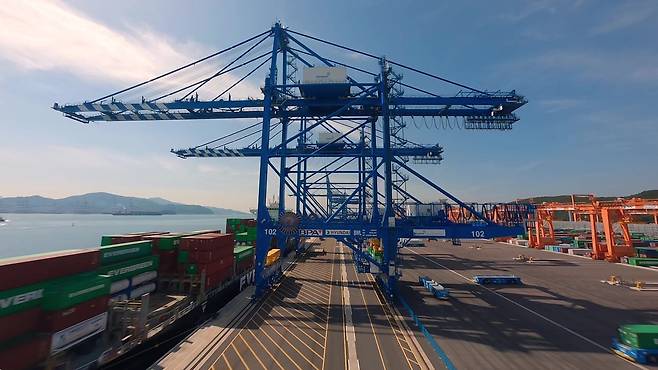
South Korean crane manufacturers—including HD Hyundai Samho, Doosan Enerbility, and HJ Shipbuilding & Construction—are exploring new opportunities in the United States as Washington grows increasingly wary of Chinese-made port cranes, citing them as potential national security threats.
Port cranes, the towering machines used to load and unload containers and other cargo at harbors, often come equipped with advanced surveillance features such as closed-circuit TV cameras.
These systems allow real-time monitoring of vessel arrivals and departures, as well as the tracking of cargo information. U.S. officials have expressed concern that such capabilities could be used to collect sensitive data—including information on military shipments—and transmit it to China.
The sense of urgency has grown in recent months. On May 28, industry sources said the Office of the United States Trade Representative (USTR) is reviewing a proposal to raise tariffs on Chinese-made port cranes from the current 25% to 100%. A public hearing was held on Apr. 17, and public comments were accepted through May 19.
This review follows longstanding U.S. government warnings that Chinese cranes could compromise national security.
Currently, about 80% of cranes operating at American ports are produced by Shanghai Zhenhua Heavy Industries (ZPMC), a Chinese manufacturer that dominates the market with competitively priced equipment.
Last year, former U.S. President Joe Biden announced a plan to invest $20 billion over five years to replace all foreign-made port cranes operating in the country.
However, implementation has been slow, largely due to high replacement costs and the reluctance to scrap cranes that have not yet reached the end of their service lives.
Under the current Trump administration, the U.S. took a more aggressive stance—aiming to stop imports of Chinese cranes altogether by imposing steep tariffs and undercutting their price advantage.
Chinese-made cranes have established a firm foothold in the global market by offering technology comparable to that of international competitors at prices 10–20% lower. Their widespread adoption has also led to a perception of superior after-sales service.
Outside of China, the remaining 20% of the global market is divided among companies such as Germany’s Liebherr, Japan’s Mitsui, and S. Korea’s HD Hyundai Samho.
Despite their limited market share, S. Korean manufacturers are keeping a close watch on the shifting landscape. With growing barriers facing Chinese exports, they believe the U.S. market could open up within the next few years.
At present, HD Hyundai Samho, Doosan Enerbility, and HJ Shipbuilding & Construction are the only S. Korean firms producing port cranes. However, since completing a contract for cranes at the Busan New Port, they have not pursued new orders aggressively.
Some expect that new procurement opportunities could arise around 2026, when cranes will be needed for a terminal under development in Geoje.
Should the U.S. impose higher tariffs on Chinese cranes, S. Korean firms may be well positioned to fill the gap.
On May 16, HD Hyundai Executive Vice Chairman Chung Ki-sun reportedly met with USTR representative Jamieson Greer to showcase the company’s crane manufacturing capabilities.
HJ Shipbuilding & Construction is preparing for a long-term entry into the U.S. market, while Doosan Enerbility is considering making a move if the right business opportunity presents itself.
Copyright © 조선일보. 무단전재 및 재배포 금지.
- [팔면봉] 북한 9차 당대회, 김정은 3대 체제 떠받치던 ‘혁명 2세대’ 퇴장하고 신진 대거 수혈.
- [사설] “현지 누나” 김남국 與 대변인으로, 제어 장치 아예 없나
- [한삼희의 환경칼럼] 세계 동시 출생률 급락 뒤에 스마트폰이 있다
- [우정아의 아트 스토리] [620] 스케이트를 탄 변호사
- [에스프레소] 국민의힘 ‘청년·여성 마케팅’은 빈껍데기
- [김국현의 과학기술 유행어 도감] [4] 프롬 스크래치(From scratch)
- [전문기자의 窓] 지귀연 판사는 진보인가 보수인가
- [기고] 노인·장애인·아동 돌봄 비용, 지출 아니라 전략적 투자다
- [신문 속 작은 창문] [10] 올림픽이 끝나고 나면
- [윤희영의 News English] 외국인들도 울컥하게 하는 한국식 표현