Could glass help Samsung crack next semiconductor conundrum?
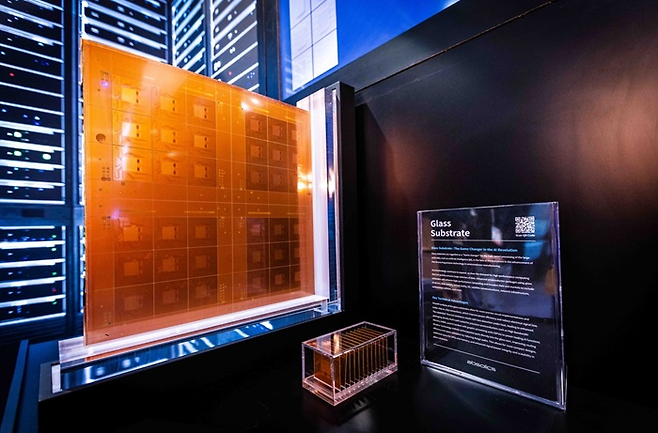
Glass substrates, long viewed as a promising next-generation component in advanced chip packaging, are now nearing real-world deployment, as Samsung Electronics signals a transition away from conventional silicon interposers.
According to industry sources Wednesday, Samsung plans to adopt glass substrate interposers for its advanced semiconductors by 2028 to “meet customer demands.” While the company neither confirmed nor denied the development, it stated, “We are investing in (research and development) and preparing in line with industry trends.”
In semiconductor manufacturing, interposers are critical in advanced packaging technologies. They connect high-bandwidth memory (HBM) chips with graphics processing units (GPUs) or other logic chips, enabling faster data transfer and improved overall performance.
Although chipmakers have traditionally relied on silicon substrates for their manufacturing maturity and compatibility, they are increasingly exploring glass as a high-performance alternative that offers improved energy efficiency.
“If glass substrates are successfully adopted, they could become a very attractive material,” said a chip materials professor on condition of anonymity. “But there are still significant hurdles to clear before they can be commercialized.”
Glass core substrates are widely seen as a potential game changer in the semiconductor landscape. They serve as thin, rigid platforms that allow for side-by-side mounting of logic and memory chips, forming the foundation of high-performance computing systems.
Their advantages are substantial: exceptional heat resistance, ultra-flat surfaces for greater chip density and finer patterning capabilities.
According to SKC, the parent company of glass substrate maker Absolics, the material can improve chip processing speeds by up to 40 percent and reduce power consumption by more than 40 percent compared to traditional silicon substrates.
Despite these benefits, commercialization has been slow, primarily due to the brittleness of glass and the high-precision demands of the manufacturing process.
Nevertheless, leading chipmakers — including Samsung, Intel, AMD, Broadcom and Nvidia — are actively exploring the adoption of glass substrates in their next-generation chip products.
“Competition in the chip market is intensifying, and players are constantly seeking breakthroughs to set themselves apart,” said Lee Byung-hun, professor of electrical engineering at Pohang University of Science and Technology. “It’s encouraging that Samsung continues to pursue differentiation to strengthen its competitive edge.”
Amid growing momentum, the global glass substrate market is projected to grow from $7.2 billion in 2024 to $10.3 billion by 2034, according to market tracker Global Market Insight.
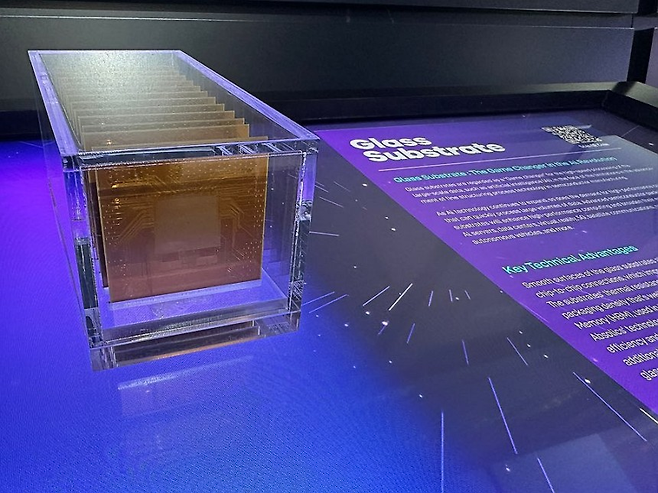
The first company expected to commercialize glass core substrates is Absolics, a semiconductor materials subsidiary of SKC. The firm has already begun prototype production at its Georgia, US facility, which boasts an annual capacity of 12,000 square meters.
Absolics is currently undergoing product qualification with clients and aims to complete preparations for mass production within this year.
Its Georgia plant, completed in the first half of last year, made Absolics the first Korean firm to receive $40 million in subsidies under the US CHIPS and Science Act — part of a broader $75 million support package from the US government.
Samsung Electro-Mechanics, which announced its entry into the glass substrate market last year, aims to produce its first prototype by the second quarter of this year. It has reportedly begun operating a pilot line at its Sejong plant.
LG Innotek is also preparing to enter the space, building a pilot line at its Gumi plant and planning to begin prototype production by year-end. As a latecomer, the company aims to differentiate itself through a strategic partnership with a “major North American client,” according to its CEO.
While companies are racing to develop prototypes in 2024, experts caution that the timeline for full commercialization remains uncertain.
“Company activities are largely driven by client interest, but that does not necessarily guarantee immediate deployment,” said another professor specializing in glass core technologies, also requesting anonymity. “Absolics, for instance, announced more than a year ago that it had begun product qualification with clients, but no results have been disclosed to date.”
“Glass substrates clearly offer compelling advantages,” the professor added. “But so do their limitations, especially in terms of long-term reliability. Their use will depend heavily on specific applications, and competing materials remain in play. So while the potential is there, it’s still too early to speak with certainty.”
Copyright © 코리아헤럴드. 무단전재 및 재배포 금지.