From mussels to hair: How a KAIST scientist turned polyphenol into a global shampoo hit
전체 맥락을 이해하기 위해서는 본문 보기를 권장합니다.
"Despite differences in hair types, Grabity proved to be effective."
"In our clinical study with patients diagnosed with hair loss, daily hair shedding dropped by up to 90 percent, with some seeing results in just two weeks," Lee said. "Someone losing 100 strands a day saw that fall to around 30."
이 글자크기로 변경됩니다.
(예시) 가장 빠른 뉴스가 있고 다양한 정보, 쌍방향 소통이 숨쉬는 다음뉴스를 만나보세요. 다음뉴스는 국내외 주요이슈와 실시간 속보, 문화생활 및 다양한 분야의 뉴스를 입체적으로 전달하고 있습니다.
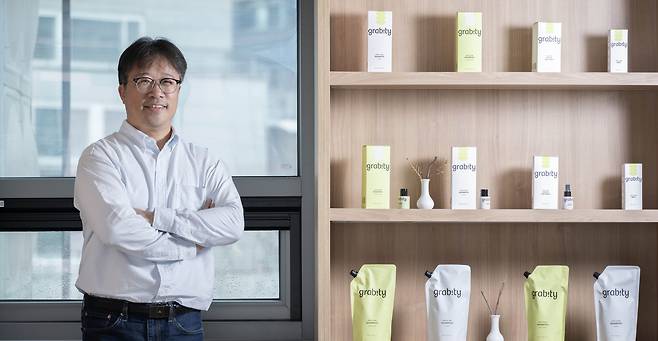
It all started with mussels. How do they cling so tightly to rocks underwater without hands? The answer lies in polyphenol — a transparent, adhesive substance they secrete. Inspired by this natural phenomenon, Lee Hae-shin, a leading chemical engineering professor at the Korea Advanced Institute of Science and Technology, developed Grabity shampoo — a runaway hit that grips hair the way mussels cling to rocks.
Since its launch in April last year, over 1.2 million units have been sold, with sales of 20 billion won ($14.6 million).
The shampoo has demonstrated a remarkable ability to reduce hair loss by up to 70 percent — and by as much as 90 percent among patients clinically diagnosed with hair loss — making it a breakout success for Lee’s startup, Polyphenol Factory.
Born in a science lab, the shampoo is now setting its sights on global expansion, with its proven effectiveness aimed at tapping into the billion-dollar hair loss treatment industry.
“We’re just a little over a year old as a brand, and the popularity we gained in Korea gave us the confidence to go abroad,” Lee said in an interview with The Korea Herald on May 16, the day he returned to Seoul from Paris, where his company showcased Grabity at Foire de Paris 2025, one of Europe's largest consumer trade fairs.
“But we didn’t expect to receive such an overwhelming response from people of different nationalities and ethnicities, since the product was originally developed with Korean consumers in mind.”

At Foire de Paris 2025, Polyphenol Factory's booth drew about 10,000 visitors on the first day alone, with all 5,000 units of Grabity shampoo selling out. An additional 5,000 units brought in by the company quickly sold out as well.
“I had never tested or sold our product to what you’d call a Western demographic, but I found that people were genuinely interested,” Lee said, noting that one visitor even returned the next day with a friend after trying the product.
“Despite differences in hair types, Grabity proved to be effective.”
Grabity received similarly enthusiastic responses during its US debut at CES 2025, the world’s largest annual tech and consumer trade show held in January in Las Vegas.
Grabity shampoo and treatment products are currently available on Amazon, but Lee is preparing for an official launch in the US and other major markets. Polyphenol Factory has partnered with Lotte Home Shopping to expand into several European countries as well as Japan and Taiwan.
The key ingredient that helps Grabity hold hair in place is polyphenol, a natural compound commonly found in plants.
“The adhesive has to withstand exposure to water during shampooing, and polyphenol is a great substance that has this capability,” Lee explained.
While shedding 50 to 70 hairs per day is normal for a healthy scalp, individuals experiencing hair loss may shed over 100 strands daily. As hair strands become thinner and narrower than the pores they grow from, they loosen and more easily fall out. Grabity’s formula addresses this by filling that gap — the polyphenols form bonds between the hair strand and the pore wall, acting as a natural adhesive to hold hair in place.
“In our clinical study with patients diagnosed with hair loss, daily hair shedding dropped by up to 90 percent, with some seeing results in just two weeks,” Lee said. “Someone losing 100 strands a day saw that fall to around 30.”
In 2023, Lee registered his lab as a faculty-led startup at KAIST, where the ingredients were specially processed into a high-adhesion form. The resulting technology was patented under the name LiftMax 380.
This processed polyphenol sets Grabity apart from many other shampoo products on the market that claim to use the compound. According to Lee, most products simply add polyphenol extracts into a conventional shampoo base.
“It’s more like turning soybeans into tofu,” he explained. “You’re not just adding a raw ingredient — you’re changing its form and function.”
For Grabity, Lee’s lab uses extracts from walnut shells.
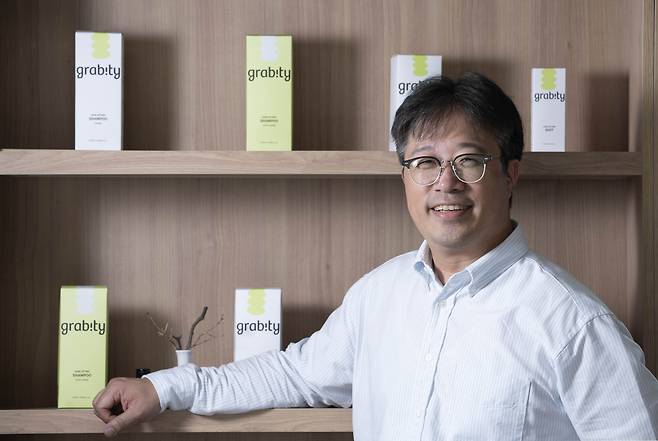
Lee's work with polyphenol dates back to his postdoctoral research at the Massachusetts Institute of Technology, where he studied how the compound could be used to deliver anti-inflammatory drugs directly to the walls of blood vessels — helping prevent arterial narrowing, a key factor in conditions like arteriosclerosis and cerebral infarction.
“To prevent blood vessels from narrowing and becoming blocked, the anti-inflammatory drug needs to be delivered precisely to the affected vessel. But it was always challenging because blood flows at an incredibly fast speed — faster than cars on a highway,” Lee said.
“Polyphenols have made this targeted delivery possible.”
He published his research and transferred the technology to a Japanese company. Learning that polyphenols bond well to blood due to its high plasma protein content, Lee was inspired to develop his next invention: a hemostatic agent.
“When I thought about what might work outside the body, hair came to mind easily, because it’s made of keratin — a protein,” he said.
Grabity’s production remains limited, as the LiftMax 380 solution is mixed in-house by a 15-member team, including seven core researchers, before being manufactured by a partner factory.
With demand surging — and resale prices on secondhand platforms reaching up to seven times the original price when the product sells out — Polyphenol Factory is planning to expand its production capacity. Still, Lee is clear that scaling up the company is not his ultimate goal.
“We often talk about ‘innovation in the everyday,’” Lee said. “Polyphenols can be used in highly technical applications, but I wanted to create products that people can actually feel and use in their daily lives — something accessible, not just advanced.”
New products using the same nature-driven material are already in the pipeline, including nail and eyelash adhesives, and even a solution for hair implantation.
His research has shown that polyphenol-based adhesives can effectively implant hair without follicles. While the implanted hair does not grow, it can visibly fill in thinning areas — a solution Lee believes could be especially helpful for women experiencing small, patchy hair loss.
“We’re not a cosmetics company. We’re a tech company,” he said, emphasizing his role as a researcher.
Lee, now an endowed chair in KAIST’s department of chemistry, in his career has authored 237 papers and holds 68 technology patents.
“If there’s no clear scientific foundation behind what we offer, we won’t expand product lines just for the sake of it. We don’t do concept-only products. That’s our guiding principle.”
The Top 100 Global Innovators series spotlights the trailblazers shaping Korea’s future across a range of industries — from bold entrepreneurs and tech pioneers to research leaders — whose innovations are making a global impact beyond Korea. More than a celebration of success, the series offers a deeper exploration of the ideas, breakthroughs and strategies driving their achievements. — Ed.
Copyright © 코리아헤럴드. 무단전재 및 재배포 금지.