S. Korean defense SMEs target Southeast Asia at LIMA 2025
By Hwang Joo-young and Joint Press Corps
LANGKAWI, Malaysia — A group of small and mid-sized South Korean defense and technology firms participated in Southeast Asia’s largest defense exhibition, LIMA 2025 as part of the Korea Pavilion organized by the Korea Defense Industry Association.
While not as high-profile as companies specializing in full-scale platforms or missile systems, these firms are making their pitch to expand from a domestic customer base into export markets, offering niche, narrative-driven solutions.
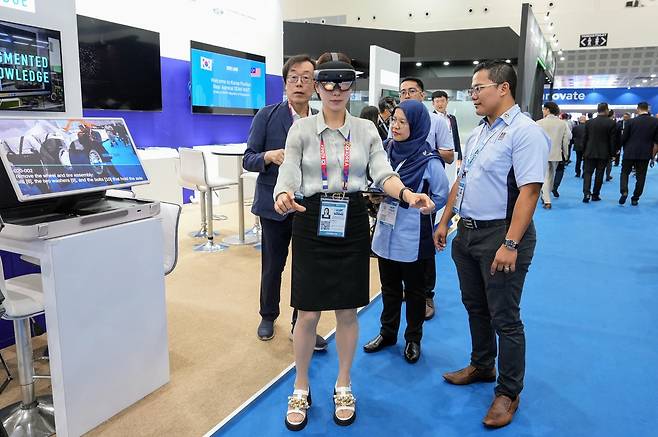
Augmented Knowledge, a company specializing in immersive training technology, showcased a mixed-reality simulation for aircraft maintenance. When a visitor put on the headset, a virtual 3D model of a Boeing 737's landing gear appeared, accompanied by on-screen instructions and voice prompts guiding the user through the steps needed to take it apart. Saying “next page” moved the simulation onto the next step.
The system is powered by an artificial intelligence engine trained on hundreds of thousands of pages from aircraft maintenance manuals.
“It can even be used on the actual aircraft during maintenance,” said Jo Geun-sik, CEO of Augmented Knowledge. “It cuts task time in half.”
Jo added that the company was preparing to enter Southeast Asia’s aviation training and maintenance, repair and overhaul, or MRO, markets, beginning with Malaysia.
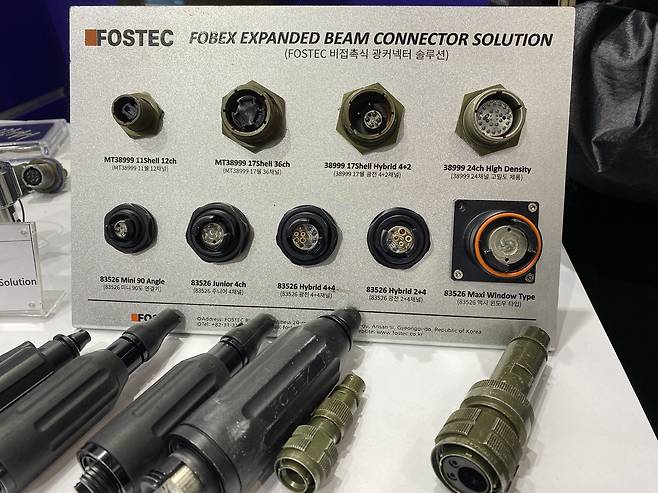
Another participant, Fostec, specializes in optical fiber connectors used in missile defense systems that link launchers, radar and command centers. The company aims to position itself as a cost-effective alternative to dominant US and European suppliers.
“Our products cost about 70 percent of what American and European firms charge, and we can deliver in less than a third of the time,” a Fostec official said. The company’s connectors are already used aboard South Korea’s Ulsan-class frigates and are slated for installation in its next-generation destroyers.
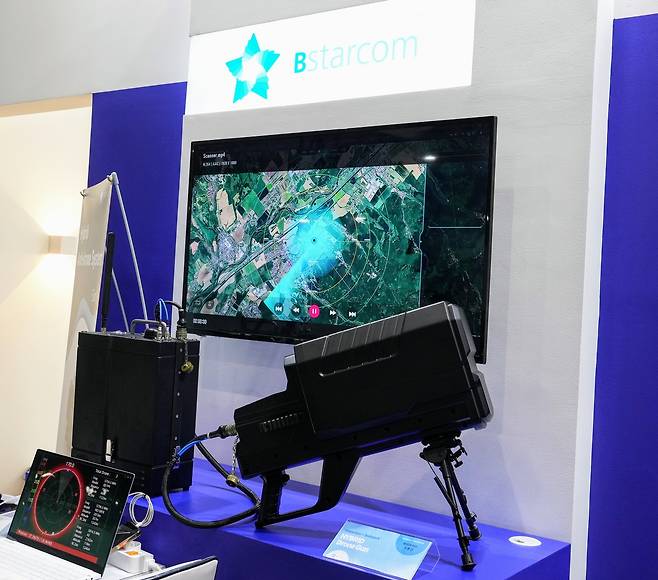
At the booth of Bstarcom, Malaysian and Indonesian military officers examined a backpack-style anti-drone weapon called the Hybrid Drone Gun, inquiring about its weight and operational range.
The system integrates detection, jamming and spoofing capabilities to not only block a drone’s signal but also redirect it using false GPS data.
“Some customers are price-sensitive, while others prioritize performance,” said a company manager. “But all of them share the same concern: the need to protect critical infrastructure from drone threats.”
This year, 12 South Korean defense and technology firms participated in the Malaysia-based exhibition, ranging from smaller firms including Bstarcom, Augmented Knowledge, Fostec and Fine Precision Industry to major players such as Korea Aerospace Industries, LIG Nex1 and HD Hyundai Heavy Industries.
Government-affiliated institutions also took part, including the Korea Research Institute for Defense Technology Planning and Advancement, and the Defense Acquisition Program Administration.
Copyright © 코리아헤럴드. 무단전재 및 재배포 금지.