Google’s YouTube Music deal avoids sanctions, shakes S. Korean streaming market
이 글자크기로 변경됩니다.
(예시) 가장 빠른 뉴스가 있고 다양한 정보, 쌍방향 소통이 숨쉬는 다음뉴스를 만나보세요. 다음뉴스는 국내외 주요이슈와 실시간 속보, 문화생활 및 다양한 분야의 뉴스를 입체적으로 전달하고 있습니다.
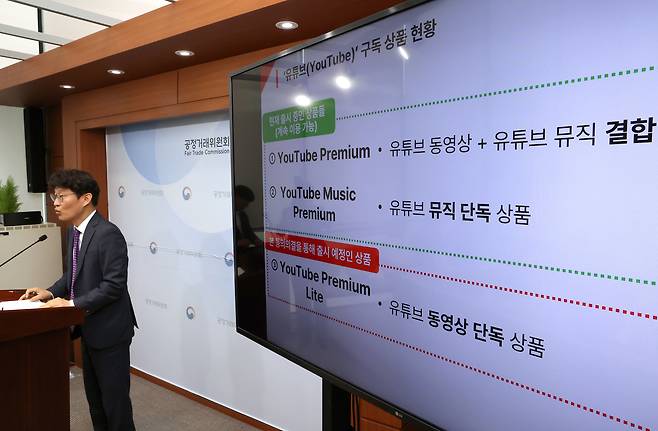
South Korea’s Fair Trade Commission said on May 22 that it has decided to initiate consent decree proceedings in a case involving Google’s alleged bundling of YouTube Music with its ad-free YouTube Premium service.
A consent decree is a legal mechanism that allows an antitrust investigation to be swiftly closed without imposing penalties such as fines, provided that the company under scrutiny proposes corrective measures deemed appropriate by the commission.
Google introduced YouTube Premium in 2018, offering ad-free video streaming bundled with YouTube Music. The move quickly reshaped the South Korean music streaming market, allowing the U.S. tech giant to overtake long-standing domestic leaders such as Melon and Genie Music. In February 2023, the Fair Trade Commission launched a probe into Google’s practices, citing concerns that the bundling may have restricted consumer choice and constituted coercive sales tactics.
After more than two years of investigation, the commission has now opted for a negotiated resolution rather than formal sanctions.
That decision has drawn criticism in some quarters. Observers point out that the United States has consistently pushed back against overseas regulations targeting American tech firms like Google and Microsoft. Under former President Donald Trump, the U.S. government had warned it would treat such measures as non-tariff barriers and respond with retaliatory tariffs. Against this backdrop, critics say the commission may have chosen the easier path to avoid trade friction.
An official from South Korea’s music industry echoed that sentiment, saying the regulator had long overlooked Google’s growing grip on the domestic market and was now effectively granting the company immunity.
The controversy began in earnest in June 2018, when Google Korea launched YouTube Premium in South Korea. The service, which combined ad-free video streaming with YouTube Music, immediately disrupted the existing market. Local platforms—some of which had been operating for more than a decade—saw their market shares erode rapidly. Melon, for instance, had launched in 2004, followed by Genie Music in 2011.
According to mobile analytics firm WiseApp Retail, YouTube Music recorded 9.79 million monthly active users last month—far outpacing Melon’s 6.01 million, Genie Music’s 2.60 million, and Flo’s 1.76 million. Just two years ago in 2021, YouTube Music trailed Melon, with 4.03 million users compared to Melon’s 6.89 million. However, the surge in YouTube Premium subscriptions has helped YouTube Music overtake its rivals, claiming the top spot by 2023.
Faced with mounting pressure from local competitors, Google submitted a consent decree application in April. The commission accepted the proposal within a month—a relatively swift decision that reflects growing concern about the need to protect domestic platforms from further harm.
“Compared to traditional sanctions, a consent decree enables us to implement corrective measures more quickly, without the need for protracted legal battles,” said Kim Moon-sik, director of market surveillance at the Fair Trade Commission. He added that had the commission pursued penalties, the resulting litigation could have dragged on for years—potentially allowing YouTube Music to tighten its market grip and drive out more domestic players in the meantime.
To address the issue, Google proposed several remedies. Among them was the launch of a new subscription tier—YouTube Premium Lite—that would exclude YouTube Music and offer only ad-free video viewing at a lower price. This plan is already available in countries such as the United States, Thailand and Mexico.
In the U.S., YouTube Premium currently costs $13.99 per month, while the Lite version is priced at $7.99—a roughly 43% discount. In South Korea, the standard plan is priced at 14,900 won, or about $10.92.
Google also pledged to establish a 30 billion won (approximately $22 million) fund to support the local music industry and artists. In exchange, the company would not face any fines or further sanctions.
Despite these measures, many in the domestic music sector remain unsatisfied. They argue that the commission not only failed to stop Google’s rise in the market but is now effectively legitimizing it. Even if a cheaper, music-free subscription is introduced, they say, YouTube Music has already cemented its dominance—and reversing that trend will be difficult.
Copyright © 조선일보. 무단전재 및 재배포 금지.
- 10살 딸 성추행 영상 찍고 판매한 日아빠…사간 사람은 초등교사
- KB 박지수, 두 라운드 연속 MVP...통산 20번째
- “행사장 삐에로냐” 14㎝ 통굽은 기본…아이돌 공연 필수템 ‘스탠딩화’ 논란
- 이학재 인천공항 사장 사의 표명
- 李대통령, 룰라 브라질 대통령과 오늘 ‘청와대 치맥 회동’
- 당정 “모든 기업 퇴직연금 의무화 연내 입법, ‘노란봉투법’은 내달 시행
- 李대통령 변호인 이력 논란 황수림 국힘 공관위원 자진 사의
- 부산 자동차 부품공장 화재... 12시간 만에 진화, 소방관 1명 부상
- 인사 청탁 문자 논란 김남국, 민주당 대변인 임명
- 매일 새벽 수매한 여수 갈치, 가시 완벽 제거해 집까지 배송