'Silence is dangerous. We must keep chatting': bilingual novelist Yoko Tawada
전체 맥락을 이해하기 위해서는 본문 보기를 권장합니다.
"I've heard predictions that AI translations will decline in quality year by year," Tawada said at a press conference in Seoul on Monday. "Since these systems learn from the sentences produced by a wide range of anonymous translators, the proportion of poorly constructed sentences will inevitably increase. In the long term, I don't think it will succeed."
She continued, "Hiruko is deeply lonely at first, having no one left to speak her native language with. But on her journey, she meets a variety of people, and comes to realize that friendship can blossom even if their languages only partially overlap, or are mixed in unconventional ways."
이 글자크기로 변경됩니다.
(예시) 가장 빠른 뉴스가 있고 다양한 정보, 쌍방향 소통이 숨쉬는 다음뉴스를 만나보세요. 다음뉴스는 국내외 주요이슈와 실시간 속보, 문화생활 및 다양한 분야의 뉴스를 입체적으로 전달하고 있습니다.
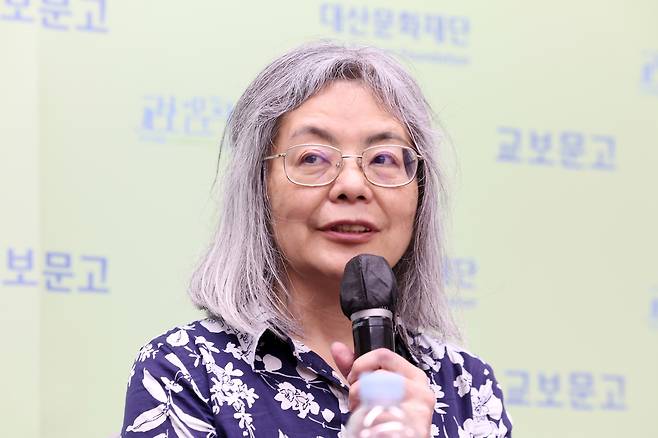
Yoko Tawada, a celebrated novelist who writes in both Japanese and German, is skeptical about the use of artificial intelligence in literary translation.
“I’ve heard predictions that AI translations will decline in quality year by year,” Tawada said at a press conference in Seoul on Monday. “Since these systems learn from the sentences produced by a wide range of anonymous translators, the proportion of poorly constructed sentences will inevitably increase. In the long term, I don’t think it will succeed.”
The 65-year-old Japanese author is in Seoul to attend events hosted by the Daesan Foundation. Her works have been introduced in over 30 countries but she said Korea has published the highest number of her works.
“I’m curious what would happen if an AI were trained solely on translations produced by a single exceptional translator. It’s something I’d like to experiment with. But I’m not comfortable with an AI that’s trained on sentences by an unspecified crowd translating my work," Tawada added.
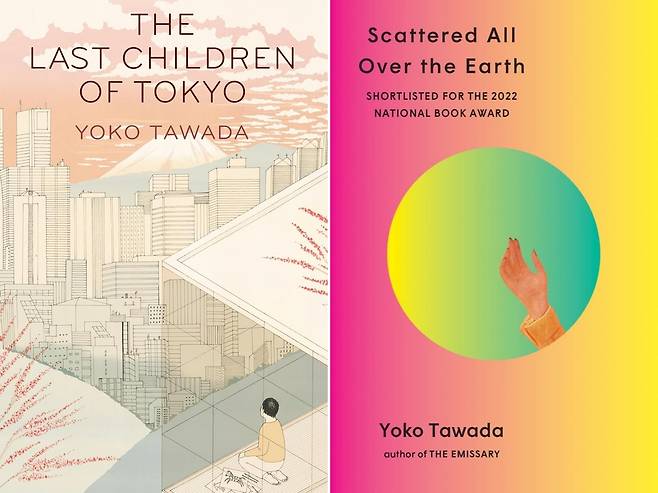
It is not easy to gain recognition in even one language, but Tawada is widely acclaimed in both Germany and Japan for her literary achievements in both, having won numerous literary awards. The English edition of "The Last Children of Tokyo" won the National Book Award for Translated Literature in the US in 2018.
While literary scholars might categorize writers who publish in two languages as “bilingual authors,” Tawada describes her literary practice as “exophony” -- a term that denotes writing outside one’s native language.
Tawada's Hiruko Trilogy embodies this linguistic philosophy. The trilogy follows Hiruko, a woman studying abroad whose home country has vanished. She embarks on a journey to find others who speak her language and, along the way, begins to invent a language of her own.
“It's natural to feel fear or anxiety when stepping outside the bounds of one’s native language,” Tawada said. “But in the end, I wanted to highlight that doing so can actually expand the possibilities of one’s life -- and increase the chances of meeting new friends.”
She continued, “Hiruko is deeply lonely at first, having no one left to speak her native language with. But on her journey, she meets a variety of people, and comes to realize that friendship can blossom even if their languages only partially overlap, or are mixed in unconventional ways.”
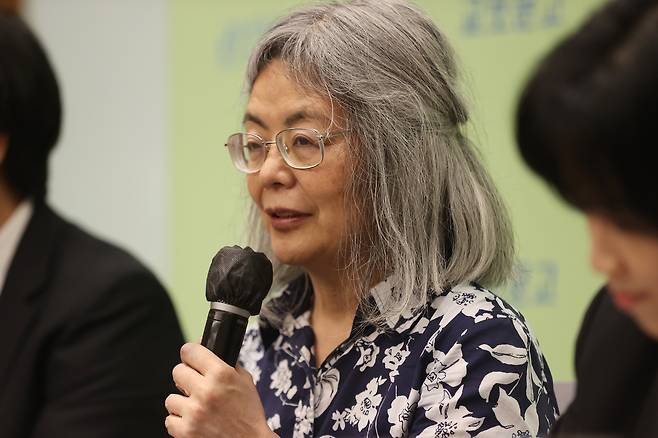
Another hallmark of Tawada’s work is its persistent use of humor and loquacious characters -- even in bleak, apocalyptic settings.
“In Japan, I’ve heard that students started avoiding political discussions 10 or 20 years ago because they feared creating an awkward atmosphere,” she noted. “In Germany, by contrast, people from diverse backgrounds express different opinions freely and engage in lively debates.”
“Silence, I believe, is very dangerous,” she added. “If we don’t talk and chat about all sorts of topics, how can we ever gather and understand everyone’s opinions?”
Tawada will participate in a reading and conversation event on Wednesday and Thursday. On Thursday, she is scheduled for a closed-door dialogue with poet Kim Hye-soon. The conversation will be published in the summer issue of Daesan Culture, a quarterly literary webzine.
Copyright © 코리아헤럴드. 무단전재 및 재배포 금지.