‘A village of dust in hindsight was a field of blossoms’
전체 맥락을 이해하기 위해서는 본문 보기를 권장합니다.
"That, I think, captures the very spirit of Shin (Kyung-rim)," Do, also a former culture minister, said. "As I read and reread the poems, I noticed how often he illuminated what is small, hidden or dismissed. This collection tells us: What lives, simply by living, is beautiful."
Poet Do, who wrote a commentary to the collection, noted: "His language remains consistent with his earlier works — simple, unpretentious and sincere. These poems are filled with compassion for neighbors, love for humanity and moments of self-reflection."
이 글자크기로 변경됩니다.
(예시) 가장 빠른 뉴스가 있고 다양한 정보, 쌍방향 소통이 숨쉬는 다음뉴스를 만나보세요. 다음뉴스는 국내외 주요이슈와 실시간 속보, 문화생활 및 다양한 분야의 뉴스를 입체적으로 전달하고 있습니다.
The village I passed, thick with dust,
now that I’ve come far,
it was a field of peach blossoms
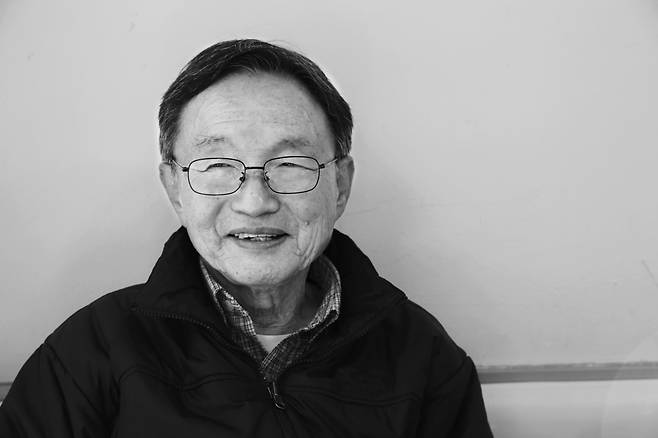
These lines, from the poem “Red Dragonfly,” open "All Living Things Are Beautiful," the posthumous poetry collection of Shin Kyung-rim (1936-2024), released to mark the first anniversary of his death. They speak to the realization that a life filled with hardship and dust, once viewed from a distance, was in fact beautiful.
At a press conference held Wednesday at Changbi Publishers’ office in Seoul, poet Do Jong-hwan reflected on the late Shin’s final work.
“That, I think, captures the very spirit of Shin (Kyung-rim),” Do, also a former culture minister, said. “As I read and reread the poems, I noticed how often he illuminated what is small, hidden or dismissed. This collection tells us: What lives, simply by living, is beautiful.”
The volume was assembled from drafts and completed works that the late poet's family, including his second son Shin Byung-gyu, discovered on his computer. They were sent to Changbi, where Do and editors sorted through and selected the poems for the posthumous collection.
Of the 60 poems included, only a handful had been previously published in literary journals; the majority are being released for the first time.

Divided into four sections, the collection offers a quiet yet powerful summation of Shin’s enduring concerns and poetic vision.
Part I centers on “the poet’s gaze that discovers what is hidden.” According to Do, Shin was “a poet who loved the insignificant, the small, the overlooked.” Part II, titled “Poems on the Road,” captures the poet's journeys to unfamiliar places and the people he met along the way. Part III reflects on “letting go” and “shedding burdens,” with poems that evoke the soul’s liberation through detachment. Part IV, simply titled “Pain,” confronts the collective traumas of the times, including the 2014 Sewol ferry disaster, that Shin grieves deeply through his verses.
Shin’s son recounted his father’s unwavering dedication to writing, even during his illness.
“My father kept saying, ‘I want to write,’ even on his hospital bed,” Byung-gyu said. “But he couldn’t write much during treatment. He used to say that writing poetry required deep thought, but thinking made his head hurt. We tried to dissuade him.”
The family believes few unpublished works remain beyond those in this collection.

Since his literary debut in 1956, Shin Kyung-rim has been a towering figure in Korean poetry. Widely known as the “poet of the people,” he spent decades writing verses about the lives of Korean farming communities. He rose to critical acclaim with his landmark collection “Farmers’ Dance” (1973), a series of realistic portraits of farmers and migrant laborers, capturing their suffering and impoverishment brought on by rapid industrialization. His poems, such as “A Love Song for the Earnest,” “Mokgye Market” and “Reeds,” have been included in school textbooks as modern classics.
“All Living Things Are Beautiful” is his first new book in 11 years, following “Upstairs at the Photo Studio,” the last collection released in 2014.
Poet Do, who wrote a commentary to the collection, noted: “His language remains consistent with his earlier works — simple, unpretentious and sincere. These poems are filled with compassion for neighbors, love for humanity and moments of self-reflection.”
To commemorate the first anniversary of his death, Shin’s alma mater Dongguk University hosted a literary memorial on Thursday. On May 22, Shin Kyung-rim Literary Festival will take place in Noeun-myeon, Chungju, North Chungcheong Province — Shin’s hometown and final resting place.
Copyright © 코리아헤럴드. 무단전재 및 재배포 금지.