S. Korea’s debt ratio to hit 54.5%, surpassing peer average for first time
이 글자크기로 변경됩니다.
(예시) 가장 빠른 뉴스가 있고 다양한 정보, 쌍방향 소통이 숨쉬는 다음뉴스를 만나보세요. 다음뉴스는 국내외 주요이슈와 실시간 속보, 문화생활 및 다양한 분야의 뉴스를 입체적으로 전달하고 있습니다.
The International Monetary Fund (IMF) has projected that South Korea’s national debt ratio will reach 54.5% this year, surpassing the 54.3% average of 11 advanced economies without reserve currencies for the first time. The rise is largely attributed to aggressive fiscal spending during the coronavirus pandemic and increasing welfare expenditures amid the country’s rapidly aging population.
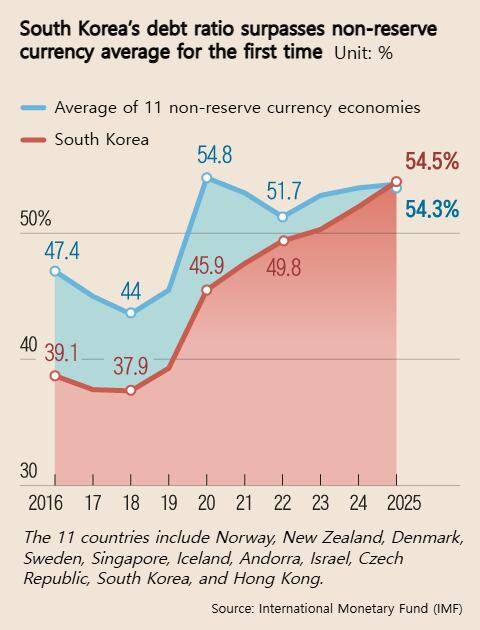
In its Fiscal Monitor report published last month, the IMF estimated that South Korea’s general government debt ratio will reach 54.5% of GDP by the end of the year. This figure includes debt from the central and local governments, as well as liabilities from non-profit public institutions like the Government Employees Pension Corporation. The general government debt-to-GDP ratio is a key measure used internationally to assess a country’s fiscal health.
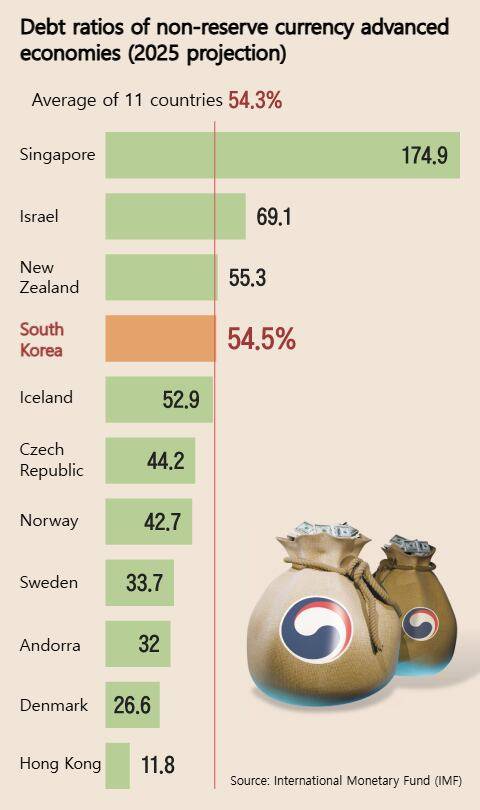
For the first time, South Korea’s debt ratio will surpass the 54.3% average among 11 advanced economies without reserve currencies, including Norway, New Zealand, Denmark, Sweden, Singapore, Iceland, Andorra, Israel, the Czech Republic, and Hong Kong. In contrast, reserve currency economies such as the United States, Japan, and Eurozone countries, which use currencies like the dollar, yen, and euro, can print money to meet national debt obligations during crises. However, non-reserve currency countries must manage their debt more strictly. Since their currencies are not widely used globally, rising debt levels pose a greater risk than for reserve currency economies.
South Korea’s national debt ratio was 37.9% at the end of 2018, and it increased to 39.7% by 2019. By the end of 2020, the ratio had risen to 45.9%, the first year of the pandemic. At that time, South Korea ranked seventh among the 11 non-reserve currency countries. However, as government spending escalated to support businesses and individuals affected by the pandemic, South Korea moved to fifth place by the end of 2021 and has remained in fourth place since 2022.
Experts argue that the rapid rise in South Korea’s national debt is a result of increased fiscal spending to address the COVID-19 crisis and a unique rate of aging that has spiked welfare expenditures. Some analysts also point out that the expansionary fiscal policies of the Moon Jae-in administration, which took office in 2017, worsened the situation. Kang Sung-jin, a professor at Korea University, explained, “It’s understandable for the government to run deficits during a crisis, but the decision to increase welfare spending before 2019, when there was no external crisis, has now led to significant consequences.”
According to IMF projections, only Singapore (174.9%), Israel (69.1%), and New Zealand (55.3%) will have a higher debt ratio than South Korea by the end of this year.
Looking ahead to 2029, the IMF predicts that South Korea’s debt ratio will rise further to 58.4%, surpassing New Zealand (57.1%) and becoming the third highest among non-reserve currency countries, behind Singapore (177.6%) and Israel (70%). This continued rise is expected to be driven by increasing welfare costs related to an aging population. Some observers warn that the national debt could climb faster than expected if the incoming administration implements populist policies or economic stimulus measures.
Despite being below Singapore and Israel in terms of debt ratio, some experts are concerned about South Korea’s fiscal future. Singapore, for example, is a net creditor that does not borrow for routine government spending. Instead, its government issues bonds to fund investments by sovereign wealth funds, which are recorded as debt for accounting purposes. This allows Singapore to maintain a high credit rating, with agencies such as Fitch assigning it the highest possible sovereign rating, AAA.
Copyright © 조선일보. 무단전재 및 재배포 금지.
- 대낮에 수녀 넘어뜨리고 발길질…이스라엘, 또 기독교 혐오 범죄?
- 조경태, 장동혁 지지자들과 충돌... “여러분 때문에 국힘이 안 돼”
- 한예종 광주 이전 논란에... 문체부장관 “한 번도 생각해본적 없어”
- 화곡동 다가구 주택서 화재… 50대 심정지 이송
- 금주의 나라에 ‘술 대란’...전쟁이 멈춰 세운 사우디의 비밀 상점
- 월드컵 출전 담판 짓나 ... FIFA-이란 곧 공식 회담 연다
- 국힘 단체장 후보들 “李, 네로 황제 되려 하나… 심판해야”
- 청주여자교도소 5인방 화보? 쏟아지는 AI 콘텐츠에 2차 가해 논란
- 양향자 “지도부, 극단 세력에 휘둘리지 말고 포용·화해로 당 이끌어야”
- 외교 무대까지 번진 ‘영토 전쟁’…베네수엘라 임시 대통령 배지에 가이아나 반발