Young Koreans turn to 'dopamine detox' as they wake up to risks of shorts loop
![A particiapant of the dopamine detox meetup "Blank Space" works on his painting. [SEOL HAK-YEONG]](https://img2.daumcdn.net/thumb/R658x0.q70/?fname=https://t1.daumcdn.net/news/202505/09/koreajoongangdaily/20250509105800479jhml.jpg)
After finding herself hooked for 10 hours a day in an endless social media scroll, 21-year-old college student Moon Da-bin had a mental breakthrough and decided to go on a dopamine detox last year, starting by deleting her Instagram account.
“Even with looming deadlines, social media came off as irresistible, pulling me into an endless cycle of short-form videos until late at night,” Moon said. “I simply couldn't stop scrolling down.”
From TikTok to YouTube Shorts or Instagram Reels, quick-hit videos glue people to their smartphones for longer, but a group of young people like Moon is mindful of the excessive exposure.
Their maneuvers vary: some simply delete their social media accounts while others turn to offline, slow-paced activities like reading and painting.
Against overstimulation
To combat dopamine addiction, where the brain's reward system is overstimulated, a growing number of young people are consciously seeking ways to reduce their exposure to instant pleasure drivers for a healthier lifestyle, a movement known as “dopamine detox.”
“It's not just me: many of my friends and acquaintances have quit social media and YouTube to live a healthier life,” 26-year-old software engineer Shin Yoon-ji said.
Shin has recently decided to delete her Instagram to “focus more on her work.”
“I know a couple of friends who stopped using social media, and they express satisfaction over their decisions,” Moon said.
If one is not self-disciplined enough, they join online forums or anonymous group chat rooms themed around digital detox. On KakaoTalk, Korea's dominant instant messenger, dozens of chat rooms exist where numerous people share their tips and progress.
Having abstained from social media for one and a half years, Moon said improved concentration was the biggest benefit of dopamine detoxing.
“I’ve noticed that my focus has improved when I read books and do my work,” Moon said.
“Without social media, I can also find joy in every little detail of my life, build more solid friendships, and smile more often because my brain is now free from instant dopamine.”
Shin shared a similar view, saying she has been able to spend her time much more efficiently.
“After deleting Instagram, I started to engage in more effective activities like reading books and appreciating the lyrics of my favorite songs,” Shin said. “I began to feel less guilty and more satisfied by embracing such hobbies.”
![People read books and relax at the outdoor library at Gwanghwamun Square in Jongno District, central Seoul. [YONHAP]](https://img3.daumcdn.net/thumb/R658x0.q70/?fname=https://t1.daumcdn.net/news/202505/09/koreajoongangdaily/20250509105804489mpiu.jpg)
Detox hobbies
While refraining from using social media and short-form videos is one of the most common ways to detox dopamine, many practitioners also get the best of healthy hobbies that help them stay mentally healthy without resorting to instant pleasure.
Seol Hak-yeong, who runs a drawing meetup called Blank Space, is one of a cohort trying to create a synergetic environment where people can help one another practice dopamine detox.
“As we work together on art and consider the space and atmosphere we’re in, we gravitate toward analog activities rather than digital ones,” Seol said. “Especially young people need focus and peace, so they try to find it in healthy hobbies like drawing.”
Drawing is not the only activity people seek when detoxifying themselves. On Somoim and Munto — the two most popular mobile platforms for social meetups — hundreds of gatherings that involve wholesome activities like discussion, meditation and reading fall under this concept.
“I think we need to seek the right type of pleasure through various activities like reading, exercise or deep focus,” said Park Dong-hyun, a book club organizer.
“I started the book club in June 2021 under the concept of dopamine detox, and the demand for my club has been rising over time,” Park said. “We began with just four people, and now we have around 400 members.”
![Particiapants of the dopamine detox meetup "Blank Space" work on their paintings. [SEOL HAK-YEONG]](https://img4.daumcdn.net/thumb/R658x0.q70/?fname=https://t1.daumcdn.net/news/202505/09/koreajoongangdaily/20250509105806770cnuq.jpg)
Still trapped in the loop
As creative as those conscious smartphone users get, many people remain in the endless scroll.
Koreans spent 102.1 billion minutes on YouTube, a twofold jump from 2019 (51.9 billion minutes), according to a report from market trackers WiseApp, Retail and Goods last year.
The report noted the main reason behind this dramatic increase was the growing demand for short-form videos.
“Shot-form videos and social media content stimulate the brain's reward system and dopamine circuit very effectively,” said Kim Jong-wan, a psychology professor at Jeonbuk National University. “Overconsuming such content repetitively within a short time leads to addiction to instant pleasure as our brains are relatively sensitive to new stimulants.”
“When people get addicted, they begin to look for the same type of instant pleasure providers instead of seeking cognitive processing or learning,” Kim added.
![Participants of a book club engage in a discussion after reading books together. [PARK DONG-HYUN]](https://img3.daumcdn.net/thumb/R658x0.q70/?fname=https://t1.daumcdn.net/news/202505/09/koreajoongangdaily/20250509105808644imwl.jpg)
A report released last year by the Korea Creative Content Agency indicated that 69.6 percent of free streaming service users have engaged with short-form content. Notably, around 85 percent of these users were in their teens and twenties, highlighting the trend of dopamine addiction among young people.
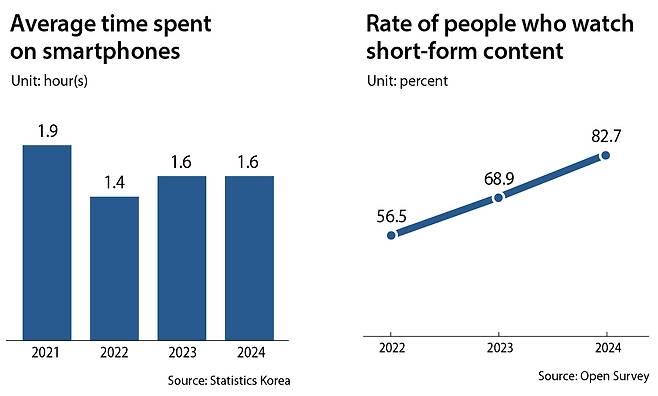
Further underscoring this trend, a separate report from local market tracker Open Survey last year revealed a significant surge in short-form content consumption, jumping sharply from 56.5 percent in 2022 to 82.7 percent in 2024.
Experts have warned that overexposure to dopamine-driven content could lead to damaging effects on the brain's functionality.
“Addiction to dopamine leads to psychological side effects like attention deficit and lack of critical thinking,” Prof. Kim said. “Conversely, if people refrain from being exposed to such instant pleasure drivers, they can recover concentration and critical thinking.”
BY YOON SEUNG-JIN [yoon.seungjin@joongang.co.kr]
Copyright © 코리아중앙데일리. 무단전재 및 재배포 금지.
- Accidental North Korean defectors want to go home but Pyongyang is ignoring their calls
- Tom Cruise in Seoul: 'Mission: Impossible — The Final Reckoning' is 30-year culmination
- Merger push becomes legal battle as Kim Moon-soo challenges Han in court
- Ancient craft, modern couture: The Korean fashion designers behind Jennie's 'Ruby' look
- Young Koreans turn to 'dopamine detox' as they wake up to risks of shorts loop
- Why are Chinese fishing boats disappearing from the Yellow Sea?
- Bear sculptures to be removed from Seoul park after complaint that they 'promote low birthrates'
- 'The Devil's Plan 2' reveals upcoming season's contestants
- 'When Life Gives You Tangerines,' 'Harbin' honored at Baeksang Awards — as it happened
- 'The Match' to portray legendary Go battle between Cho Hun-hyun and Lee Chang-ho