What's K-beauty's top firm in Q1? Amorepacific rises as LG H&H falls
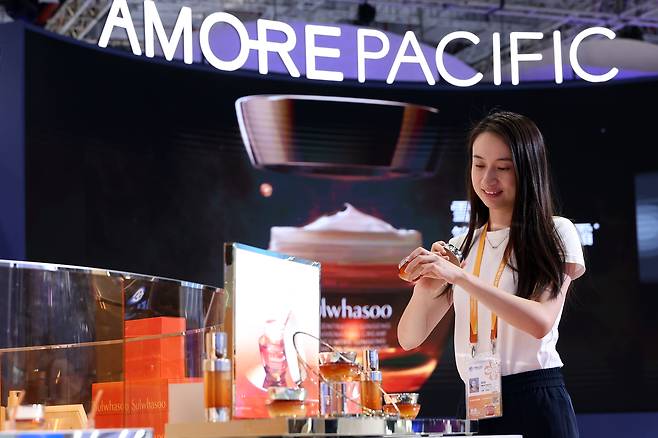
The first quarter earnings of South Korea’s top two beauty giants, Amorepacific and LG Household & Health Care, have been largely shaped by their approaches to international market diversification beyond China.
In the January–March period, Amorepacific Holdings reported consolidated revenue of 1.16 trillion won ($817 million), up 15.7 percent from a year earlier, with operating profit climbing 55.2 percent on-year to 128.9 billion won.
Noticeable in the company’s profit growth was the strong performance of its overseas markets, where sales surged 40.5 percent on-year to 473 billion won, and operating income profit more than doubled to 69.6 billion won.
This upswing stemmed from Amorepacific’s global rebalancing strategy, spanning North America as well as Europe, the Middle East and Africa.
Sales in the Americas surged 79 percent, fueled by aggressive product rollouts from flagship brands -- Laneige, Innisfree and Sulwhasoo -- alongside robust performance from skin care brand Cosrx, which was newly consolidated into the company’s earnings.
Revenues in Europe, the Middle East and Africa tripled, with brands such as Laneige and Innisfree leading the explosive growth.
Yet, in the Greater China region, overall sales declined, while improved cost efficiencies and streamlined operations led to a modest return to profitability. Meanwhile, in other parts of Asia, strong performances from both flagship and emerging brands fueled a 53 percent surge in sales.
Amorepacific has been reducing its dependence on the Chinese market, having suffered collateral damage from China’s sweeping ban on Korean cultural exports -- widely seen as economic retaliation for South Korea’s 2016 deployment of the US Terminal High Altitude Area Defense system.
The move led to a sharp decline in Chinese tourism to Korea, along with reduced exports of Korean food and cosmetics.
Unlike Amorepacific’s proactive pivot toward global diversification -- particularly in Western markets -- fellow beauty giant LG H&H remains relatively in the early stages of reducing its reliance on China.
In the first quarter of this year, LG H&H reported more muted results, with consolidated revenue down 1.8 percent to 1.69 trillion won on-year and operating profit slipping 5.7 percent to 142.4 billion won, amid sluggish domestic demand and ongoing headwinds in the Chinese market.
Modest gains in Japan, up 23.2 percent, and North America, up 3.1 percent, signaled early signs of recovery, contributing to a 4.2 percent uptick in overall overseas revenue. However, with China still making up nearly 40 percent of total international sales, a 4.1 percent decline in the Chinese market weighed heavily on the results.
Yet, despite a downturn in its core beauty division, LG H&H found strength in its premium daily beauty lineup within the Home Care & Daily Beauty division.
Bolstered by strong performances from brands like Physiogel and Dr. Groot, the segment saw revenue rise 2.2 percent to 573.3 billion won, while operating profit jumped 13.7 percent to 36.6 billion won.
“While we’ve seen growth in key domestic and international channels, overall sales declined due to continued weakness in outlets such as duty-free stores and door-to-door sales,” said an LG H&H official. “We plan to strengthen market responsiveness through customized marketing strategies tailored to each retail channel.”
In a bid to fast-track its global ambitions, LG H&H announced earlier this week that it would participate in a $130 million paid-in capital increase for its North American subsidiary. The investment is poised to ramp up marketing for brands like The Face Shop and CNP, while broadening the subsidiary’s product lineup and deepening its reach in online retail, the company explained.
Copyright © 코리아헤럴드. 무단전재 및 재배포 금지.