Tariff shock: Sidecar triggered as Kospi falls below 2,400
전체 맥락을 이해하기 위해서는 본문 보기를 권장합니다.
"The market saw a meaningful correction last year, and current valuations are quite attractive for bargain hunters," said Park Sang-hyun, a researcher at iM Securities. "That should help limit further downside."
"Foreign inflows will likely stay subdued in the near term," said Jeong. "Rising global volatility is driving demand for safe-haven assets, making it harder for foreigners to commit to Korean stocks."
이 글자크기로 변경됩니다.
(예시) 가장 빠른 뉴스가 있고 다양한 정보, 쌍방향 소통이 숨쉬는 다음뉴스를 만나보세요. 다음뉴스는 국내외 주요이슈와 실시간 속보, 문화생활 및 다양한 분야의 뉴스를 입체적으로 전달하고 있습니다.
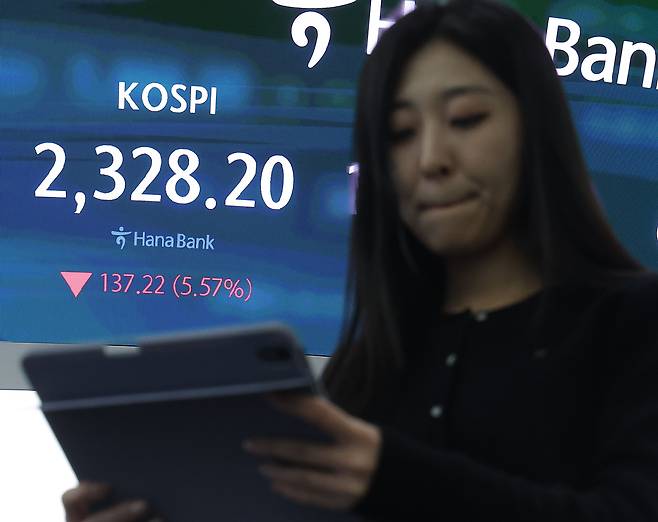
South Korean stocks slumped Monday as renewed US tariff threats rattled markets, triggering a rare trading halt to curb volatility.
The benchmark Kospi plunged 5.57 percent to close at 2,328.2, its lowest finish since November 2023. The tech-heavy Kosdaq also slumped 5.25 percent to 651.3.
Panic selling erupted from the opening bell, prompting a sidecar — a five-minute halt on program trading — at 9:12 a.m. on Kospi 200 futures. It was the first activation in eight months, but losses deepened through the session.
Foreign investors led the exodus, dumping 2.1 trillion won ($1.43 billion) of Kospi shares and 187.2 billion won on the Kosdaq. Retail investors stepped in as dip buyers, scooping up 1.67 trillion won in Kospi and 167 billion won in Kosdaq stocks.
The turmoil spilled into currency markets, with the Korean won tumbling 33.7 won to 1,467.8 per dollar — its biggest daily drop in five years. The won briefly touched 1,471.3 during intraday trading, sliding as much as 2.6 percent from Friday’s close.
The selloff came as fears of a global trade war escalated, after the US last week unveiled sweeping “reciprocal tariffs,” including a 25 percent levy on South Korean imports. Tensions intensified further over the weekend, with China announcing retaliatory duties on US goods and President Donald Trump vowing to press ahead with the measures.
Market turbulence is unlikely to ease soon, analysts said, with global recession risks and US tariff uncertainty set to keep volatility elevated.
“The market isn’t operating on rational logic at this point, so typical valuation arguments may not carry much weight,” said Cho Jun-kee, analyst at SK Securities. “Without a clean resolution in sight, fresh shocks could drive further declines, with any rebound likely to be limited."
The hit is proving especially painful for Korea, whose export-driven economy has been struggling with weakening trade growth since last year.
“Korea’s dependence on exports makes it particularly vulnerable, and steeper-than-expected tariffs will inevitably weigh on growth,” said Jeong Yong-taek, senior analyst at IBK Securities, who expected market weakness to persist at least through April.
Estimates from the financial sector suggest the “reciprocal tariffs” could trigger a roughly 13 percent drop in Korea’s exports to the US, its second-largest trading partner after China. The US accounts for 18.7 percent of Korea’s total exports.
Still, analysts see limited room for further downside given already depressed valuations.
The Kospi’s price-to-book ratio has fallen to 0.87 — a level rarely seen outside of major crises like the 2008 global financial crash or the 2022 pandemic selloff.
While the Kospi had been under pressure from worsening trade tensions and weak domestic demand since last year, sentiment took a decisive hit in December after former President Yoon Suk Yeol’s failed attempt to impose martial law. The shock dragged the index below 2,400, leaving it stuck in the 2,400 to 2,700 range for months.
The Constitutional Court’s ruling last Friday to formally remove Yoon offered a brief reprieve. The Kospi initially rallied above 2,500 after the verdict, but gains quickly evaporated as focus shifted back to tariff risks.
“The market saw a meaningful correction last year, and current valuations are quite attractive for bargain hunters,” said Park Sang-hyun, a researcher at iM Securities. “That should help limit further downside.”
Yoon’s ouster also clears the path for faster policy action after months of political paralysis, offering a boost to sentiment. An early presidential election has been tentatively set for June 3, with parties expected to roll out stimulus-heavy pledges in the weeks ahead.
Reflecting the improving sentiment, NH Investment & Securities raised its Kospi target range from 2,380 to 2,850. “The stock market will likely first price in relief seen in the currency market, followed by momentum from potential stimulus measures, such as a supplementary budget,” said Kim Byung-yeon, NH’s chief strategist.
Offshore investors — a key driver of Korea’s markets — are unlikely to rush back in soon, with the won still weak and global volatility elevated. Foreign traders have sold Korean equities for eight straight months, dumping nearly 13 trillion won so far this year.
“Foreign inflows will likely stay subdued in the near term,” said Jeong. “Rising global volatility is driving demand for safe-haven assets, making it harder for foreigners to commit to Korean stocks.”
The won has come under heavy pressure in recent months, trading above 1,400 per dollar — well above last year’s average of around 1,360. Some even warn it could test the 1,500 level if external risks persist.
Yet, the resolution of key uncertainties may offer some room for the won's near-term stability, a potential catalyst for the stock market.
“The won has been an outlier in the broader dollar-weakening cycle globally, weighed down by trade risks, capital outflows and political uncertainty,” said Kim. “But it could settle in the low-1,400 range later this year.”
Once trade tensions ease and the new administration rolls out its policy agenda, foreign inflows could pick up in the second half, analysts said.
“We think tariff-related uncertainty has largely peaked, with Trump having already rolled out most of his flagged policies,” said Park. “For Korea, stronger policy support under the new administration could pave the way for improved foreign fund flows.”
Copyright © 코리아헤럴드. 무단전재 및 재배포 금지.