K-beauty fuels Shiseido’s global strategy: APAC chief
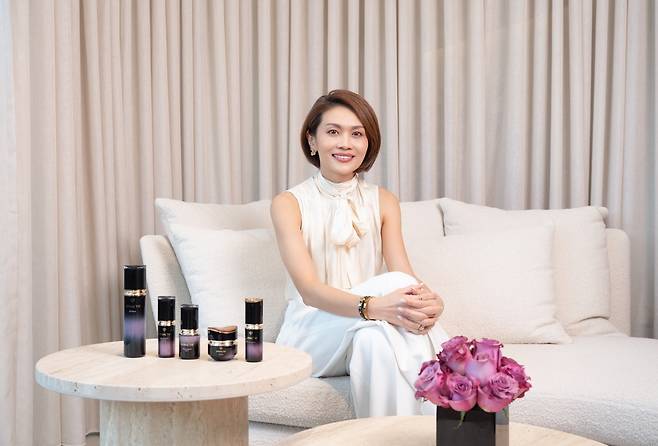
Nicole Tan, president and CEO of Shiseido Asia Pacific, highlighted the rapid ascent of K-beauty and Korea’s growing influence in the global beauty market.
"Today, it’s no longer just ‘Korea for Korea,’ it’s ‘Korea for the world’ in the beauty industry,” Tan said in an interview with The Korea Herald during her visit to Seoul on Thursday for the launch of Cle de Peau Beaute beauty spa at The Shilla Seoul.
As a brand under Shiseido, the luxury skincare and makeup label CPB introduced its first-ever beauty spa globally through a collaboration with The Shilla in Seoul and on Jeju Island this March. The spa program, built around the brand’s signature products, is designed to offer personalized wellness and body treatment experiences.
In Korea, the strong performance of the Shiseido and CPB brands has driven the company’s overall beauty category growth to more than five times the market average in the last fiscal year.
Having spent over 25 years navigating the beauty industry’s trends and transformations, Tan said that Korea holds strategic importance and ranks among the top three markets for Shiseido in the Asia-Pacific region. She emphasized that K-beauty’s global prominence — though seemingly recent to global consumers — has been years in the making.
“The K-beauty trend evolved over more than 15 years, slowly building momentum,” she noted, tracing its roots to innovations like BB creams, CC creams and cushion compacts — products pioneered in Korea that have since become staples in beauty routines worldwide.
While some critics argue that K-beauty’s reliance on low-priced indie brands could limit its longevity, Tan sees it differently.
“A lot of interesting trends actually started from low-priced mass brands in Korea and then evolved into mid-premium categories,” she explained. Tan cited cushion foundations as a prime example: initially dismissed by prestige brands, they have since become a global phenomenon embraced by major international players. “Years later, it’s still here — stronger than ever.”
For Shiseido, Korea is not just another market but a strategic hub for innovation and cutting-edge consumer insights.
Tan pointed out that trends originating in Korea often influence markets in Japan, Southeast Asia, China and the West. Recognizing this dynamic, Shiseido established the Korean Innovation Center in 2018 to monitor consumer preferences, technological advancements, and product trends — and to feed these insights into the company’s global ecosystem.
Shiseido’s product development across its portfolio is significantly relevant with K-beauty trends. The brand has embraced concepts like “slow aging” and the “no foundation look,” that are also popular amongst Korean consumers.
For instance, the recent launch of Shiseido’s Ultimune serum — which incorporates advanced technology to help slow the skin’s aging process — aligns with Korea’s growing emphasis on self-care and holistic beauty.
Understanding the discerning nature of Korean consumers is central to Shiseido’s strategy. “We’ve observed that Korean consumers are among the most demanding in the world, along with Japanese consumers,” Tan said.
Copyright © 코리아헤럴드. 무단전재 및 재배포 금지.