Trump unveils global reciprocal tariffs
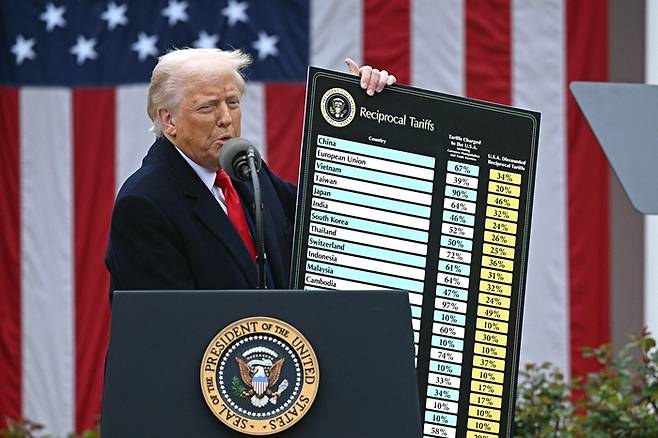
The new tariff plan combines two concepts: a universal 10 percent tariff on all imports alongside what Trump calls reciprocal tariffs for some nations and the White House describes as “bad actors” on trade.
Alongside South Korea, major economies such as China, Japan, the European Union (EU), Taiwan, and Vietnam will face reciprocal tariffs that are much higher than the baseline.
Trump unveiled the tariffs during a speech at the White House, where he signed an executive order instituting the tariffs on countries throughout the world.
He declared that the era of American taxpayers being “ripped off” was over after decades of exploitation, saying that “our country and its taxpayers have been ripped off for more than 50 years, but it isn’t going to happen anymore.”
Among the country-specific tariff rates are 34 percent for China, 25 percent for Korea, 20 percent for the European Union, 46 percent for Vietnam, 32 percent for Taiwan, and 24 percent for Japan, according to the White House.
The sweeping trade action significantly escalates Trump’s tariff war as the United States imposes tariffs on all imports rather than targeting specific goods or nations. The move is expected to disrupt global trade with key economies, including the European Union, already vowing retaliatory measures.
For Korea, which relies heavily on exports, the 25 percent tariffs put it at a competitive disadvantage against Japan and the European Union, which face lower duties. The new U.S. tariff plan could force Korea to negotiate new trade deals with the United States as it also effectively nullifies the free trade agreement between Seoul and Washington.
Speaking at the White House, Trump showed a chart with some of the so-called reciprocal rates, saying that Korea charges a 50 percent tariff on the United States. The chart, however, marked Korea as “discounted reciprocal tariffs of 25 percent.”
The U.S. tariff plan comes at a time of heightened uncertainty for Korea amid a leadership vacuum and an intensifying global trade conflict.
Copyright © 매일경제 & mk.co.kr. 무단 전재, 재배포 및 AI학습 이용 금지
- 오늘의 운세 2025년 4월 3일 木(음력 3월 6일) - 매일경제
- [속보] 대리인단 “尹 대통령, 탄핵심판 선고일에 불출석” - 매일경제
- “부부 국민연금 합쳐 月500만원 이상 처음 나왔다”...부부수급자 평균은 108만원 불과 - 매일경
- [속보] 대법, ‘선거법 위반’ 홍남표 창원시장 당선무효형 확정 - 매일경제
- 100도 이상에서 끓여도 살아남는 ‘이 식중독균’… 봄철에 기승부려 - 매일경제
- “점심은 사무실 책상에서, 근무 중 이어폰 금지”…충격적인 근무규정 놓고 中 시끌 - 매일경제
- “이번엔 러시아 애가 전학왔어?”…국제학교도 아닌데 외국인 몰리는 이곳, 왜? - 매일경제
- [단독] “수업거부” 외쳤던 서울대 의대생 80%...알고보니 본과 60%는 수강신청 - 매일경제
- [속보] ‘도이치 주가조작’ 유죄 확정…권오수·전주 등 징역형 집유 - 매일경제
- [오피셜] PL 정신차렸다! 오심 줄어드나?…32R부터 ‘반자동 오프사이드’ 도입 - MK스포츠