Rediscovering landscape painter Jeong Seon as 'magician of colors'
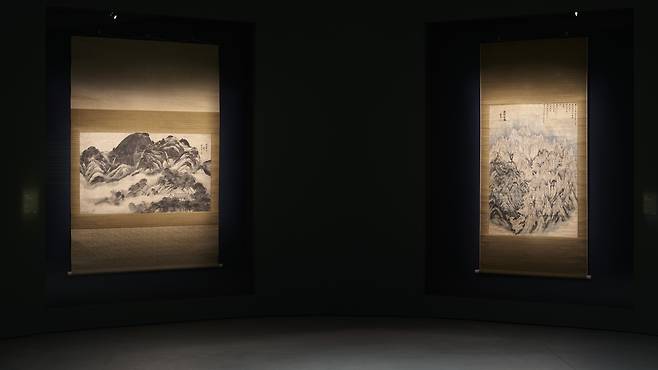
Landscape paintings by Jeong Seon, a master painter of the Joseon era (1392–1910), collectively known as “Jingyeong landscape” paintings, or “true-view landscape” paintings, are considered the pinnacle of Joseon art.
Also known by his penname, Gyeomjae, the painter's true-view landscape paintings were distinguished from “silgyeong landscape” paintings, or “real landscape” paintings, that had prevailed before his time. Unlike those who painted "real landscapes" for records or simply portrayed real locations, Gyeomjae revealed his own artistic inspirations in his landscape paintings.
The masterpiece “Clearing after Rain on Inwangsan Mountain” from 1751 is perhaps the artist's best-known work, a state-designated National Treasure that depicts the dreamlike mountains shrouded in mist and clouds after rain. The painting was acquired by the late Samsung Chairman Lee Kun-hee and donated to the National Museum of Korea in 2020.
The exhibition “Gyeomhae Jeong Seon” at the Hoam Museum of Art, co-organized with the Kansong Art Museum, is the largest presentation of the artist’s paintings, displaying 165 works, including those on loan from 18 institutions and collectors. The exhibition includes two state-designated National Treasures and 10 state-designated Treasures.
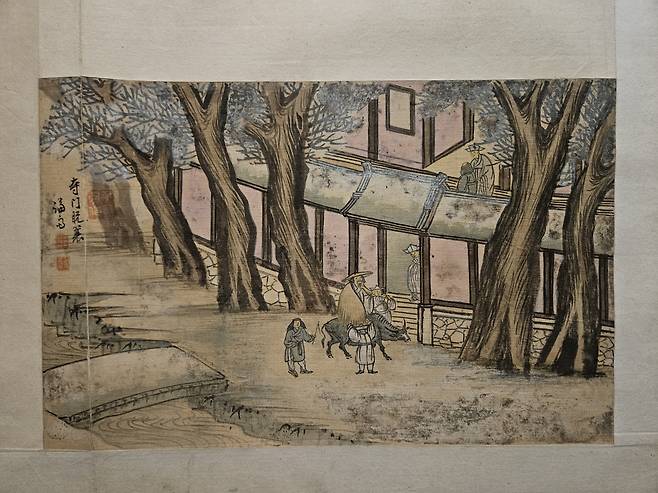
What is most surprising about the artist is that he used many colors for ink paintings, even pinkish colors, according to Jo Ji-yoon, head of the Collections Department at Leeum Museum of Art, who curated the exhibition.
“I would say he is a ‘magician of colors,’” the curator said at a press tour on Monday. “That is a new aspect of the artist we discovered for the exhibition.”
A rainbow -- extremely rare in ink paintings of the era, according to the curator -- is seen in the painting “Mi Fu’s Boat under the Rainbow,” while “Taking off Raincoat at the Temple Gate” employs a light pinkish color for the temple.
Gyeomjae traveled to Geumgangsan and the capital Seoul, then known as Hanyang. The two places are the most frequently depicted scenes in his paintings, and Geumgangsan is known as the first subject that he painted in the "true view" style after he traveled to the mountain in 1711.
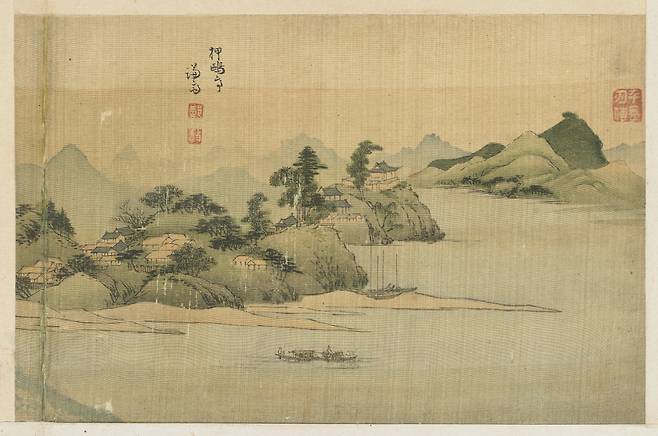
Born in Yurandong in the foothills of Bugaksan in Seoul, he was a lifelong resident of Seoul and left behind many paintings of the capital and its suburbs, including “Apgujeong Pavilion," which shows a peaceful scene of nature; a huge contrast to the bustling affluent neighborhood that Apgujeong is today.
The curator said the highlight of the exhibition is to be found in a section titled “Jeong Seon’s Literati Consciousness” in a dark room that reveals the little-known identity of the artist.
Gyeomgjae, the most popular artist of the 18th century, was a descendant of a well-known yangban, or literati, family. By the time he was born, his family had declined as no member of the previous three generations had been able to advance in government service. Gyeomjae’s father died when he was 14.
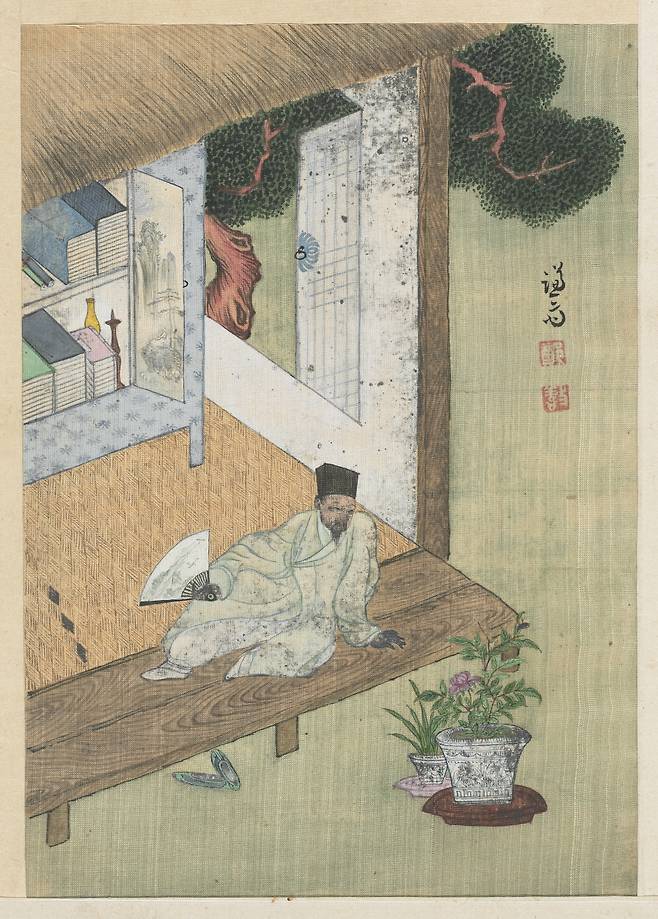
“So this section aims to show who he is,” the curator continued. Pointing to a painting entitled "Taking a Rest after Reading," the curator said, “It is still controversial, but it is assumed that the man sitting with a stack of books behind him in this painting may be Jeong Seon himself. It is as though he is saying through the painting, ‘I paint, but I am from a literati family.’”
This year marks the 350th anniversary of the artist's birth.
“The founders of both the Samsung Foundation of Culture and the Kansong Art and Culture Foundation -- Lee Byung-chull and Chung Hyung-pil -- were visionaries who were utterly devoted to protecting our national pride and sovereignty by preserving Korea’s rich cultural heritage. It is particularly meaningful that these two institutions are now collaborating on a project highlighting Jeong Seon,” said Hong Ra-hee, director general emerita at the Leeum Museum of Art, in the exhibition brochure.
The exhibition runs until June 29 and will later travel to the Kansong Art Museum in Daegu.
Copyright © 코리아헤럴드. 무단전재 및 재배포 금지.