Trump trade adviser defends tariffs, cites Korea’s impact on US manufacturing
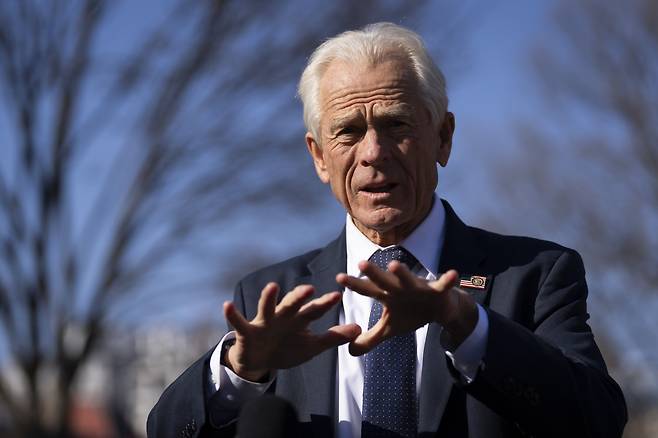
As President Donald Trump announced new 25 percent tariffs on imported cars and with plans to roll out sweeping reciprocal tariffs also underway, his top economic advisers are delivering aggressive messages to defend the move, referring to South Korea as among the countries undermining American manufacturing.
Peter Navarro, the White House's senior counselor for trade and manufacturing, on Sunday in the US defended the administration’s push for auto tariffs in an interview with Fox News, arguing the tariffs could bring back American manufacturing and jobs.
“What the Germans and the Japanese and the South Koreans are doing is they are turning this country from a manufacturing nation into an assembly nation,” Navarro said.
He criticized German and Japanese carmakers for sending the most “important, high-value-added” auto parts to be assembled in the US, claiming that only 19 percent of the cars Americans buy each year have American-made engines and transmissions.
He pointed to Mexico as another example, noting that auto plants there manufacture car engines destined for the US market.
“The Germans and the Japanese and South Koreans and the Mexicans have taken our manufacturing capability, so we’ve got to get that back and we are going to do it in a way which is going to protect American consumers and create jobs for American workers,” he said, claiming there would be over 1 million new jobs created in the auto industry as a result of tariffs.
Navarro’s remarks came just days after Trump announced a series of tariffs on foreign-made cars and key auto parts, such as engines, transmissions, power train parts and electrical components, set to take effect Thursday.
The auto tariffs are expected to hit the export-dependent Korean economy particularly hard, as the US market accounts for the lion's share of the country’s car shipments. Last year, South Korea exported $34.7 billion worth of vehicles to the US, nearly half of the country’s total car exports of $70.8 billion.
The tariffs are expected to make Korean cars pricier, reducing their appeal in the all-important US market. As a result, Korean automakers like Hyundai Motor and Kia could see their profits tumble.
Trump is also preparing to roll out reciprocal tariffs on Wednesday. Amid growing speculation as to the scope of the tariffs, the US president on Sunday told reporters they will apply to all countries.
It signaled a move from earlier remarks by Trump's aides that the tariffs will target only a small group of 10 to 15 countries with the biggest trade imbalance, dubbed the “Dirty 15” by Treasury Secretary Scott Bessent.
While the secretary has not named specific countries, concerns are growing here that Seoul could be among them. The US posted a $66 billion trade deficit with South Korea last year, according to US government figures, placing Korea ninth on its list of countries from which it imports more than it exports.
Another of Trump’s top economic advisers on Sunday said it is up to the president to decide the scope and number of countries the tariffs will affect.
“President Trump is going to decide how many countries,” National Economic Council Director Kevin Hassett said during an appearance on Fox News. “The point about 15 countries is that we have massive trade deficits with about 15 countries. It doesn’t mean that there aren’t a lot of unfair trade practices around the world. So the reciprocal part of our trade actions will be visible to everybody on (April) 2nd.”
Amid rising speculation on the extent of tariffs, the Wall Street Journal on Monday reported that Trump has been urging his advisers to take on a more aggressive approach on tariffs, including higher rates on a broader range of countries. Among the options reportedly being discussed is a global tariff of up to 20 percent on all countries.
Copyright © 코리아헤럴드. 무단전재 및 재배포 금지.