Korea Zinc chair triumphs in management rights defense
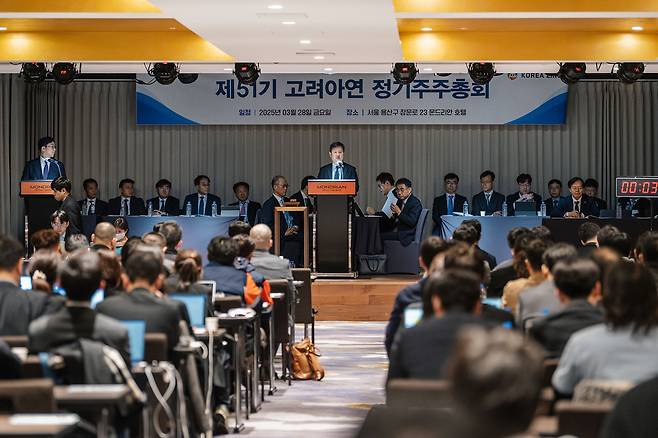
Korea Zinc Chair Choi Yun-beom successfully defended his management rights in a proxy battle against major shareholder Young Poong and private equity firm MBK Partners, retaining a majority of board seats.
However, with MBK planning to challenge the results of the shareholders meeting, the dispute ongoing for the last seven months is likely to continue.
At the general shareholders meeting Friday, Choi secured approval for key agenda items, including capping the number of directors at 19 and appointing five new directors backed by his faction.
"Many shareholders and the public have expressed strong support for protecting Korea Zinc, a vital national industry, from hostile acquisition threats," a Korea Zinc official said.
"We will strive to meet the expectations of our shareholders and the public while continuing to ensure Korea's resource security and playing a central role in the global strategic mineral supply chain."
Korea Zinc is one of the world's largest zinc smelters, producing high-purity zinc using advanced technology.
The firm's current management gained an advantage in the voting process by limiting Young Poong’s voting power through a cross-shareholding structure, acquiring Young Poong shares via its wholly owned Australian subsidiary, Sun Metals Holdings, just before the meeting.
Before this maneuver, Young Poong and MBK held a combined 40.97 percent stake in Korea Zinc, while Choi controlled 34.35 percent.
Following the latest board changes — factoring in existing directors and excluding four suspended directors aligned with Choi — his faction holds 11 seats, while his proxy rival controls four.
The agenda to establish an upper limit on the number of directors aims to cap the currently unlimited Korea Zinc board at 19, a proposal by Choi to thwart Young Poong’s plan to introduce 17 new directors.
At the next shareholders meeting, the MBK alliance’s stake will increase to 41.25 percent, while Choi’s will drop to around 30 percent. This change follows Young Poong's transfer of its 25.42 percent stake to YPC Limited, a newly established firm, in order to circumvent cross-shareholding restrictions.
However, with the director cap in place, even if MBK and Young Poong appoint four additional directors, securing a board majority will be challenging.
To remove the cap on the number of directors, more than two-thirds of shareholder approval is required, making such a move virtually impossible.
The same threshold applies to the dismissal of directors. As a result, MBK and Young Poong will be engaged in a prolonged proxy battle, contesting board seats as each director’s term expires, which could take at least two years for them to gain full control.
"We will immediately appeal and suspend the results of the regular shareholders meeting, which were distorted due to restrictions on Young Poong's voting power, and we will rectify the distorted shareholders' will in court," the alliance stated Friday.
MBK and Young Poong are also expected to file a lawsuit over concerns of insider trading linked to the stock purchase process of Sun Metals Holdings.
Korea Zinc, co-founded in 1974 by Chang Byung-hee and Choi Ki-ho, has been under the management of the Choi family, while the Chang family oversees Young Poong Group and its electronic parts affiliates.
Since Choi Ki-ho’s grandson, sitting Chair Choi Yun-beom, took office in 2022 and expressed his intention to separate the company from Young Poong, the two families have been embroiled in a battle for control of Korea Zinc.
Copyright © 코리아헤럴드. 무단전재 및 재배포 금지.