Historian Yuval Harari warns of paradox of trust behind AI race
전체 맥락을 이해하기 위해서는 본문 보기를 권장합니다.
"An AI weapon can independently decide whom to bomb, and an AI system can even develop entirely new weapons on its own," Harari said during a press conference Thursday in Jongro-gu, Seoul. "The invention of AI represents a completely different kind of revolution compared to all previous technological breakthroughs. Anyone who believes we can control AI just as we controlled previous tools fundamentally misunderstands what AI truly means."
"The job market will become extremely volatile, continuously evolving as AI keeps improving," he explained. "People will need highly flexible minds, with the ability to keep learning and adapting throughout their entire lives."
이 글자크기로 변경됩니다.
(예시) 가장 빠른 뉴스가 있고 다양한 정보, 쌍방향 소통이 숨쉬는 다음뉴스를 만나보세요. 다음뉴스는 국내외 주요이슈와 실시간 속보, 문화생활 및 다양한 분야의 뉴스를 입체적으로 전달하고 있습니다.
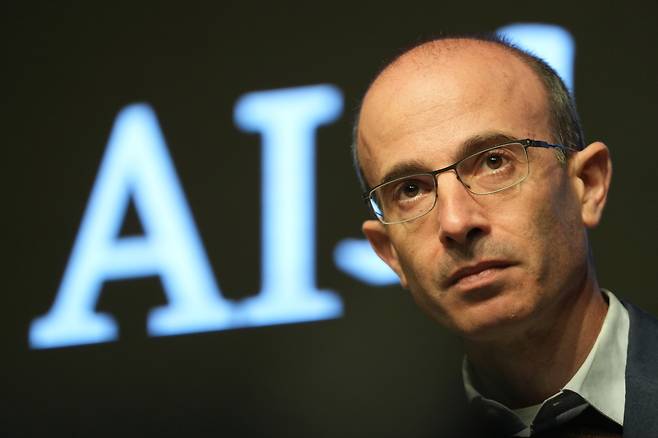
As humanity faces unprecedented changes driven by rapid advancements in artificial intelligence, historian and best-selling author Yuval Noah Harari warns of significant potential risks.
While humanity has created many impactful tools -- such as knives, the printing press and even atomic bombs -- Harari, known globally for influential books such as “Sapiens” and “Homo Deus,” which examine humanity’s past and future, stressed that artificial intelligence stands apart, as it’s not simply a tool but an autonomous agent capable of independent decision-making and innovation.
“An AI weapon can independently decide whom to bomb, and an AI system can even develop entirely new weapons on its own,” Harari said during a press conference Thursday in Jongro-gu, Seoul. “The invention of AI represents a completely different kind of revolution compared to all previous technological breakthroughs. Anyone who believes we can control AI just as we controlled previous tools fundamentally misunderstands what AI truly means.”
In South Korea to promote his new book, "Nexus: A Brief History of Information Networks from the Stone Age to AI," and to attend a forum hosted by the Ministry of Culture, Sports and Tourism, Harari highlighted the troubling "paradox of trust" surrounding AI.
Given AI's profound potential impacts -- characterized by Harari as possibly the greatest transformation in human history -- he stressed the necessity for cautious development, pointing out that technology leaders are struggling with critical trust issues precisely when trust is most essential.
There is a growing global crisis of trust among people in which leaders spearheading AI development increasingly distrust each other, yet paradoxically place immense trust in the technology itself.
Harari noted that whenever he meets leaders in AI technology, their primary fear is competitors gaining supremacy in the AI race and eventually dominating the world.
He explained that this fear arises from the possibility that AI development could lead to disproportionate power concentrated in the hands of just a few countries or corporations, dramatically widening the gap between the technological "haves" and "have-nots" -- a scenario reminiscent of inequalities that emerged during the industrial revolution of the 19th century.
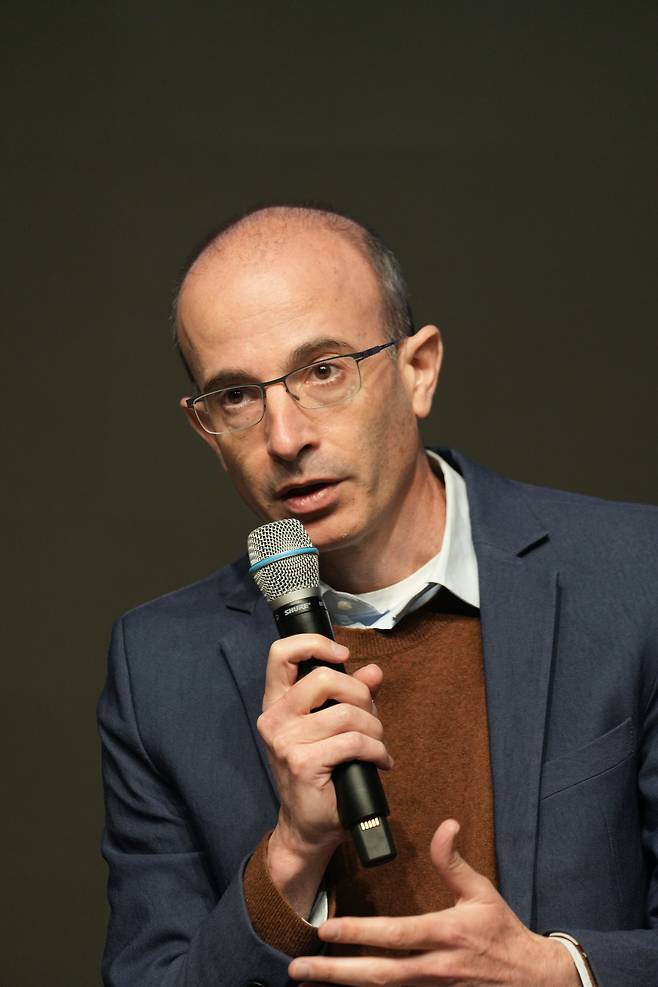
He also pointed out the rise of cheap, attractive fiction over costly, complicated truth in the era of information technology.
The rise of social media platforms has resulted in a mix of fiction and truth and preference for engagement, even pushing politicians to act for more engagement instead of being responsible and truthful.
“For social media platforms, engagement is important. Engagment is a good measure in the entertainment business but not in the news business,” the author said, stressing that the role of journalism is even more important than ever.
When asked about South Korea's political situation, Harari humorously noted his initial confusion when he first learned about it, thinking North Korea had finally experienced a coup. However, he also said he was ultimately unsurprised by South Korea's martial law declaration, amid similar political developments worldwide.
“The biggest problem with democracy is what happens if the person that you give power to doesn’t want to give it back. Once they have the power, they can use the power that they gained democratically in order to stay in power,” he said, adding that check and balance mechanisms such as journalism and judicial oversight are essential in democracies.
Facing profound changes the direction of which remains uncertain, Harari said people should cultivate a wide range of skills -- intellectual, emotional and physical -- to adapt effectively to the rapidly shifting job market.
“The job market will become extremely volatile, continuously evolving as AI keeps improving,” he explained. “People will need highly flexible minds, with the ability to keep learning and adapting throughout their entire lives.”
Copyright © 코리아헤럴드. 무단전재 및 재배포 금지.