Trump’s ‘four times’ tariff talk a negotiation gambit, experts say
![President Donald Trump addresses a joint session of Congress at the Capitol in Washington, on March 4. [AP/YONHAP]](https://img3.daumcdn.net/thumb/R658x0.q70/?fname=https://t1.daumcdn.net/news/202503/06/koreajoongangdaily/20250306193755649nbnr.jpg)
[NEWS IN FOCUS]
U.S. President Donald Trump’s outspoken claim about Korea imposing tariffs on U.S. goods that are "four times higher" was a strategic move to set the stage for follow-up negotiations aimed at securing more favorable terms for the United States, according to trade experts.
The Korean government was quick to correct the claim with a joint statement and data tables, saying that Trump's accusation in his address to a joint session of the U.S. Congress on Tuesday doesn't hold true.
Experts assess that the president's comments are designed to gain the upper hand in trade talks. However, they caution that Seoul should handle the situation with both prudence and tact — ensuring a firm response without sounding condescending.
“I think that Trump’s point here is that Korea is running a significant trade surplus with the United States, and his remarks reflect both his determination and strategic approach to negotiations,” said Lee Tae-kyu, head of the global risk assessment team at the Federation of Korean Industries. The truth on tariffs: Near zero Korea and the United States barely impose any tariffs on each other’s industrial goods under their FTA, according to the Ministry of Trade, Industry and Energy. The average tariff rate on all U.S. imports to Korea was approximately 0.79 percent in 2024. When considering duty refunds, the effective rate is even lower.
However, Korea’s average most favored nation (MFN) tariff rate applied to World Trade Organization member states is 13.4 percent, about four times higher than the 3.3 percent imposed by the U.S. on Korean goods. Seoul believes that President Trump misunderstood this figure, as the MFN simple average tariff rate does not apply to the United States.
“Korea’s tariff rate on the U.S. imports is effectively close to zero percent,” the Trade Ministry said. “President Trump’s remarks are not factually accurate, and we will actively clarify this matter with the United States.”
When considering what Trump has done in office, however, it remains doubtful whether he could be swayed by data, according to Prof. Heo Yoon of international trade at the Graduate School of International Studies at Sogang University.
“The Trump administration said last month that value-added taxes would be considered a trade barrier and factored into reciprocal tariff calculations, even though they are technically not a form of tariffs,” he said. “Given Trump’s approach, he is likely to push forward with his objectives, even if the rationale behind it is not entirely logical.” Trepidation over trade surplus
Tension runs deep over how long the Trump administration will continue to engage in the ongoing tariff war, with a possibility that Korea’s low currency value could factor into Washington's duty regime.
The president on Monday addressed concerns about currency devaluation by the country's major trading partners, China and Japan, commenting that it was disadvantageous for U.S. manufacturers and the go-to solution to resolve this matter is to hike the tariff rates.
“Korea could face high tariffs if the U.S. views the weak won — driven by persistently low growth rates and political instability — to be a deliberate act to widen its trade surplus with the United States,” said Prof. Ahn Dong-hyun of the Department of Economics at Seoul National University.
Seoul is currently holding backdoor negotiations with Washington, highlighting Korea's significant contribution to the U.S. economy through substantial investments.
![The view of Samsung Electronics’ chip plant under construction in Taylor, Texas [YONHAP]](https://img1.daumcdn.net/thumb/R658x0.q70/?fname=https://t1.daumcdn.net/news/202503/06/koreajoongangdaily/20250306193757342ivpb.jpg)
Chipping away at semiconductor subsidies
Trump’s denunciation of the CHIPS and Science Act on Tuesday cast Korean chipmakers’ plans of expanding their U.S. manufacturing bases into uncertainty as the multi-billion-dollar subsidies promised under the Joe Biden administration were suddenly thrown into doubt.
Samsung Electronics and SK hynix planned to invest $37 billion in Texas and $3.87 billion in Indiana, respectively, to build chip plants and were awarded funding covering 11 to 13 percent of their investments.
In 2024, both companies saw an increase in semiconductor exports to the United States and China compared to the year before.
Samsung Electronics’ U.S.-based semiconductor and display sales subsidiary saw its revenue double last year to reach 46.87 trillion won ($32.4 billion), while net profit soared 471 percent to 780 billion won.
SK hynix’s U.S. sales subsidiary generated 33.46 trillion won in revenue, surging 167 percent on year.
Samsung’s semiconductor sales subsidiary in China reported an on-year increase of 92 percent in both revenue and net profit last year, logging 30.07 trillion won and 470 billion won.
SK hynix’s semiconductor subsidiary in China also saw a 64 percent jump in revenue to 13 trillion won and a 65 percent surge to 143 billion won in net profit.
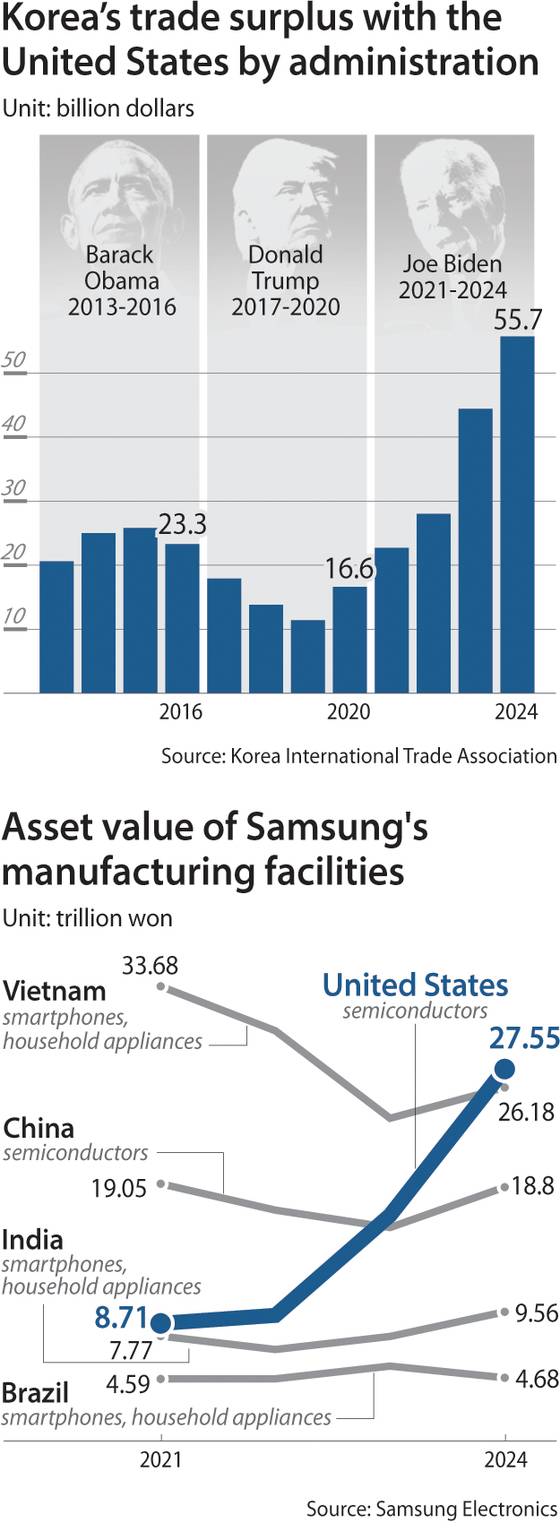
Trump has proposed using tariffs instead of subsidies to drive chip investments into the United States. TSMC and Apple, wary of the president's policies, announced investment plans worth $100 billion and $500 billion, respectively.
A small comfort, a different concern
Analysts suggest that semiconductor tariffs would have less of an impact on Korea than on countries such as Taiwan. Only 7.5 percent of Korea’s total semiconductor exports go directly to the United States, according to the Korea International Trade Association, while most chips processed and packaged in Taiwan and Hong Kong are being exported to the United States.
“As the United States expands its AI infrastructure, it will still be worthwhile for Korean companies to continue investments in the country, provided that Big Tech’s chip demand is assured,” said Lee Jong-hwan, a system semiconductor engineering professor at Sangmyung University. “However, since the United States seeks cutting-edge fabrication plants, careful calculations are necessary, considering concerns over technology leakage and a local labor shortage.”
It has been suggested that Trump’s threats to cancel chip subsidies would not be as detrimental for Korea as the additional 20 percent tariff that the United States slapped on China.
A large portion of Korea-manufactured components and chips is used in Chinese electronic products and household appliances, but if additional tariffs on the neighboring country's goods lead to a decline in U.S. sales, demand for Korean components could also suffer.
Intermediate goods, including semiconductors, account for over 80 percent of Korea’s exports to China, according to the Bank of Korea. When the United States hiked tariffs on Chinese imports in 2018 from an average rate of 3 percent to 18 percent, Korea’s exports to China declined by 3 percent.
BY KIM MIN-JOONG, SHIM SEO-HYUN, YI WOO-LIM [lee.jaelim@joongang.co.kr]
Copyright © 코리아중앙데일리. 무단전재 및 재배포 금지.
- Korea's new 'top-tier' visa offers various perks to attract select foreign professionals
- Trump says Korea wants to join Alaska LNG project for 'trillions of dollars'
- Exclusive: LG Energy's Arizona battery plant to start mass production in first half of 2026
- Trump points to South Korea as a nation unfairly benefiting from U.S. military support
- Pocheon village in ruin after Korean Air Force fighter jet misfires
- Tariffs, military 'help' and subsidies: Trump dismantles dynamic with Korea in Congressional address
- Trump says Korea is freeloading off the U.S. Data shows the opposite is true.
- 'Aren't you ashamed?': Agency CEO MC Mong accuses SM of underhanded practices in Xiumin, KBS ordeal
- L.A. Dodgers' Kim Hye-seong not favorite for opening day roster
- Philippine flight foul-up leaves some 170 Jeju-bound travelers stranded