Hyundai, Kia weigh cost of US expansion against tariff hikes
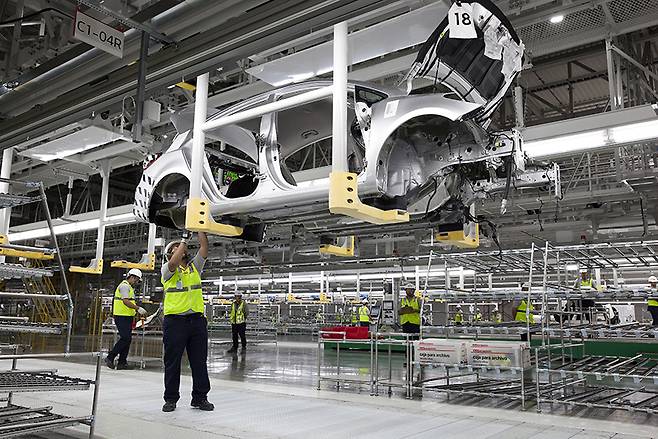
In response to President Donald Trump’s tariff threats, Hyundai Motor Co. and Kia plan to ramp up production within the all-important US market, shifting away from their traditional export routes from South Korea and Mexico.
However, this move is expected to come with higher labor costs.
"Hyundai Motor and Kia have long targeted the US market by relying heavily on exports from Korea and Mexico due to manageable production costs and a stable local supply chain," said an industry source on condition of anonymity. "With the pressure of new tariffs, the companies will need to ramp up their US operations, likely leading to rising labor expenses in the coming years."
Last year, Hyundai Motor Group committed to gradually increasing hourly wages by 25 percent for workers at its Georgia and Alabama manufacturing plants by 2028. Notably, production line employees in Alabama received a cumulative 14 percent pay increase in 2024 compared to the previous year.
While Hyundai Motor Group declined to disclose specific wage figures, data from Indeed, a US-based job search engine, indicates that the average salary for a Hyundai automotive technician in Alabama ranges from $55,000 to $71,151 per year.
This is currently less than the 100 million won ($75,000) average salary of Hyundai’s domestic production workers, but wages in the US are trending sharply upward.
And the influence of United Auto Workers — one of North America’s largest labor unions — could further impact Hyundai’s labor costs.
Hyundai has already implemented the 25 percent pay increase demanded by UAW, with sources suggesting this was partly to dissuade them from joining. As of February last year, over 30 percent of Alabama plant workers had joined the union. If 70 percent of employees join, UAW could demand company recognition or hold a union representation vote.
For Kia and Hyundai Mobis, the car parts subsidiary of Hyundai Motor Group, shifting production away from Mexico could substantially increase labor costs. Mexico has been a key beneficiary of the US “nearshoring” policy, allowing automakers to leverage low-cost labor for production. However, Trump’s proposed 25 percent auto tariffs could disrupt Kia’s cost advantages.
Kia’s Mexican manufacturing base primarily produces the Forte and K4 compact models for the US market, accounting for about 18 percent of Kia’s US sales, according to Edmunds, a US-based automotive information provider.
While Kia has not disclosed specific wage figures for its Mexican plant, the company previously reported in 2016 that workers earned $3.75 per hour — a staggering 93.7 percent less than the $40 per hour typically earned by US autoworkers at the time. According to the International Labour Organization, the wage gap between the US and Mexico is unlikely to close soon.
"Hyundai Mobis supplies auto parts from Mexico to Kia’s local plants and exports them to the US. Even with shipping costs, the carmaker has maintained a competitive edge due to cost-effective labor," the industry source explained.
While higher labor costs pose a challenge, Hyundai and Kia are committed to shifting from an export-dependent model to expanding local production in the US.
In 2023, approximately 68 percent of Hyundai and Kia’s US vehicle supply came from exports out of Korea and Mexico.
Hyundai shipped 637,638 units from Korea to the US, while Kia exported 377,367 units from Korea and an additional 141,695 units from Mexico.
Hyundai Motor Group aims to produce 1 million units annually in the US, including: 300,000 units from Hyundai’s new Georgia plant; 360,000 units from the Alabama plant; and 340,000 units from Kia’s Georgia plant.
The Georgia facility alone could further expand capacity by 500,000 units, bringing Hyundai’s total US production to 1.2 million units, which would meet nearly 70 percent of local demand based on 2023 sales figures.
However, some experts argue that even with a 25 percent tariff, exporting might be cheaper than absorbing high US labor costs.
"For Hyundai Motor Group, paying tariffs on exports could be less costly than facing high labor expenses," said Lee Ho-geun, a car engineering professor at Daeduk University. "Rather than blindly scaling up US production, Hyundai will likely negotiate with Trump to lower tariff rates."
On Monday, Industry Minister Ahn Duk-geun held a closed-door meeting with Hyundai Motor Group executives to discuss investment strategies as leverage in US trade negotiations.
This comes two days before Ahn’s scheduled business trip to Washington, where he is set to meet federal officials and US Congress members regarding the proposed auto tariffs.
Copyright © 코리아헤럴드. 무단전재 및 재배포 금지.