Spicy success: Buldak boom drives Samyang’s record profits
전체 맥락을 이해하기 위해서는 본문 보기를 권장합니다.
A Samyang Foods official explained: "The growing popularity of the Buldak series, especially in the US and Europe, has driven our strong sales."
"Samyang has benefited from the weak Korean won since it exports all products from domestic facilities, with no overseas plants currently in operation unlike Nongshim," said an industry official on condition of anonymity. "Samyang's streamlined manufacturing process focused on Buldak noodles gives it an efficiency advantage, while Nongshim's more diverse product lineup leads to lower production efficiency."
이 글자크기로 변경됩니다.
(예시) 가장 빠른 뉴스가 있고 다양한 정보, 쌍방향 소통이 숨쉬는 다음뉴스를 만나보세요. 다음뉴스는 국내외 주요이슈와 실시간 속보, 문화생활 및 다양한 분야의 뉴스를 입체적으로 전달하고 있습니다.
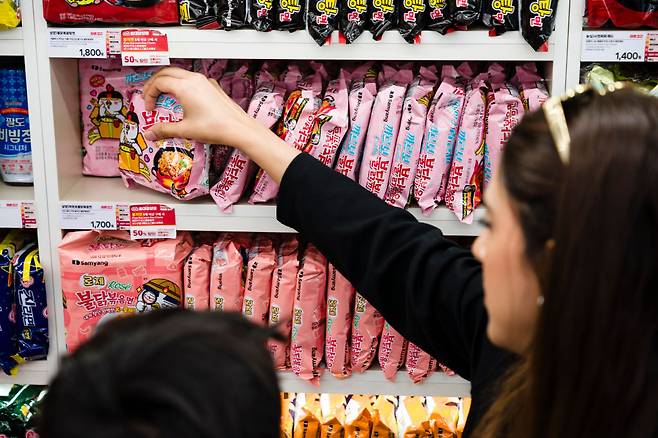
Korea’s top instant noodle maker, Nongshim, appeared to maintain its market leadership last year with 3.43 trillion won ($2.37 billion) in annual revenue -- double the 1.73 trillion won posted by Samyang Foods, the country’s first instant ramyeon manufacturer and long-time market rival.
Yet, a deeper look into their profit figures belies a reversal of fortunes, as Samyang, the company behind the globally popular Buldak brand, doubled Nongshim’s operating profits.
Such an upset had never occurred since corporate filings first went online in 1998.
Nongshim holds the lion’s share of the domestic instant noodle market.
It seized the market lead in 1985, with a 40.4 percent share, nudging aside Samyang’s 39.6 percent -- a pivotal moment that marked the shift from Samyang, the original pioneer of Korea’s instant noodle scene with the first ramyeon in 1963.
According to data from the Food Information Statistics System, Nongshim had five brands in the top 10 for domestic market share in 2023, with Shin Ramyun leading at 16.05 percent. Samyang Foods placed two brands in the ranking -- Buldak at 6.16 percent and Samyang Ramen at 2.98 percent -- while Ottogi’s Jin Ramen took third place at 8.75 percent.
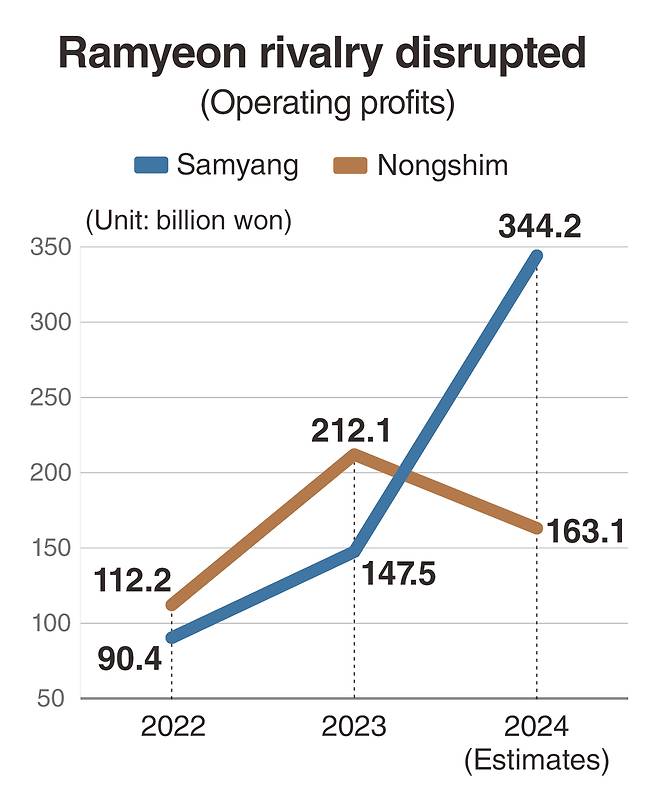
However, despite its smaller domestic market share and lower annual revenue, Samyang Foods unseated the industry heavyweight with a record 344.2 billion won in operating profit in 2024 -- a 133 percent leap from the previous year -- while Nongshim’s profits slid 23.1 percent to 163.1 billion won.
Just a year earlier, Nongshim had held the upper hand, posting a 212 billion won operating profit, outpacing Samyang’s 147.5 billion won.
The turnaround underscores Samyang Foods' triumph in global expansion, with its record performance fueled by soaring overseas demand, especially for the Buldak brand, which accounts for about 80 percent of the company’s global sales.
A Samyang Foods official explained: ”The growing popularity of the Buldak series, especially in the US and Europe, has driven our strong sales."
In the third quarter of last year, Samyang Foods' overseas sales made up about 78 percent of total revenue, while Nongshim’s overseas sales ratio was around 38 percent. Ottoki had around 10 percent in overseas sales.
According to a Nongshim official, the company's weak performance stems from multiple factors: sluggish domestic consumption, higher promotional spending and rising material costs due to the won's depreciation.
Industry insiders further underscored that structural differences between the companies drove the profit gap.
"Samyang has benefited from the weak Korean won since it exports all products from domestic facilities, with no overseas plants currently in operation unlike Nongshim,” said an industry official on condition of anonymity. "Samyang's streamlined manufacturing process focused on Buldak noodles gives it an efficiency advantage, while Nongshim's more diverse product lineup leads to lower production efficiency."
With eyes on boosting overseas revenue, the two ramyeon powerhouses are preparing to scale production for what lies ahead.
Samyang anticipates the completion of its new plant in Miryang, South Gyeongsang Province, this June. The move is expected to supercharge the company’s annual ramyeon production capacity from 1.8 billion to 2.5 billion units, according to the Samyang official.
The company is also constructing its first overseas plant in China, slated for completion in January 2027.
Meanwhile, Nongshim is expanding its export capacity with a new factory in Noksan, Busan, complementing its existing Busan facility.
Once the new plant begins full operations in 2026, Nongshim's annual ramyeon production in Busan is expected to double to 1 billion units. This will bring the company's total production capacity to approximately 6 billion units, including output from its facilities in the US and China.
Both companies continue to craft new instant noodle flavors, targeting consumers in Korea and abroad.
Nongshim’s Shin Ramyun Toomba, a bold blend of spice and cream, is set to debut on shelves in Woolworths in Australia and 7-Eleven in Japan, with launches scheduled for March and April.
Samyang Foods is expanding globally with MEP, a soup-based spicy ramen the company launched to complement the success of its Buldak series. MEP was showcased at a pop-up store in Thailand in December and a Japanese food exhibition in February, targeting Japan's 7 trillion won ramen market.
"There's strong demand for Korean food, especially spicy offerings, in Southeast Asian countries like Thailand," a company official said. "We'll expand MEP's presence into North American and Chinese markets, starting with Southeast Asia."
Samyang Foods operates its corporate entities abroad in Japan, China, the United States, Indonesia and the Netherlands, while Nongshim maintains a presence in China, Japan, Vietnam, Australia, the US and Canada. Nongshim is set to launch a European subsidiary in the Netherlands this March.
Copyright © 코리아헤럴드. 무단전재 및 재배포 금지.