Emerging Asian artists embody experimental spirit of Nam June Paik
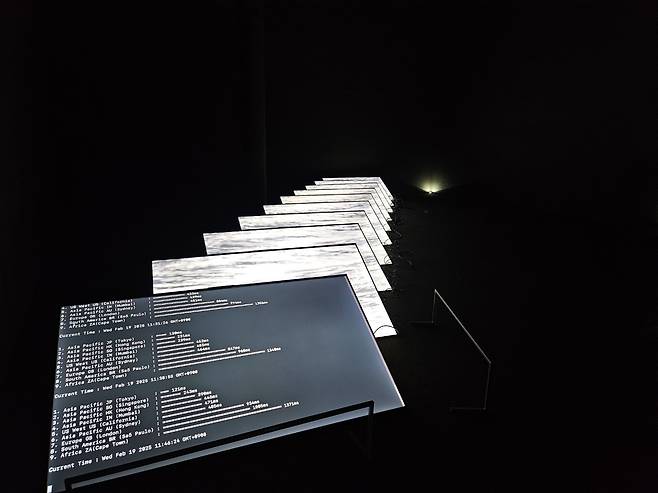
Video art pioneer Nam June Paik broke away from conventional art practices to become the founder of video art. Nam June Paik Art Center, the sole museum dedicated to the late artist, expanded its annual project this year to seek emerging innovative artists in Asia that embody his experimental spirit.
The museum’s “Random Access Project” brought together seven artists and an artist duo based in Asia, selected by the museum’s curatorial team. Established in 2018, previous editions of the project focused on Korean artists, but for the first time this year emerging international artists join for a group exhibition, according to the museum.
“We had discussions among curators of the museum to select young artists who push their boundaries in Asia this year,” curator Lim Chae-eun said on Wednesday at the press tour.
“Random Access Project 4.0” shows some 14 works by the artists -- Han U-ri, Goyoson, Kim Ho-nam, Chang Han-na, Saroot Supasuthivech, yang02 and artist duo Jeong Hye-seon and Yuk Seong-min.
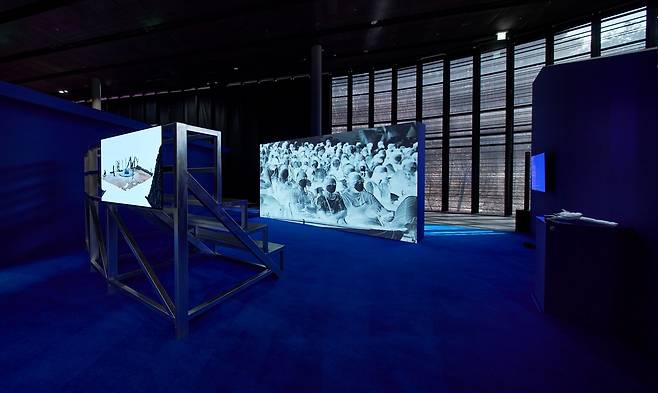
Saroot's works involve a multifaceted research approach regarding specific geographical locations with an emphasis on social and historical context. The Thai artist’s “River Kwai: This Memorial Service was Held in the Memory of the Deceased” is a virtual memorial space for the hundreds of thousands of war prisoners and Asian workers who died while working on the construction of the Burma-Thailand Railway during Japan's occupation of Thailand in World War II.
“When I go somewhere or some places, I feel like locations or objects talk to me. That is how I figure out the history related to those places,” the artist said.
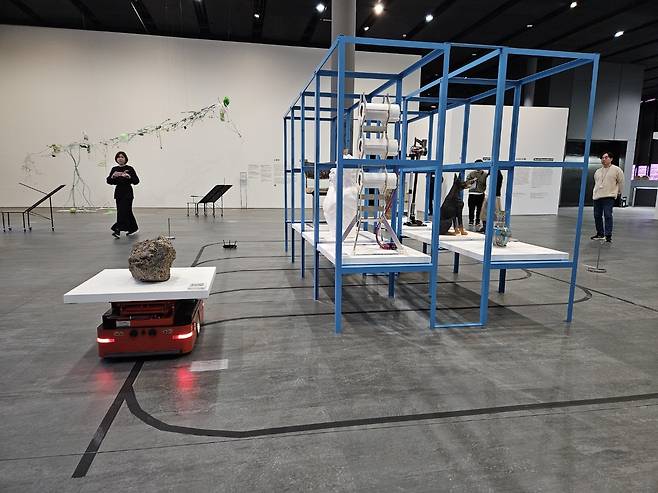
Japanese artist yang02’s installation, “Installation in Progress,” shows an automated guided vehicle that constantly repeats the process of selecting, transporting, displaying and removing various objects.
The artist questions how a machine or artificial intelligence -- usually considered unique to humans -- could actually affect us. On the shelves “artworks” and “non-artworks” are placed together, but the automated guided vehicle treats them equally.
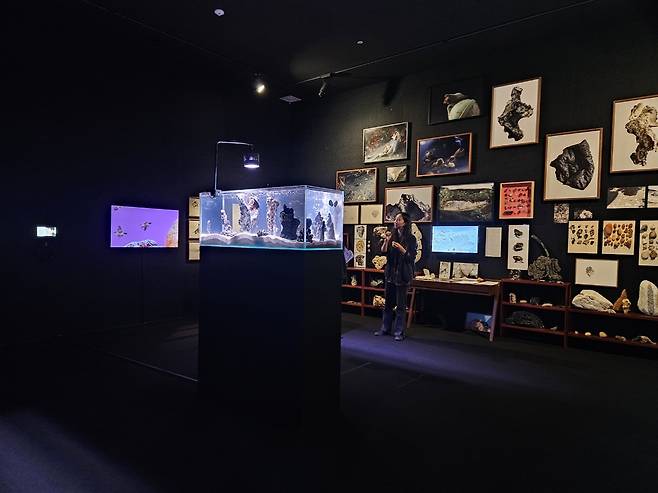
Korean artist Chang Han-na uses diverse art mediums to reflect on the nature we live in in the installation “New Ecosystem.” The work reveals an ecosystem unseen in our daily lives and draws imagination from nature's constantly changing environments. The artist coined the term “new rock” to define plastic waste that transforms over time into stone-like forms.
The museum's project title, "Random Access," originates from a work Paik presented at his first solo exhibition "Exposition of Music — Electronic Television" in 1963. In Paik’s "Random Access," strips of audio cassette tapes taken out of the case are randomly attached to the wall and visitors can produce sounds of their own using a magnetic head, according to the museum.
The exhibition “Random Access Project 4.0” runs until June 29 at the museum that is closed on Mondays.
Copyright © 코리아헤럴드. 무단전재 및 재배포 금지.