Anti-CCP themes ring through rallies against Yoon's impeachment
전체 맥락을 이해하기 위해서는 본문 보기를 권장합니다.
The Democratic Party of Korea's chief spokesperson Rep. Jo Seoung-lae said one of the driving motives behind the rallies opposing Yoon's impeachment appears to be a "red scare."
"The president said in his address that it was the Chinese spies," he told The Korea Herald. "When such tales are told by someone in a position of ultimate influence, the top leader of our country, they can resonate far beyond the usual club of extreme supporters."
이 글자크기로 변경됩니다.
(예시) 가장 빠른 뉴스가 있고 다양한 정보, 쌍방향 소통이 숨쉬는 다음뉴스를 만나보세요. 다음뉴스는 국내외 주요이슈와 실시간 속보, 문화생활 및 다양한 분야의 뉴스를 입체적으로 전달하고 있습니다.
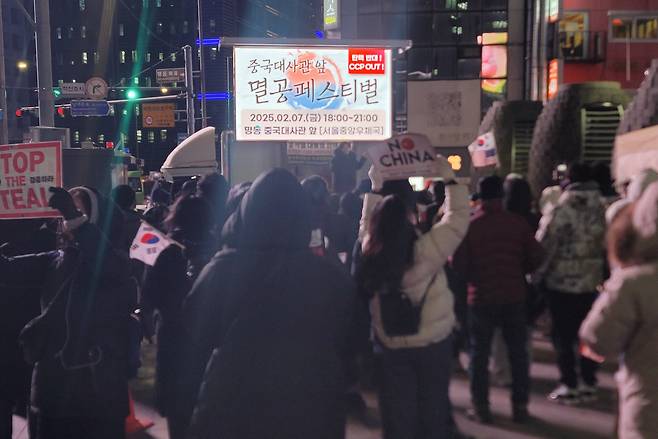
Animosity toward China, more precisely the Chinese Communist Party, has become a central theme in the recent string of rallies supporting South Korea's suspended President Yoon Suk Yeol, who is currently undergoing his impeachment trial.
Outside the Chinese embassy in Seoul on Friday afternoon, a crowd gathered for a rally protesting Yoon's impeachment under the slogans, "Annihilate communism" and "Get the CCP out of Korea." Intermittent chants of "down with Xi Jinping" could be heard.
One of the organizers of the weekly rally is Kim Jeong-sik, a former youth spokesperson with the ruling People Power Party, who, quoting Yoon, said China was threatening South Korea's sovereignty.
The Democratic Party of Korea's chief spokesperson Rep. Jo Seoung-lae said one of the driving motives behind the rallies opposing Yoon's impeachment appears to be a "red scare."
"I think there are a lot of factors spurring the anti-impeachment rallies. One of them seems to be some fear of the spread of communism," he told reporters Monday, without specifically mentioning China.
The curious link between the anti-China, or anti-CCP, sentiment and Yoon's supporters can be traced to the president's words, according to Moon Heung-ho, director of the Institute of Chinese Studies at Hanyang University in Seoul.
"The president said in his address that it was the Chinese spies," he told The Korea Herald. "When such tales are told by someone in a position of ultimate influence, the top leader of our country, they can resonate far beyond the usual club of extreme supporters."
In his Dec. 12 address, Yoon said he was forced to resort to martial law after the Democratic Party, with its majority in the National Assembly, "threatened national security" by repeatedly obstructing crucial bills like those that would criminalize foreign espionage -- by which the president seemed to mean Chinese espionage in particular.
The president went on to cite the apprehension of Chinese spies last year caught surreptitiously filming South Korean military and intelligence facilities as an example of how the opposition party was undermining the country's national security with its routine obstruction of bills.
"To stop cases like this, I tried to revise the Criminal Code's provisions on espionage. But the opposition in control of the Assembly has stubbornly thwarted it," Yoon said.
Appearing in court, Yoon's top officials have been careful not to associate themselves with the president's views toward China.
At the impeachment hearing on Tuesday, Yoon's defense team appeared to harden the rhetoric on Beijing when they asked Shin Won-sik, Yoon's national security adviser and former defense minister, if he thought the Chinese government was capable of meddling in South Korean politics. Shin declined to answer, saying, "I can't respond to a hypothetical question."
When asked again by one of Yoon's attorneys what he thought of former Democratic Party President Moon Jae-in's "China appeasement policies," Shin replied, "I don't have a response to that."
The People Power Party has distanced itself from Yoon's theories about China's role in the country's elections and the ongoing rallies in front of the Chinese embassy.
Rep. Kim Dai-sik, the party's chief spokesperson, told The Korea Herald that the anti-CCP rallies were "not related to the People Power Party in any official capacity." Rep. Kweon Seong-dong, the party's floor leader, told reporters that the People Power Party "does not support or approve of election denialism."
The demographics of the attendees at the anti-CCP rallies are not yet clear. But "certainly a lot of young people" are showing up, according to Kim Min-soo, the former People Power Party spokesperson, who spoke at one of the rallies near the Chinese embassy.
Kim, who told The Korea Herald he was invited to speak at the rally, was forced to step down as the party's spokesperson last month after he defended Yoon's martial law declaration on a YouTube show.
When asked about the high turnout of young people at the rally, a 33-year-old living in Seoul, who identified himself as a conservative, said it was "not really weird" to him. "My generation grew up watching China's aggressive, expansive foreign ventures," he said.
Although the anti-CCP rallies were "not mainstream," he said a general dislike of China or its ruling party seemed to be growing.
"Just a few years ago, when people protested about China, it was about a certain issue, like when they deported North Korean defectors back to North Korea. Now, it's just about China or the CCP in general," he said.
A 29-year-old graduate student said the rally was "not anti-China." "It's not about ordinary Chinese people. People don't like the CCP, and that's different," he said.
Joo Jae-woo, a professor of Chinese studies at Kyung Hee University in Seoul, said the Chinese embassy recently advised its nationals living in South Korea against participating in political events, following reports some Chinese people were at impeachment rallies.
Joo said it was unusual for the Chinese embassy to issue such a warning. "It can be a sign they view the political situation unfolding in Seoul to be quite serious, and they don't want Chinese people attending or getting involved in the rallies," he said.
In the online space, an army of Beijing-backed commenters, known as the "wumao," were launching a ferocious hate campaign against not only Korea but Japan, according to Joo.
"Young people spend a lot of time online, and they are likely to be more exposed to these hateful sentiments," he said, when asked why more young people may be responding to anti-China talking points.
Copyright © 코리아헤럴드. 무단전재 및 재배포 금지.