Foreign investors pull billions from S. Korean stocks as AI fears spread
이 글자크기로 변경됩니다.
(예시) 가장 빠른 뉴스가 있고 다양한 정보, 쌍방향 소통이 숨쉬는 다음뉴스를 만나보세요. 다음뉴스는 국내외 주요이슈와 실시간 속보, 문화생활 및 다양한 분야의 뉴스를 입체적으로 전달하고 있습니다.
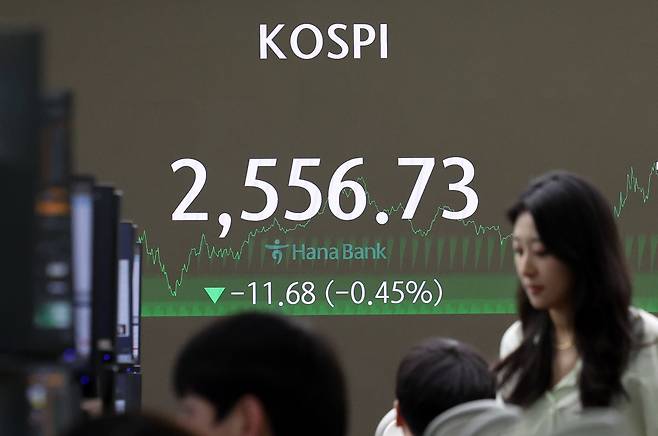
On Aug. 8, the KOSPI closed down 0.45% at 2,556.73, and the KOSDAQ closed down 0.44% at 745.28. This result was expected due to concerns about an economic recession in the United States, which caused the New York stock market to drop the previous night.
The Dow Jones Industrial Average fell 0.60%, the S&P 500 dropped 0.77%, and the Nasdaq declined 1.05%. Some analysts even suggest that the S. Korean market fared better than the New York stock market’s decline, primarily because individual investors were actively buying, providing support to the market.
Despite foreign and institutional investors selling off a net 530.4 billion won ($386.6 million) and $208.7 million respectively, individual investors purchased a net $589.7 million worth of stocks in the Korean market.
In fact, foreign investors have withdrawn a total of $1.9 billion from the Korean stock market over five consecutive trading days since Aug. 2, while institutions have net sold $1.3 billion. However, individual investors injected $3.1 billion into the market during this period.
Over the same timeframe, the stock most heavily sold by foreign investors was Samsung Electronics, with about $18.2 million withdrawn. The second was Korea Line Corporation, followed by SK Hynix, Woori Financial Group, and Industrial Bank of Korea (IBK).
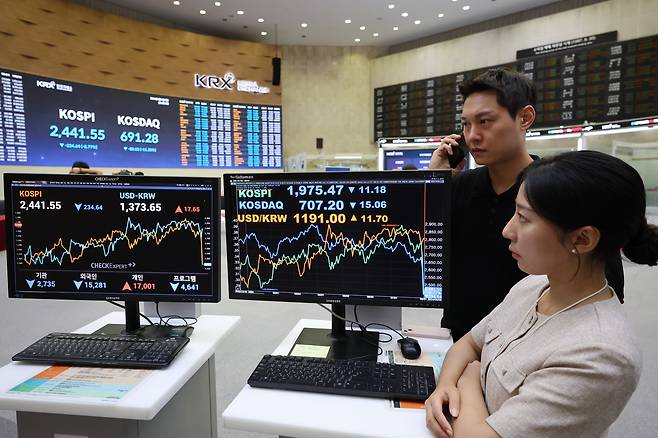
The reason why foreign investors are selling stocks like Samsung Electronics and SK Hynix is due to the AI (Artificial Intelligence) bubble concerns that arose in the U.S., which have now spread to South Korean semiconductor stocks.
Korea Line Corporation, a shipping company, saw its gains evaporate due to concerns over the Middle East conflict. Woori Financial Group and IBK likely experienced declines due to a pullback in gains that had been driven by the S. Korean government’s recent initiatives aimed at increasing the value of state-owned enterprises and financial institutions.
Lee Jae-won, an analyst at Shinhan Investment, noted, “The U.S. market initially rose because the Bank of Japan hinted at slowing down its interest rate hikes. However, it eventually closed lower as concerns about the potential profitability of AI companies resurfaced. Similarly, in the KOSPI, foreign investors are pulling money out of semiconductor stocks because they are becoming less interested in taking risks.”
In the New York market, Nvidia, a leading AI company, dropped by 5.12%, while Super Micro, which recently surprised investors with disappointing earnings, plummeted by 20.14%
Global research firm Gavekal Research stated, “The recent market turmoil signals the start of the AI bubble bursting.” They added that just as the 2008 crisis revealed vulnerabilities in the banking sector, the overvaluation of AI could trigger a U.S. economic recession.
Kim Ji-won, an analyst at KB Securities, said, “Until the U.S. Consumer Price Index is released on Aug. 14, any upward momentum is likely to be limited.” Kim added, “Foreign investors will only return to the Korean market if concerns about a U.S. economic recession are alleviated in some way.”
However, outlooks for the global stock market vary among experts.
After “Black Monday” on Aug. 5, when the market experienced a sharp and sudden decline, there was a brief rebound the following day, only for the market to resume its downward trend on Aug. 7.
This sequence of events led some analysts to suggest that the rebound on Aug. 6 was merely a “dead cat bounce.” A “dead cat bounce” refers to a temporary recovery in the market after a significant drop, akin to a dead cat bouncing once when it hits the ground.
Bloomberg described Tuesday’s rebound as a “classic example” of a technical correction, suggesting that it was simply a minor bounce after a sharp decline and not a sign that the market’s downward trend has ended.
However, Claudia Sahm, chief economist at New Century Advisors and the developer of the “Sahm Rule,” stated in a CNBC interview on Aug. 7 that she does not see any factors that would prompt the Federal Reserve to make an emergency rate cut. She added that the current economic situation is not severe enough to justify such drastic action by the Fed.
Copyright © 조선일보. 무단전재 및 재배포 금지.
- “여보, 연금 계좌에 로봇 ETF 담을까?”... 올해만 3조 넘게 몰렸다 [왕개미연구소]
- [그 영화 어때] 먹고 살기 위해 참아야하는 피땀눈물, ‘어느 파리 택배기사의 48시간’
- 바닥에 앉아 만든 장난감 이야기… 30년의 모험
- ‘2002년 복수 성공’ 우승후보 프랑스, 음바페 멀티골로 세네갈 3대1 제압
- [더 한장] 곤충 만지는 체험…작은 생명은 안전할까
- [김한수의 오마이갓] 서울 아현동 정교회 대성당 종탑의 비밀
- 상반기에만 13조원…K바이오 기술수출, 올해 또 ‘역대 최대’ 경신하나
- 사상 최대 매출에도 ‘크아’까지 정리… 게임사 ‘장수 IP 다이어트’ 본격화
- “北 위장 취업 IT 요원, 1인당 7500건 지원… 3.5건 채용 제안 받아”
- 로켓처럼 솟은 스페이스X, 아마존 제치고 시가총액 5위로