Black Monday Strikes: Korean stock market plummets, triggering circuit breakers
이 글자크기로 변경됩니다.
(예시) 가장 빠른 뉴스가 있고 다양한 정보, 쌍방향 소통이 숨쉬는 다음뉴스를 만나보세요. 다음뉴스는 국내외 주요이슈와 실시간 속보, 문화생활 및 다양한 분야의 뉴스를 입체적으로 전달하고 있습니다.
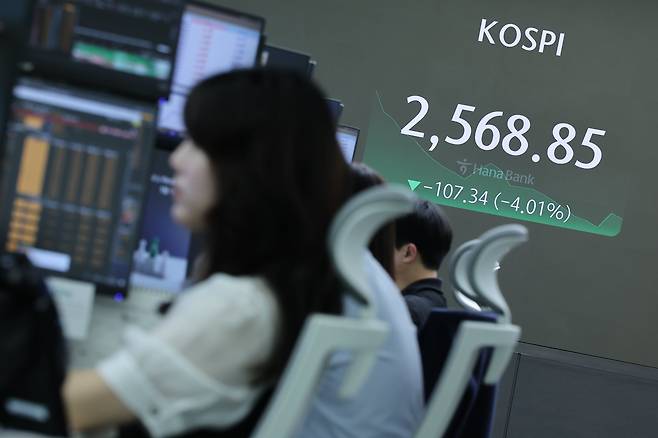
On the Aug. 5, the Korean stock market experienced a significant downturn, triggering the first level of the circuit breaker (CB) on both the KOSPI and KOSDAQ, the two major Korean stock indices, temporarily halting trading.
A circuit breaker is a regulatory measure designed to temporarily halt trading on an exchange to curb panic-selling.
The Korea Exchange announced at 2:14 PM on Aug. 5 that the KOSPI index had dropped by 8.10% compared to the previous day, activating the first level of the circuit breaker and suspending market trading.
Earlier, the KOSDAQ index had also dropped by more than 8% for over a minute compared to the previous day’s closing index, prompting the first level of the circuit breaker.
This is the first time in 4 years and 5 months since the COVID-19 pandemic declaration in Mar. 2020 that the circuit breaker has been activated. It’s the sixth time in history for the KOSPI and the tenth for the KOSDAQ.
Currently, the KOSPI stands at 2,459.81, down 8.09% from the previous day, while the KOSDAQ has dropped 8.72% to 711.37.
Leading companies in the KOSPI market like Samsung Electronics and SK Hynix have also seen significant declines. Samsung Electronics fell by 8.54% to 72,800 won ($53.01), SK Hynix dropped by 8.14% to 159,100 won, and Hyundai Motor Company is trading at $165.67, down 6.76%.
This steep decline is attributed to concerns about a potential recession in the United States and the possibility of an escalating conflict in the Middle East, leading to a ‘panic sell-off,’ effectively creating a ‘Black Monday.’
A panic sell-off occurs when sudden negative news triggers widespread fear among investors, causing them to sell their stocks and bonds to avoid substantial losses. This selling frenzy often leads to a rapid market decline as more investors join in.
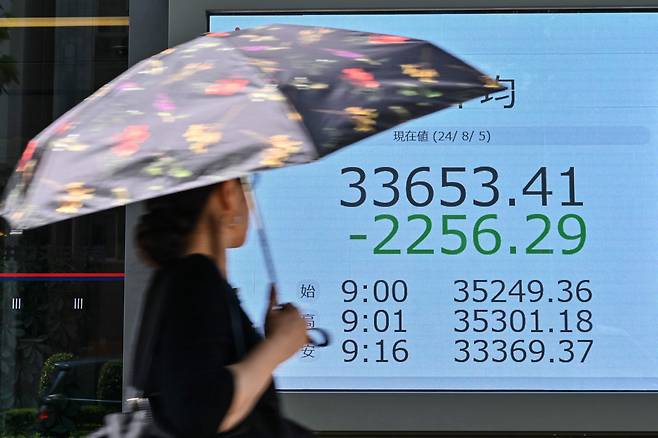
On the same day, stock markets across Asia, including Japan and Taiwan, also faced Black Monday due to panic selling. As of 1:10 PM, Japan’s Nikkei index had plunged by 7.40% to 33,253.72, leading the losses in Asian markets. The TOPIX index also fell by 7.91% to 2,336.86, erasing gains made over the past eight months in just three trading days.
This sharp decline has sparked discussions in financial circles about whether the Bank of Japan’s early interest rate hike was a mistake.
Copyright © 조선일보. 무단전재 및 재배포 금지.
- 경북 포항서 패러글라이딩하던 70대 추락… 심정지 상태로 이송
- [만물상] ‘회화의 구원자’ 호크니
- 인천서 상가 건물 외벽 칠하던 60대 작업자 추락사
- ‘김민재 후계자’로 부상한 이한범, ‘월드컵 대운’ 열리나...리버풀 등 유럽 빅클럽 관심 커
- 李대통령 “정전 넘어 남북 평화체계 구축, 모든것 다하겠다”
- 키움, 한화에 3연전 모두 역전승...원성준 두 경기 연속 결승타
- ‘마약 수사 외압’ 백해룡 경정, 권익위에 공익신고자 보호 신청
- [오늘의 운세] 6월 15일 월요일 (음력 5월 1일 庚申)
- 동원F&B, ‘수출 전진기지’ 진천2공장 본격 가동
- 신민준, LG배 결승 1국 혈투 끝에 中 왕싱하오에 반집승