Germany, South Korea talk energy transition
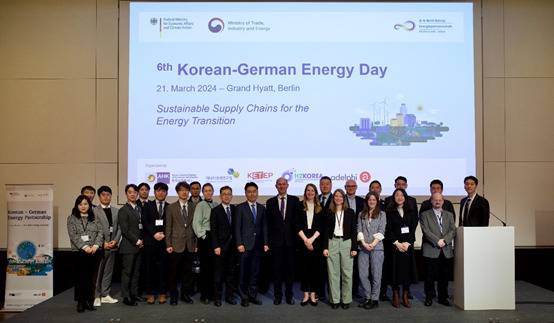
Germany and Korea discussed the role of sustainable supply chains for energy transition while co-hosting the sixth edition of the Korean-German Energy Day conference in Berlin on Thursday.
Korean-German Energy Day is an event held under the Korean-German Energy Partnership, jointly hosted by the German Ministry for Economic Affairs and Climate Action and South Korea's Ministry of Trade, Industry and Energy.
The partnership, initiated in 2019 through a joint declaration of intent, signifies the commitment of Germany and Korea to collaborate extensively to navigate the challenges of the energy transition.
Under the theme of “Sustainable Supply Chains for the Energy Transition," this year's conference was attended by more than 100 officials from the Korean and German energy sectors.
“Germany and Korea have set targets for achieving carbon neutrality by 2045 and 2050, respectively,” said Martin Henkelmann, president and CEO of the Korean-German Chamber of Commerce and Industry, in his opening remarks.
“As highly industrialized nations, we face similar challenges,” said Henkelmann, adding that Germany and Korea are paving the way toward a sustainable future powered by renewable energy and clean hydrogen through collaborative efforts and dialogue.
“We hope this discussion will lead to innovative solutions that will enhance energy security and promote a clean energy transition, and we look forward to strengthening the Korean-German Energy Partnership,” noted Choe Nam-ho, vice minister of trade, industry and energy, in his video message.
“The energy transition is one of our key building blocks for climate action," said Udo Philipp, German state secretary at the Federal Ministry for Economic Affairs and Climate Action of Germany, underscoring the role of the energy transition.
The conference discussed supply chains for renewable energies and sustainable supply chains for hydrogen, photovoltaic, wind power and electricity storage systems, as well as import strategies, government policies and industry perspectives on transporting, storing and redistributing hydrogen.
By Sanjay Kumar(sanjaykumar@heraldcorp.com)
Copyright © 코리아헤럴드. 무단전재 및 재배포 금지.