Late poet Park Mok-wol’s 166 unpublished verses unveiled
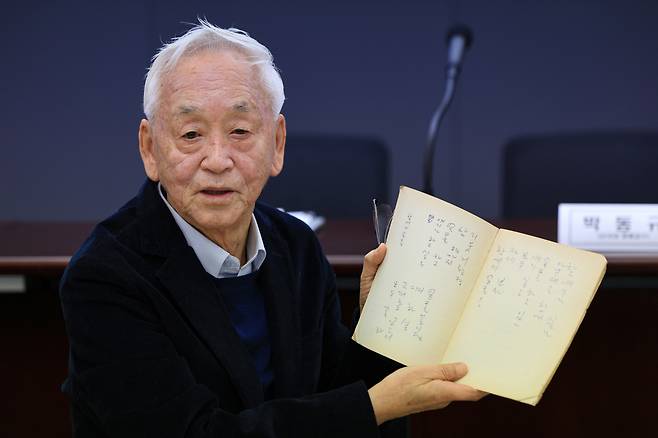
A collection of 166 previously unreleased poems penned by Park Mok-wol, one of South Korea's preeminent poets, has been uncovered.
Park (1915-1978) reveals a broader spectrum of his literary prowess through these newly unveiled works, which delve into social realities and embrace prose poetry, according to the Park Mok-wol Literary Works Publication Committee during a press conference in Seoul on Tuesday.
Led by Professor Woo Jeong-gwon of Dankook University, the committee, comprising professors Bang Min-ho (Seoul National University), Yoo Sung-ho (Hanyang University), Park Duk-kyu (Dankook University) and Jeon So-young (Hongik University), was formed in August 2023 to curate and analyze Park's literary notes.
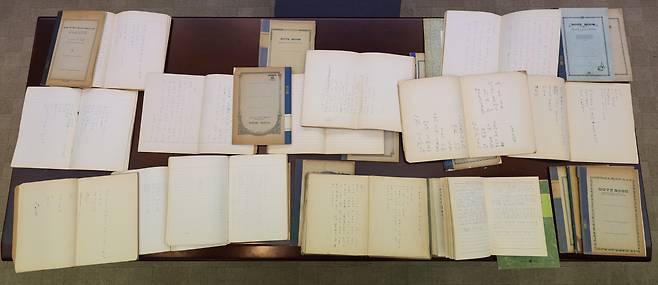
The 62 notebooks were gathered from the residence of Park Dong-gyu, the poet's oldest son and a professor emeritus of Korean literature at Seoul National University, and 18 notebooks were found at Dongni Mokwol Literary Museum in Gyeongju, North Gyeongsang Province.
Together, the notebooks contain over 400 poems, according to the committee, who sifted through the materials, selecting 166 poems that met their criteria of literary completeness and thematic diversity.
"The notes provide a comprehensive insight into the poet's life, spanning from his literary debut in 1939 until his passing in the 1970s," said Woo.
"We excluded previously published works and incomplete compositions. … And selected works that exhibit high literary significance or reflect Park’s writing process.”
Park is primarily celebrated for his pastoral and lyrical compositions, such as "A Wanderer." Following liberation from Japanese colonial rule, he published an anthology titled “Cheongrok Collection” (1946) with fellow poets Cho Ji-hoon and Park Du-jin. Later they were collectively called the Cheongrok School.
Additionally, Park was a poetry mentor to Yook Young-soo, the wife of then-President Park Chung-hee, and penned her biography after her assassination in 1974, igniting criticism that he was pandering to the authoritarian regime.
Among the newly disclosed works are pieces about the atrocities of the Korean War and the jubilation of liberation. They also depict the struggles of urban dwellers amid rapid modernization during the 1960s. In form, the works include lengthier compositions and serial pieces.
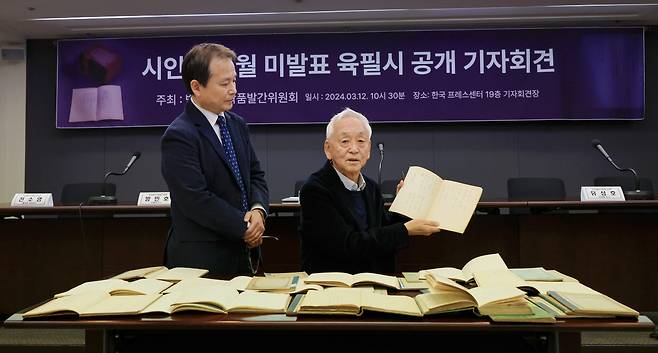
"The Park Mok-wol we thought we knew was characterized by pastoral and lyrical themes. These newly discovered works present a more multifaceted perspective. For instance, 'Shoeshine Boy' depicts a war orphan eking out a living on the streets," said Woo. "They afford us a deeper understanding of Park's literary legacy."
At the press conference, the poet's eldest son, Park, 84, expressed his apprehensions regarding his father's unpublished works.
"My father deliberated extensively before publishing his poems. Perhaps these unreleased works were omitted because he didn’t want to publish them or felt they were not good enough. While I'm anxious about how they’ll be received, I took courage because I believe the process of poetic creation is a form of poetry," said Park.
By Hwang Dong-hee(hwangdh@heraldcorp.com)
Copyright © 코리아헤럴드. 무단전재 및 재배포 금지.