South Korean exports to China plunge to three-decade low
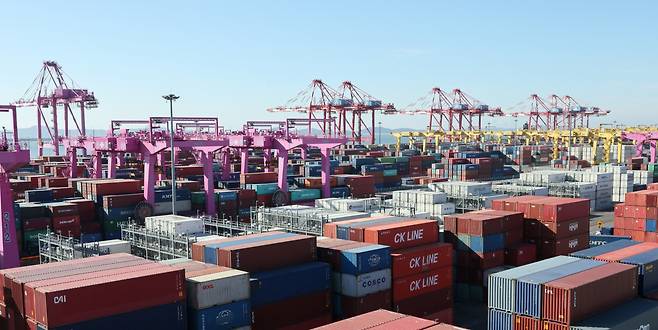
China’s imports of Korean goods plunged to the lowest level in three decades last year, amid the escalating Washington-Beijing rivalry and Seoul’s strategic pivot.
According to data from the Korea International Trade Association on Sunday, South Korea accounted for 6.3 percent of China’s imports last year, down from 7.4 percent a year earlier.
In 2022, Korea ranked second on China’s top importer list, following Taiwan. Last year, the country was outpaced by Taiwan and the US, which made up 7.8 percent and 6.5 percent of its total imports, respectively.
Experts say that China’s growing self-reliance in key product manufacturing and technological development, spurred by geopolitical tensions and supply chain disruptions, is leading to Korea’s reduced commercial presence in the all-important market.
Samsung Electronics, which had topped China’s smartphone sales with 20 percent market share until 2013, was dethroned by previous Chinese runners-up like Huawei and Xiaomi, while Hyundai Motor Group, whose market share peaked at 7 percent there in the 2000s, now has almost no presence in the world’s largest automotive market.
"Enhancing the overall competitiveness of Korea’s key export items is undoubtedly fundamental. Beyond that, Korea should look to broaden ties with provincial governments that are eager to attract investments while less affected by geopolitical tensions than the central government,” Park Seung-chan, a Chinese studies professor at Yong In University, told The Korea Herald.
Following China’s cuts in chip orders, Korean chipmakers have suffered a prolonged slump in sales in recent months. Chips are one of the nation’s top export items to China, making up almost 20 percent of the export volume between the two nations.
Park added that it is crucial to enhance collaboration with the country in relatively new and emerging sectors like bio-health care and information technology, more so than traditional manufacturing domains such as semiconductors and batteries.
"This is not solely our challenge, but also pertinent for countries like Germany and Taiwan. China represents a market of undeniable significance to Korea despite the apparent economic slowdown."
China's imports totaled $2.55 trillion last year, indicating a 5.5 percent decrease from 2022, according to China's General Administration of Customs. Korea experienced a steep 18.7 percent decline in its exports to China last year, well above the average decline rate. Taiwan, Japan and the US experienced declines of 15.4 percent, 12.9 percent and 6.8 percent, respectively.
Historically, after China and South Korea formally established diplomatic relations in 1992, Korea consistently accounted for roughly 10 percent of China's import market. However, the country's share gradually declined recently, with issues like retaliation for the US' THAAD anti-missile system deployed in South Korea in 2017, which accelerated the downward trend. As a result, Korea's share dropped from 10.4 percent in 2016 to 6.3 percent in 2023, reflecting a significant loss in its market presence, particularly in major sectors such as smartphones, displays, automobiles and petrochemicals.
By Kim Hae-yeon(hykim@heraldcorp.com)
Copyright © 코리아헤럴드. 무단전재 및 재배포 금지.