How much have Korea's food delivery fees risen this year?
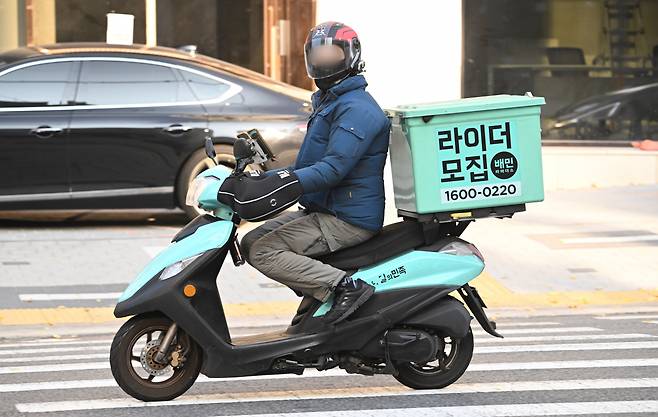
The cost of ordering food by delivery in December rose by about 4 percent on-year, higher than the on-year rise in the cost of daily necessities at 3.9 percent, data showed Friday.
According to a report released by Statistics Korea, this month’s delivery cost showed a 4.3 percent increase from the figure in November 2022. The figure also marks an increase of 0.4 percent from November this year.
The report was based on a monthly survey of eateries across the country from November 2022 through December 2023.
The cost of ordering food by delivery was defined as the difference in price between when dining in at an establishment and when ordering food from home. Other costs such as additional charges based on distance were excluded from the survey.
The delivery fee most commonly charged by restaurants or delivery services was 3,000 won ($2.30) per order, with some delivery fees reaching as high as 7,000 won, the report showed.
In terms of price ranges for delivery fees, the 3,000 won range dominated, accounting for nearly half of the cases at 47.3 percent, followed by the 2,000 won range at 30.9 percent and the 4,000 won range at 11.3 percent.
When breaking down the data per different types of food, delivery fees in the 3,000 won range appeared most frequently again.
For "fast food" including pizza, kimbap, fried chicken and burgers, delivery fees in the 3,000 won range took up 59.5 percent of the total. According to the report, 47.9 percent of the delivery fees for coffee and beverages, and 49.8 percent of delivery fees for "Korean cuisine" -- baekban meals; soups; noodle, meat and seafood dishes -- were in the 3000 won range.
Meanwhile, for "foreign cuisine" such as Chinese, Japanese and Western-style food, the most common delivery fees were in the 2,000 won range.
By region, the Seoul Metropolitan Area posted higher-on-year growth in food delivery costs at 4.6 percent, compared to a rise of 3.9 percent outside of the capital region.
The data marks the first time that Statistics Korea examined delivery costs nationwide. It will be updated and released quarterly.
Food delivery costs will also be included as a new item in the consumer price index for 2025.
By Song Jung-hyun(junghyun792@heraldcorp.com)
Copyright © 코리아헤럴드. 무단전재 및 재배포 금지.