Korean won rallies against U.S. dollar on chip industry rebound expectations
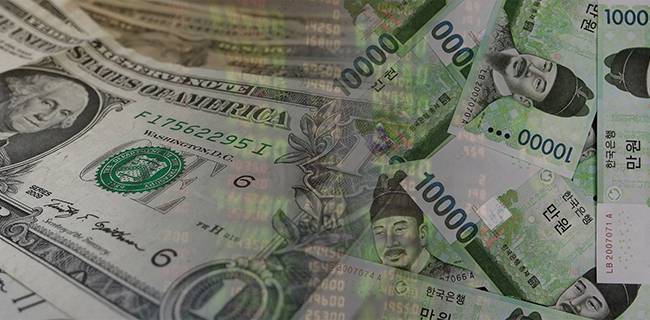
According to Bloomberg on Sunday, the value of the Korean won against the U.S. dollar increased by 5.19 percent to 1271.9 won as of Friday, compared with a month ago. Among the 11 major Asian currencies tracked by Bloomberg, the won recorded the highest increase in value. This contrasts with the falls of 2.34 percent and 3.31 percent of the British pound and the Japanese yen, respectively, during the same period.
In April, the Korean won fell to a yearly low of 1,340 won. In the three-month period from February to April, the won fell 8.34 percent, recording the highest decline rate in Asia. Among emerging markets, the fall was the third-largest after the Russian ruble at 11.4 percent and the Argentine peso at 16.2 percent. Russia has been at war for more than a year and Argentina is facing sovereign default.
The Korean won’s turnaround began in earnest last month. After a 14.9 won increase to 1321.6 won from 1327.2 won last month, the value of the won jumped by 49.7 won to 1271.9 won from 1321.6 won in the first 16 days of this month. During this period, the dollar index, which measures the value of the dollar against six major country currencies, hovered around 102 before rising to around 104 at the beginning of this month. This means that the Korean won displayed a strong won, despite the temporary strength of the dollar.
One of the reasons behind the won’s lone strength is the expectation that the semiconductor industry has bottomed out. Observers expect that domestic semiconductor companies will expand their investments as Nvidia Corp, a U.S. semiconductor company, expects demand to rise on back of a boom in AI, resulting in foreign investors buying large semiconductor stocks in the Korean stock market.
As global investors’ confidence in China has waned, some analysts also believe that foreign investment funds that have fled China are heading to Korea.
Last month, net inflow of funds from domestic securities investors reached a record $11.43 billion on a monthly basis. This month, foreigners have been net buyers of Korean stocks and bonds worth 784 billion won ($611.74 million) and 7.156 trillion won, respectively, in the first 16 days of the month. These foreign investments increase upward pressure on the won as they sell dollars and buy the won.
Signs of decoupling from the Chinese yuan are also a factor in the strengthening of the won. Since last month, the yuan has shown a decline beyond the psychological threshold of 7 yuan per dollar due to weak economic data. The won, on the other hand, has been moving in the opposite direction to the yuan.
“The won-yuan coupling was due to South Korea’s high economic dependence on China, including exporting technology intermediates to the country,” said Kim Seung-hyuk, an analyst at NH Futures. “Recently, the share of such exports has been declining, and if the semiconductor industry shows signs of rebound due to factors outside of China, there is less incentive for the won to follow the yuan.”
South Korea’s share of exports to China hit a record high of 26.8 percent in 2018, but fell to 19.5 percent in the first quarter of this year, according to data from the Korea International Trade Association.
It remains to be seen if the won’s strength will continue. Foreign exchange experts are raising the upper range of the won’s value for the second half of the year to 1,250 won to 1,260 won from 1,270 to 1,280 won. “There is a possibility that the won could rise to 1,260 won,” said Min Kyung-won, an analyst at Woori Bank. “However, it will be difficult for the won to continue to strengthen if the depreciation of the Chinese yuan continues.”
Copyright © 매일경제 & mk.co.kr. 무단 전재, 재배포 및 AI학습 이용 금지
- “은행도 거부”...장인어르신이 남긴 1300만원어치 동전, 어찌하오리 - 매일경제
- “5분간 담배 3대 내리피운다”…선정성 이어 ‘줄담배’ 논란 제니 드라마 - 매일경제
- “타보니 부셔버리고 싶다”…사고픈車 1위 ‘기아 EV9’, 가질 수 없다면 [카슐랭] - 매일경제
- “3·4·7세 아들 모두 사냥하듯 총으로”…짐승만도 못한 아빠 - 매일경제
- 집 한채 나오자 8000명 몰렸다...미분양 속썩이던 이 동네에 무슨 일이 - 매일경제
- “1260원까지 갈수도” 최약체 원화의 반전…아시아서 1위 먹었다 - 매일경제
- “러시아 ‘이 곳’ 이용해 우크라 댐 붕괴시킨 듯”...전문가 분석보니 - 매일경제
- 애들 싸움 말린 교사 고소당해...위자료 3200만원 달라는 학부모 - 매일경제
- “따져보니 냉면보다 더 올랐네”...5년간 가격 가장 많이 오른 메뉴는 - 매일경제
- 오타니, 통산 150홈런 기록...에인절스는 역전패 - MK스포츠