Seoul taxi basic rate and night surcharge may rise 20% or more, night call fee may triple
![[Photo by Kim Ho-young]](https://img4.daumcdn.net/thumb/R658x0.q70/?fname=https://t1.daumcdn.net/news/202208/26/mk/20220826115103717ybzw.jpg)
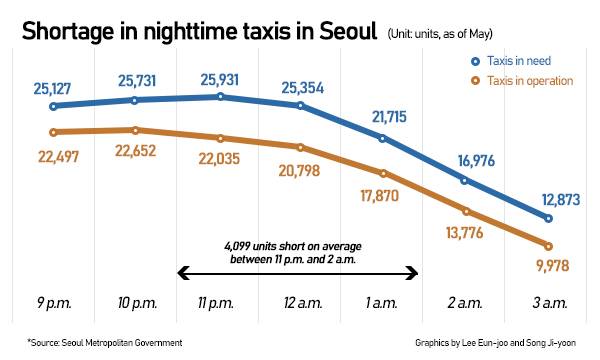
According to Seoul Metropolitan Government, about 4,099 taxis are short in the capital from 11 p.m. and 2 a.m. as of May and 4,556 lacking at around midnight.
“The rate of successfully grabbing a taxi via car-hailing platforms like Kakao T that had been at 60 percent in March fell to 30 percent these days,” said an unnamed government official. “Something needs to be done before temperature falls in winter.”
The government and Seoul city are reviewing the option of introducing a flexible taxi fare system that can more than doubles basic fare and driving and travel fares, which starts from 3,300 won~3,800 won for the first 2 kilometers in major cities, to resolve supply-demand issues.
The number of taxis managed by corporations and individuals reached 249,667 units as of end of May. The government, however, estimated that more than 30,000 taxi drivers have moved out from taxi companies when compared with pre-Covid times in 2019.
The government has turned to raising taxi call fees during night hours as not to give further inflationary pressure. A rise in taxi fare itself is reflected in consumer prices compiled by Statistics Korea but not taxi call fees. It also considered how a rise in taxi fares do not directly lead to higher income of taxi drivers.
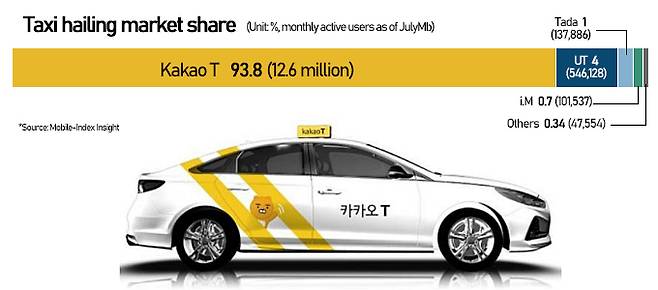
The government is considering introducing a guideline that raises taxi call fee to up to 9,000 won per taxi brand like Kakao T and Uber Taxi, up from 3,000 won, and offering 70 percent of the hike to taxi drivers. Only half of the call fee go to taxi drivers now.
“The average income of taxi drivers will go up to more than 3 million won a month if call fees during night rush hour rises to near 10,000 won,” said an unnamed industry official.
The move is expected to draw strong public backlash as it adds to spike in prices from groceries to service charges.
Whether price raise can help resolve the lack of supply is also questionable.
Platform operation industry noted that platform transportation businesses like Tada and Uber that have been ousted from the market should be able to return via ease in mobility-related regulations such as the revised passenger transport service act as a fundamental solution.
Under the passenger transport service act revised in 2020, car-sharing and ride-sharing operators like Tada, Uber, and Kakao Mobility are restricted from operations.
The government is carefully considering re-revising the passenger transport service act – not as a solution to resolve shortage in taxi drivers in the market but part of a measure to innovate mobility platform sector.
[ⓒ Maeil Business Newspaper & mk.co.kr, All rights reserved]
Copyright © 매일경제 & mk.co.kr. 무단 전재, 재배포 및 AI학습 이용 금지
- Hyundai Motor readies budget EVs for Europe, gains union ok to up EV output in US - Pulse by Maeil Business News Korea
- Preferred bidders shortlisted for $3 bn dental scanner leader Medit - Pulse by Maeil Business News Korea
- LG Uplus builds kids’ park featuring characters of SAMG behind Miniforce series - Pulse by Maeil Business News Korea
- Korean presidential couple report wealth of $5.7 mn - Pulse by Maeil Business News Korea
- Samsung Elec ready to commercialize royalty-free biologically-treating toilet for poor countries - Pulse by Maeil Business News
- 강경준, 상간남 피소…사랑꾼 이미지 타격 [MK픽] - 스타투데이
- AI가 실시간으로 가격도 바꾼다…아마존·우버 성공 뒤엔 ‘다이내믹 프라이싱’- 매경ECONOMY
- 서예지, 12월 29일 데뷔 11년 만에 첫 단독 팬미팅 개최 [공식] - MK스포츠
- 이찬원, 이태원 참사에 "노래 못해요" 했다가 봉변 당했다 - 스타투데이
- 양희은·양희경 자매, 오늘(4일) 모친상 - 스타투데이